
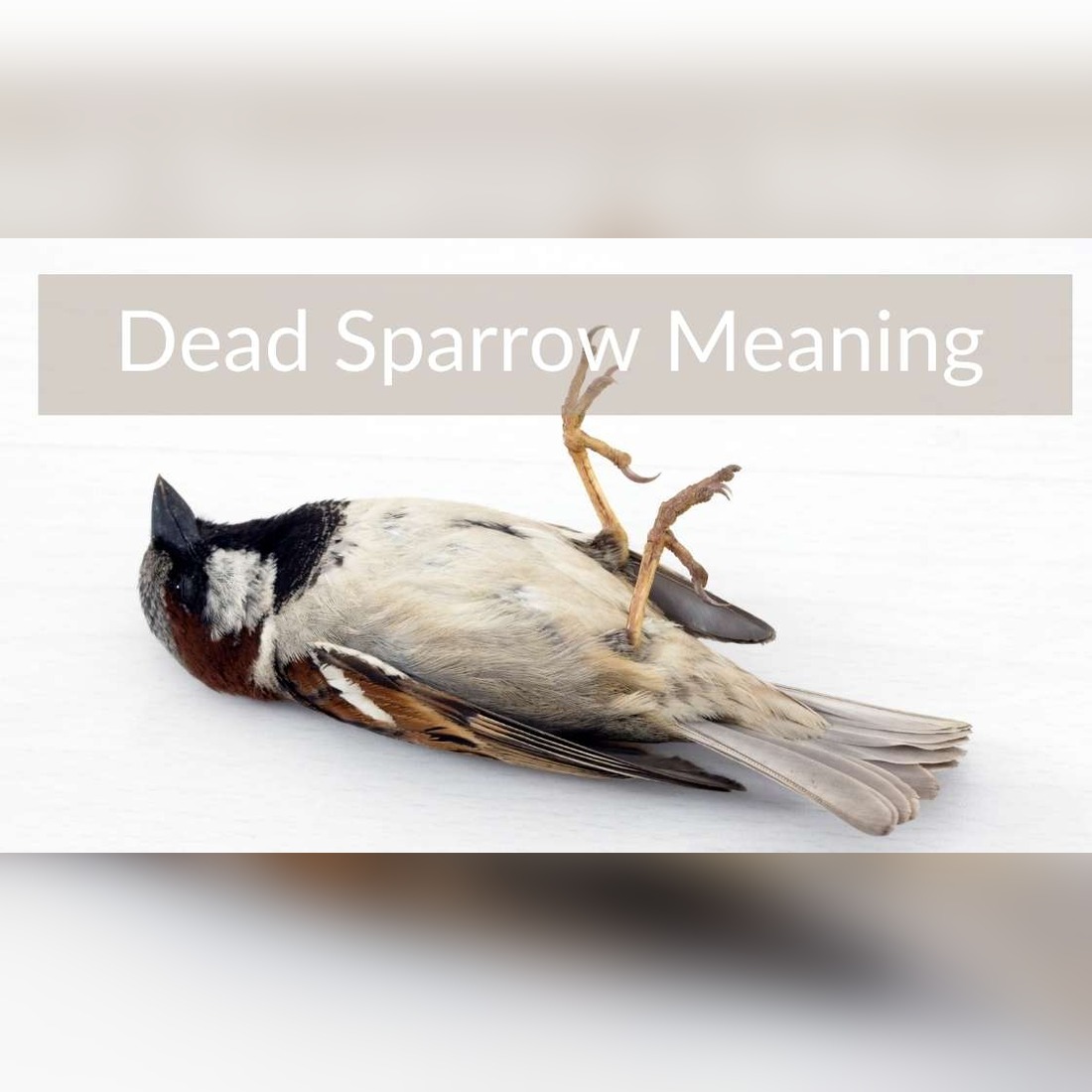
A dead sparrow on your doorstep or under a window, small and still. In Christian teaching, Matthew 10:29 says God sees every sparrow that falls, so the oldest reading is about being noticed in death, not about bad luck coming your way. But where you found it, whether it was near your house or far from it, changes what it means.
Key Takeaways
- A dead sparrow is not a universal bad omen. The reading depends entirely on which tradition you ask and where you found the bird.
- The Christian reading, grounded in Matthew 10:29 and Luke 12:6, frames a sparrow’s death as evidence that small lives are noticed, not as a warning against you.
- Reconstructions of Egyptian mortuary belief connect sparrows to the ba-soul in safe transit between worlds, reading the encounter as passage rather than punishment.
- Norwegian rural folklore treats a sparrow at or near the domestic threshold as a household warning worth taking seriously, and that tradition is real, even if it is one regional complex, not a universal law.
- The most grounded response is acknowledgment: remove the bird respectfully, sit with what it stirred in you, and resist forcing a verdict either way.
What Does a Dead Sparrow Mean Spiritually?
The short answer: it is not a curse, and it is not proof that someone you love is about to die. I want to say that plainly, because if you already landed somewhere that pointed toward doom, take a breath. That reading exists. It comes from one specific strand of Norwegian folk tradition, and the wider record is more complicated and less frightening.
My grandmother Theresa kept a leather notebook of animal lore from the Bavarian Forest, ravens as messengers, owls calling before a death, the white deer in the field. Sparrows appear in it too, but not as signs of what’s coming. Small birds, in the German folk tradition she inherited, were birds of notice. The question they asked was quiet: did you see this? Did you stop?
That framing has held up across thirteen years of reading the traditions and watching real birds at the Nature Center in Asheville. The sparrow, alive or dead, keeps circling back to the same question. Not warning. Attention.
The meaning does shift depending on where you are in the world and which tradition shaped the people who told you stories as a child. A sparrow found on your doorstep carries different weight in Norwegian folk belief than it does in Christian devotional practice, and neither is the same as what Egyptian mortuary tradition says about birds and souls. I’ll go through each one plainly.
What Does the Bible Say About a Sparrow Falling to the Ground?
Matthew 10:29 reads: “Are not two sparrows sold for a penny? Yet not one of them will fall to the ground outside your Father’s care.” Luke 12:6 goes further, five sparrows for two pennies, and not one of them forgotten. The point, documented in patristic commentary going back at least to Augustine, is that sparrows were the cheapest food available to the poor in Roman Palestine. Two for a penny. Five for two. The bird no one would notice dying is the one the passage names.
So the fallen sparrow in Christian devotional use is not a doom symbol. It is a memento of providence and fragility. The death is seen. The life mattered. That is the whole weight of the image. The Berean’s exegetical notes on Matthew 10:29-31 make this distinction carefully, the sparrow falls, yes, but the fall itself is the evidence of care, not its absence.
If your frame is broadly Christian, or shaped by that tradition without being strictly inside it: this bird is not an omen against you. It is a small, specific reminder that small things are seen.
What Did Ancient Egyptian Belief Say About Sparrows and the Soul?
I want to be careful here because the popular versions of this story run ahead of the actual record. Gothic Bite Magazine’s survey of sparrow death omens and psychopomps describes sparrows as carriers of the ba-soul in Egyptian mortuary thought, small birds escorting newly dead souls safely across the threshold between worlds. In that frame, a dead sparrow signals transition completed, passage accomplished.
But I should say this directly: these accounts rest on modern reconstructions and secondary interpretation, not on a single canonical Egyptian text devoted specifically to sparrows. The broader Egyptian framework for birds and souls is well-documented. The sparrow application specifically is thinner. I have read three versions of this claim and don’t fully trust any of them as stand-alone citations.
What I can say is that the interpretive direction in these reconstructions points consistently toward safe passage, not punishment. If that reading resonates with where you are, it is not invented from nothing. But hold it at some distance.
What Does Norwegian Folklore Say About a Sparrow at the Door or Window?
Norwegian rural folk tradition is less ambiguous, and less comforting. Icy Sedgwick’s survey of garden bird folklore records that a sparrow crossing into the domestic sphere, perching on the windowsill, flying indoors, looking directly at a household member, announces illness or death for someone inside that home. The bird is a boundary-marker. The natural world and the human interior are meant to stay separate, and when they don’t, something is being communicated.
A sparrow found dead at the doorstep fits this framework as a threshold event. The bird came as far as your door and stopped. In Norwegian lore, that proximity to the domestic line carries weight regardless of whether the bird actually crossed it.
This is the tradition that gets amplified into “bad omen” think-pieces, and I am not dismissing it. It is real. But it is one regional folk complex, specific in time and place. Not a universal law of nature.
What Does It Mean When a Dead Sparrow Is Found Inside Your House?
This is the version that rattles people most. And you are not making that up, there is a genuine difference in emotional weight between finding a small dead bird outside versus finding one on your floor near a window, or in a corner of a room.
From the Norwegian frame: a bird inside the home is the full threshold-crossing the tradition warns about. From the Christian frame: the bird is still within the scope of providence, and the encounter is still a memento of fragility rather than a verdict on your household. These two traditions don’t resolve neatly into one answer. What I’d say is this: the fact that you noticed matters. The unease you’re feeling is the signal worth attending to. Not fear. Attention.
And a practical note is worth making here. The British Trust for Ornithology records that house sparrow populations in the UK fell 71% between 1977 and 2015. A sparrow inside your home almost certainly arrived through a window strike, a cat, or an open door. The practical explanation and the symbolic question can coexist. Knowing the practical answer doesn’t always close the other question. It just keeps them separate, which is where they belong.
For the distinct tradition around feathers specifically, see the sparrow feather meaning page.
What Does a Dead Sparrow Mean as a Spiritual Message for You Personally?
Stripped of tradition: the dead sparrow asks whether something small went unnoticed in your life lately. A relationship that got less attention than it needed. A feeling you talked yourself out of. A door you walked past without stopping.
The sparrow is the smallest common bird in nearly every tradition that has built meaning around it. Its death, in almost every framework, points toward the question of what gets overlooked.
That is not a curse. It is a prompt.
You are not being targeted. The fact that you noticed this is already part of the answer.
What Should You Do After Finding a Dead Sparrow?
Use gloves or a plastic bag. Don’t handle it bare-handed. Bury it in the ground if you have outdoor space, a small hole in a garden bed is enough. If you have no outdoor space, wrap it and place it in the trash. That is not disrespectful. Disposal with attention is different from disposal with disgust.
If you want a ritual gesture, hold the wrapped bird for a moment before you bury or dispose of it and say something simple. “I saw you” is enough. No tradition required. The gesture is for you, not for the bird.
Salt the threshold if that feels right. Wash your hands after. Go back inside and drink something warm. The encounter is over. What it stirred in you is yours to sit with, at your own pace, without hurrying toward a verdict.
Frequently Asked Questions
Is finding a dead sparrow bad luck?
Not across the board. Norwegian rural folk tradition does read a sparrow near the threshold as a warning. But the Christian tradition grounded in Matthew 10:29 frames the sparrow’s death as a sign of divine attention to small, fragile lives, not bad luck, but noticed mortality. The Egyptian-influenced readings point toward safe passage. The “bad luck” reading is one regional tradition, not a consensus across the cultures that have actually written about sparrows and death.
What does it mean when a sparrow dies on your doorstep specifically?
The doorstep is the threshold, the line between the natural world outside and the human world inside. In Norwegian folklore, a sparrow at or near that line signals that something is crossing over, or trying to. I read doorstep placement as the tradition’s most charged location for this bird. Whether you take the warning literally or treat it as a prompt to pay attention to something unresolved in your household is your call. Either response is more useful than pretending you didn’t notice.
Does a dead sparrow mean someone is going to die?
No tradition says this with certainty, and I want to be straight with you: if you found a dead sparrow the same day a family member died, that timing will feel like connection whether or not it is one. The Norwegian tradition connects sparrow threshold-crossings to illness or death in a household. But the Christian tradition, which has more textual record behind it, says the opposite, the sparrow’s fall is seen and therefore meaningful, not cursed. I don’t know how to resolve that cleanly. I don’t think anyone does.
What does a dead sparrow mean in a dream?
Dream symbolism and encounter symbolism are genuinely different questions. In a dream, a dead sparrow more often points toward your own sense of smallness, or something you’ve released without fully grieving, at least in a Jungian reading of bird imagery. If the dream has stayed with you, that persistence is worth sitting with. The specifics of what you saw matter more than any general rule about sparrows and death. I’d be cautious about anyone who tells you otherwise.
Is there a difference in meaning between a dead sparrow and a dead robin or dove?
Yes, though it’s a difference of emphasis rather than kind. Robins in British and American folk tradition carry strong associations with renewal and seasonal change, so their death reads differently, the living robin is already loaded with hope-symbolism. A dove carries peace and religious weight in Christian and many other traditions, and its death tends to read as a disruption of that peace. The sparrow is specifically about smallness and overlooked lives. Different birds, different weight, same basic question underneath.
What should I say or do spiritually when I find a dead sparrow?
The Christian tradition documented in Matthew 10:29-31 suggests the appropriate response is acknowledgment, the bird was seen, the life mattered, however small. That translates practically into: don’t step over it. Pick it up respectfully, bury it or dispose of it with attention, and say something simple if you want to mark the moment. “I saw you” is enough. No specific tradition required. The gesture is yours to make or not make.
Does the meaning change if the sparrow flew into a window before dying?
A window strike before death does shift the reading, at least in terms of threshold symbolism. The bird was trying to cross the boundary between outside and inside and failed. In the Norwegian tradition, that attempt carries weight regardless of outcome. Practically, Cornell Lab of Ornithology research from 2004 estimated hundreds of millions of birds die annually from glass collisions in North America alone. Knowing that doesn’t cancel the question you’re sitting with. But it does mean you didn’t cause this, and the bird wasn’t sent specifically for you.
Sources
- Gothic Bite Magazine, “The Death Omen and Psychopomps of the Sparrows” (2023)
- BibleRef.com, Matthew 10:29 exegetical commentary
- Icy Sedgwick, Garden Bird Folklore
- The Berean, Matthew 10:29-31 commentary
- British Trust for Ornithology, House Sparrow Bird Facts
- Cornell Lab of Ornithology, Citizens Asked to Monitor Impact of Invasive Bird Species (2004)
- Birdfact, Sparrow Symbolism


Thank you so much for the information. I was told that sparrows are kind of like a harbinger of death.