In ancient Egypt, the ibis embodied Thoth, god of writing and judgment, and Egyptians mummified thousands as offerings to the dead. This practice reveals the bird was never merely symbolic, it bridged the living world and the afterlife. Yet whether Thoth’s ibis, Horus’s falcon, or the Bennu bird each carried equal weight splits those ancient meanings wide open.
Key Takeaways
- The African sacred ibis held the most specific and sustained sacred status in ancient Egyptian religion, understood as the physical form of Thoth (Djehuty), god of writing, knowledge, and divine judgment.
- Ibis mummies were votive offerings pilgrims purchased to petition Thoth, not evidence of universal ibis worship or a belief that every ibis carried afterlife messages.
- The falcon (Horus), ibis (Thoth), and Bennu are three distinct sacred birds with distinct theological functions. They are not interchangeable.
- Greek tradition identified Thoth with Hermes, producing Hermes Trismegistus, a figure associated with hidden knowledge who carried the ibis’s identity into later Western occult traditions.
- The etymology of Thoth’s Egyptian name (Ḏḥwtj, or Djehuty) is uncertain. The popular reading “he who is like the ibis” is a hypothesis, not settled scholarship.
What Is the Egyptian Bird Symbol?
The Egyptian bird symbol most people mean when they ask this is the ibis: white-bodied, black-headed, with a long downward-curving bill that made it unmistakable along the Nile. Its formal identification in modern ornithology is Threskiornis aethiopicus, the African sacred ibis. In ancient Egyptian religious practice, this bird was understood as an earthly form of Djehuty, god of writing, scribal knowledge, and the recording of cosmic judgment, now usually called Thoth in English.
I should say plainly that I come at this material from outside Egyptology. No academic training in ancient religion. What I can say is that the ibis was not a vague spiritual omen. It was a specific religious figure with specific documented domains, and that specificity is what most popular accounts miss.

The bird’s curved bill may have contributed to its cultic status. Egyptian priests associated it with the crescent moon, and the downward arc of the beak matched that shape closely enough that the connection appears repeatedly in temple art and inscription. Whether the priests made the analogy first and selected the bird accordingly, or whether the ibis’s natural behavior along the flooded Nile made it conspicuous in ways that invited religious elaboration, I honestly don’t know. The sources I’ve read don’t settle it.

What Did the Sacred Ibis Mean in Ancient Egyptian Religion?
According to Martin A. Stadler’s 2012 entry on Thoth in the UCLA Encyclopedia of Egyptology, Thoth’s domains included writing, scribal knowledge, reckoning, magic, the moon, and the administration of divine judgment. The ibis and the baboon were his two principal animal forms. Thoth appeared in temple art either as a full ibis or as a human figure with an ibis head, often holding a palette and reed, the scribal tools that defined his function.
The concept of ma’at, meaning truth, right order, and cosmic balance, was the judicial context in which Thoth operated. After death, according to Egyptian belief, the heart of the deceased was weighed against a feather representing ma’at, and Thoth recorded the result. He was the witness and the scribe, not the judge. That distinction matters: the ibis symbol was about accurate measurement and truthful recording, not mercy or punishment.
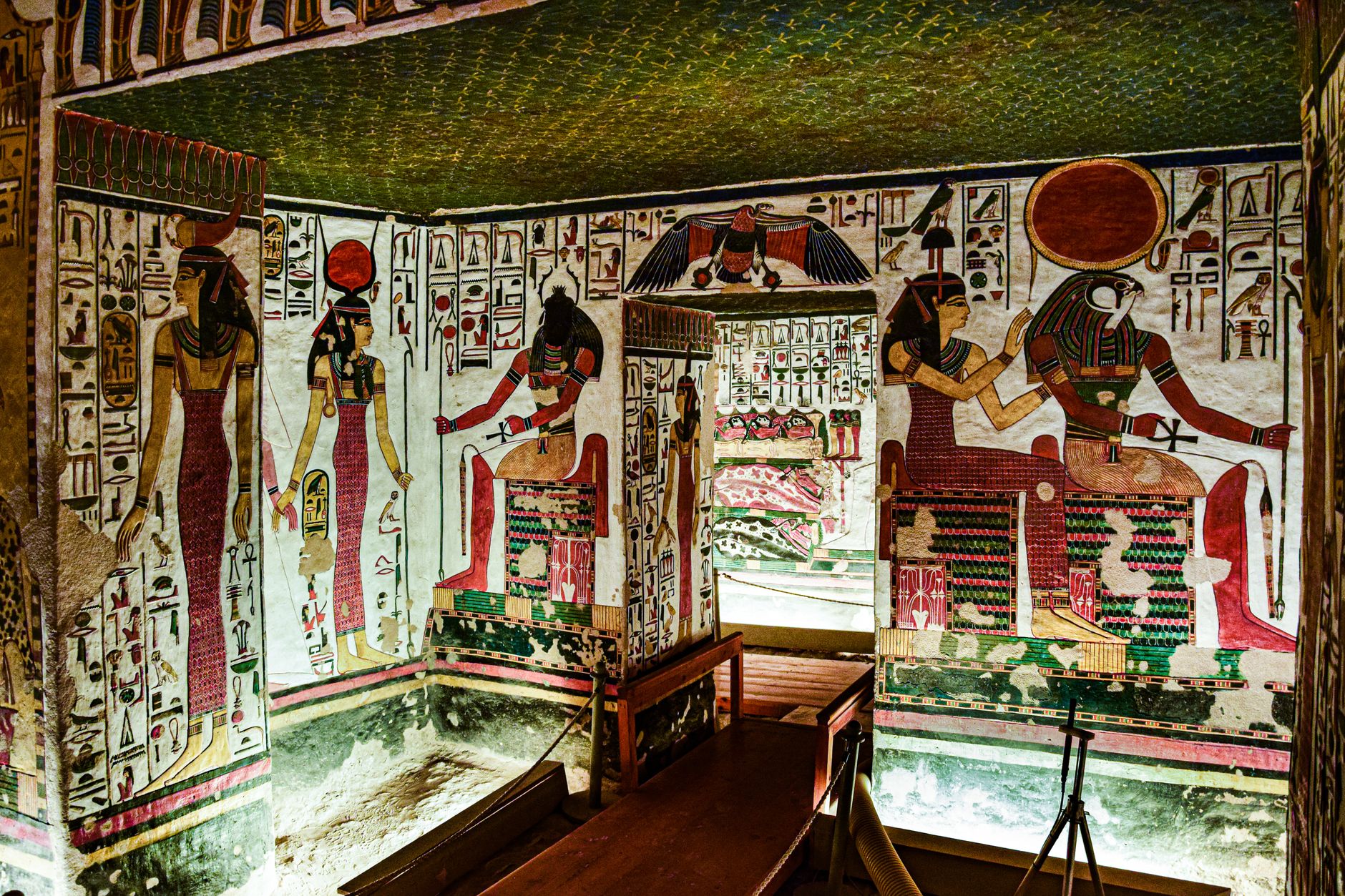
“Messenger” is a reasonable modern analogy for Thoth’s function, but the Egyptian evidence supports something more precise. Recorder. Mediator. Keeper of the cosmic account. The ibis, by extension, carried those associations. Seeing an ibis in an Egyptian religious context was not an experience that prompted a folk-omen response in the way that a raven sighting might prompt one in Northern European tradition. It was a visual encounter with a deity’s physical form.

What Does the Thoth Cult at Hermopolis Reveal About Ibis Symbolism?
Thoth’s principal cult center was Hermopolis Magna (the Egyptian name was Ḫmnw, “City of Eight”), a site in Middle Egypt that Greeks later named for Hermes after they identified the two gods. What made ibis symbolic practice concrete and archaeologically visible was the development of large-scale animal cemeteries: the ibis catacombs at Tuna el-Gebel, the necropolis linked to Hermopolis, contained millions of mummified birds deposited over several centuries.
The Harvard Art Museums hold a sculpted head of an ibis identified as Thoth, dating to the Late Period or Ptolemaic period (c. 664-30 BCE). The object gives a sense of how the bird was depicted in devotional work: formal, stylized, the long bill curved downward, the eye rendered with the precision of scribal attention. It is not decorative. It is a religious artifact made for use in a cultic economy.

What the Hermopolis cult shows is that the ibis was not a universal Egyptian bird symbol available to anyone for any purpose. It was a specific deity’s physical form, maintained in specific sacred spaces, managed by temple personnel, and approached by ordinary worshippers as a channel to a particular god’s specific powers.
How Were Ibis Mummies Used as Votive Offerings in Egyptian Temples?
Between roughly 664 BCE and 250 CE, Egyptian pilgrims could purchase a mummified ibis from temple personnel and deposit it in an underground gallery as a votive offering to Thoth. The practice was a form of petition: a worshipper who needed a scribe’s intercession, a question answered, a legal matter resolved, or a vow fulfilled could acquire the offering and place it in the catacomb. The University of Utah Natural History Museum describes this as a commercial temple economy, not a universal expression of ibis reverence.
The scale was extraordinary. Estimates of ibis mummies deposited across Egypt’s Late Period catacombs run into the millions. At Tuna el-Gebel, the underground galleries extended for considerable distances. For the priests managing the system, this required a continuous supply of birds, which raises the question of where they all came from.
The popular image is of vast temple breeding programs, carefully maintained flocks producing ibises for ritual use across generations. The genetic evidence now complicates that picture.
What Do the Genetics of Mummified Ibises Tell Us About Ancient Egyptian Practice?
In 2019, Sally Wasef and colleagues published a mitogenomic study in PLoS ONE examining 40 mummified ibises drawn from six Egyptian catacombs. They recovered complete or near-complete mitochondrial genomes from 14 of those birds. The finding that matters most: the birds showed high maternal-line diversity. That is not what you would expect from a long-established, closed captive breeding population, where a small founding group would have left a narrow genetic signature across subsequent generations.
The diversity points instead toward wild birds. Priests likely captured ibises from seasonal populations, raised hatchlings or young birds until they could be used ritually, and supplemented the supply from the wild repeatedly rather than maintaining a self-sustaining temple flock. The sacred bird was a living animal recruited into a ritual economy: caught, cared for briefly, sacrificed, embalmed, and placed in a catacomb as a physical prayer.
I find this more interesting than the breeding-farm version. It means the priests were paying close attention to a wild animal’s biology and population patterns. The sacredness was not imposed on a captive population; it was drawn out of a wild one.
How Did the Falcon Become the Symbol of Horus, and How Is It Different from the Ibis?
Horus and Thoth are both major Egyptian deities depicted with bird heads. That is where the common collapse begins. But their birds are different, their domains are different, and their relationships to the pharaoh are different.
Horus was associated with the falcon, depicted as a human with a falcon head or as a full bird wearing the double crown of Egypt. His domains were the sky, royal authority, and divine kingship. The living pharaoh was identified as Horus incarnate; the dead pharaoh became Osiris. The Fitzwilliam Museum’s “Animals in Ancient Egypt” resource notes that the precise falcon species behind Horus is uncertain, possibly the peregrine or the lanner falcon. What mattered was the bird’s attributes: keen sight, speed, mastery of the sky. Not the ornithological classification.
Thoth’s ibis was a wading bird of the river margins, associated with measurement and record-keeping. Horus’s falcon was a bird of the open sky, associated with power and divine kingship. The two were not interchangeable in temple practice or iconography, even when both appear as bird-headed male figures in Egyptian art.
And neither of them is the Bennu.
What Is the Bennu Bird and How Does It Relate to the Phoenix?
The Bennu was a heron-like bird associated with Ra and Osiris, with solar cycles, and with the first moment of creation.Egyptian texts describe it perching onthe benben stone at Heliopolis, the ancient mound where, in one creation account, the first light appeared. The Bennu was linked to the daily rising of the sun and to the idea of cyclical renewal: the sun that dies at dusk and is reborn at dawn.
Greek writers encountering Egyptian accounts of this self-renewing solar bird appear to have drawn on the Bennu when constructing what became the phoenix myth. The connection is real but indirect. The phoenix, as a later Greco-Roman literary figure, shares the Bennu’s cyclical renewal theme but strips away its specific Egyptian theological context: the creation accounts, the relationship to Ra and Osiris, the Heliopolitan cult center.
So: the ibis is Thoth, the falcon is Horus, and the Bennu is the solar renewal bird that fed into phoenix imagery. Three different birds. Three different functions. What is striking is how consistent the Egyptian system was about this, each major deity received a specific animal form, and the choice of animal was not arbitrary. It mapped onto the deity’s observed qualities and domains.
How Did Greek and Hermetic Traditions Reinterpret the Egyptian Sacred Bird?
When Greek writers and travelers encountered Thoth and his ibis cult, they reached for their nearest equivalent: Hermes, the Greek messenger god associated with language, commerce, and the guidance of souls between worlds. The identification produced the syncretic figure Hermes Trismegistus, “Hermes the Thrice-Great,” who became central to what later Western tradition called Hermeticism.
According to the Encyclopaedia Britannica’s entry on Thoth (updated 2026), both the ibis and the baboon served as Thoth’s sacred animals, and the Greek identification of Thoth with Hermes is documented in Greco-Egyptian religious texts from the Ptolemaic period onward. What the Greek reinterpretation did was shift Thoth’s specific Egyptian scribal identity, writing, reckoning, the recording of judgment, toward a broader image of a divine mediator of hidden knowledge.
The ibis itself did not become a Greek omen bird. In Hermetic tradition it became a figure attached to a god who represented the transmission of cosmic secrets and the possibility of esoteric knowledge accessible to those trained to receive it. Medieval and Renaissance occult traditions inherited this Hermetic Thoth rather than the Egyptian scribal Djehuty. That is why modern spiritual interest in Egyptian birds so often gravitates toward themes of hidden wisdom: the lineage runs through Greek and Hermetic interpretation, not directly from Egyptian temple practice.
What Does the Name “Thoth” Actually Mean, and What Is the Etymology of “Ibis”?
The Egyptian name is transliterated as Ḏḥwtj, rendered in English as Djehuty, Tehuti, or Thoth, the last form being Greek-derived. Martin A. Stadler, writing for the UCLA Encyclopedia of Egyptology, is explicit that the name’s etymology is uncertain. It may be very old, possibly pre-dynastic, and cannot be reliably explained from surviving Egyptian linguistic evidence.
One older scholarly proposal connects Ḏḥwtj with an Egyptian word for ibis and would yield an approximate meaning of “he who is like the ibis.” This is a hypothesis. I want to be clear about that because I have seen it presented as settled fact in popular accounts, and it is not. Stadler’s caution is worth taking seriously.
The word “ibis” itself traveled to English through Latin ibis from Greek ibis (ἶβις), which was simply the Greek name for the bird. The scientific name Threskiornis aethiopicus is a later construction: Greek threskeia (religious worship or sacred observance) plus ornis (bird), plus aethiopicus (broadly African). The modern species name preserves the bird’s association with sacred practice, not because ancient Egyptians named it that way, but because 19th-century naturalists who formalized the binomial system reached for a name that reflected the bird’s fame.
What Are the Natural History and Behavioral Facts Behind the Sacred Ibis?
The African sacred ibis is a colonial nesting bird. It breeds in large groups, both parents incubate the eggs, and clutch size runs from one to five eggs with an incubation period of about 28 days. Chicks fledge after roughly 35 to 40 days. According to the Animal Diversity Web (University of Michigan, updated 2026), the species can live up to 20 years in the wild.
Colonial nesting in large, visible groups along river margins would have made the birds conspicuous and seasonally accessible to temple personnel. A bird that returns reliably, year after year, to the same nesting grounds, in large numbers, is easier to collect from and easier to observe than a solitary or nomadic species.
The 20-year lifespan is worth sitting with. At the Nature Center in Asheville, I have watched individual raptors long enough to recognize their particular habits, the specific way a red-tailed hawk I’ve called “the one with the notched primary” angles into a thermal. A bird that lives two decades could become a recognized individual in a temple complex. Whether specific ibises achieved that status in Egyptian cult practice, I don’t know. The archaeological record documents the economy of mummification rather than the lives of particular birds. But the lifespan points toward a kind of continuity that would have been visible and perhaps meaningful to temple observers over years of contact with the same animals.
If you’re watching birds yourself and want to attract more of them to your space, there’s some practical guidance on the best bird feeders for balconies that might be useful.
What Are the Most Common Misconceptions About Egyptian Bird Symbolism?
Three misconceptions show up repeatedly in popular accounts. Worth naming plainly.
First: “The ibis means intuition, transformation, or afterlife messages.” This is not what the historical record supports. In the Thoth cult, the ibis represented a specific god whose domains were writing, knowledge, reckoning, magic, and the recording of judgment. The connection to the afterlife is real but indirect: Thoth recorded the result of the judgment of the dead; he did not carry personal messages between the deceased and the living. The intuition and transformation associations come from modern spiritual interpretation, not from Egyptian temple practice.
Second: “Egyptians maintained enormous temple breeding farms and worshipped every ibis as a living god.” The 2019 mitogenomic study by Wasef and colleagues showed high genetic diversity among mummified birds, which is not what a long-established closed breeding population would produce. Wild capture was likely the primary supply method. “Sacred” describes the bird’s cultic status and ritual function, not a belief that every individual ibis received personal worship.
Third: “All Egyptian sacred birds symbolize the same thing, rebirth, resurrection, or solar renewal.” The ibis (Thoth), the falcon (Horus), and the Bennu are distinct figures with distinct theological functions. Collapsing them produces an attractive modern symbol but erases the differences that Egyptian priests and temple builders spent centuries maintaining.
How Is the Egyptian Bird Symbol Used in Modern Spiritual and Tattoo Contexts?
People get ibis, falcon, and Bennu tattoos for different reasons, and I am not in a position to tell anyone what meaning they should carry personally. What I can offer is the documented historical ground those modern uses stand on, so the choice is informed.
An ibis tattoo that draws on Thoth carries associations with writing, knowledge, accurate measurement, and the administration of truth. That is a coherent set of values to put on your body permanently. The Hermetic reception adds a layer of hidden-knowledge symbolism that is historically attested, even if it is a Greek interpretation of an Egyptian original.
A falcon tattoo drawn from Horus carries associations with royal power, the sky, divine protection, and the unifying of Upper and Lower Egypt. The Eye of Horus, often combined with falcon imagery, has its own specific documented meaning: the eye that was lost and restored, associated with healing, protection, and wholeness.
The Bennu, as a solar renewal figure, works as a symbol of cyclical return and the persistence of life through apparent extinction. It is a reasonable ancestor of the phoenix in Western tradition, and people who want that meaning without the Greek and Roman overlay sometimes reach back to the Egyptian source.
What all three share is that the original meanings are specific and documented. Using them with that specificity is more honest, and I think more interesting, than treating them as interchangeable emblems of ancient wisdom.
My grandmother Theresa kept a leather notebook of Bavarian animal stories, and one of the things I’ve learned from years of reading about traditions I didn’t grow up inside is that specificity is not a constraint on meaning. It is what gives meaning its staying power. The ibis meant something precise to the priests at Hermopolis. That precision is worth keeping.
Frequently Asked Questions
What bird is most sacred in ancient Egypt?
The African sacred ibis (Threskiornis aethiopicus) held the most specific and sustained sacred status in ancient Egyptian religion. It was understood as the physical form of Thoth (Djehuty), god of writing, knowledge, and divine judgment. The falcon of Horus and the Bennu were also significant, but neither generated the same scale of votive practice, millions of ibis mummies deposited across multiple catacomb sites, that the Thoth cult produced over several centuries.
What did the ibis represent to ordinary Egyptians, not just priests?
For a pilgrim visiting a temple site, the ibis mummy was a tool for petition. You purchased one, deposited it in the gallery, and asked Thoth for something specific: a scribal intervention, resolution of a dispute, fulfillment of a vow. The ibis was not primarily a personal omen system in the way some modern readers expect. It was a currency of prayer, specific to Thoth’s domains of writing, knowledge, and truth. The relationship was practical and contractual as much as it was devotional.
Is the ibis still found in Egypt today?
No, not naturally. The African sacred ibis no longer breeds in Egypt and has not done so for well over a century.The species still exists across sub-SaharanAfrica, and introduced feral populations live in parts of Europe (notably France and Italy) and the United States. The bird’s disappearance from Egypt sometime in the 19th century sits oddly alongside its enormous presence in Egyptian religious art and the millions of mummified specimens still held in museum collections worldwide. That contrast is worth sitting with.
Why did Egyptians mummify millions of ibises?
The votive offering economy in the Late Period (c. 664-250 CE) created enormous demand. Pilgrims came to temple sites to petition Thoth, and the standard offering was a mummified ibis. Temple personnel had to supply them continuously. The University of Utah Natural History Museum’s account of ibis mummification describes this as a commercial system embedded in religious practice. The 2019 genetic study by Wasef and colleagues found diversity suggesting wild-caught birds rather than a closed breeding population, which means priests were actively harvesting from wild flocks to meet the demand.
What is the difference between Thoth and Horus in Egyptian religion?
Thoth (ibis-headed) was the scribe and recorder: he governed writing, knowledge, reckoning, and the documentation of the dead’s judgment. Horus (falcon-headed) was the sky god and embodiment of royal power: the living pharaoh was identified as Horus incarnate. Thoth operated in the domain of truth, measurement, and witness. Horus operated in the domain of kingship, sky, and divine authority. Both appear as bird-headed male figures in Egyptian art, which is probably where the common confusion starts, but their roles and their birds were distinct.
Did ancient Egyptians believe the ibis brought messages from the dead?
Not exactly, and I want to be careful here because the popular version of this belief is widespread. Thoth did record the judgment of the dead and served as a divine witness in the afterlife Hall of Two Truths. But the Egyptian evidence does not describe ibises delivering personal messages from deceased individuals to their living relatives. That model of the bird as afterlife courier is a modern folk-spiritual interpretation, not a documented ancient Egyptian belief. What the ibis represented was the administration of cosmic truth, not personal communication between the living and the dead.
What is the spiritual meaning of seeing an ibis today?
If you want to draw on the Egyptian tradition specifically, the most honest reading is: knowledge, accurate reckoning, and truth. Thoth’s domains were writing, measurement, and the fair recording of things as they are. I’d be cautious about claims that a modern ibis sighting carries direct afterlife-message significance; that is not well-supported by the historical record. What you do with an encounter is your own business. But if the Egyptian association resonates for you, the documented meaning points toward clarity, honest accounting, and the discipline of paying careful attention.
What does the Bennu bird symbolize compared to the phoenix?
The Bennu was an Egyptian heron-like solar bird associated with Ra and Osiris, linked to creation and the daily rebirth of the sun. It perched on the very first benben stone at Heliopolis in Egyptian cosmology. The phoenix, as a later Greco-Roman figure, shares the cyclical renewal theme but loses the specific Egyptian theological framework. Greek writers appear to have drawn on Bennu accounts when constructing the phoenix narrative. So the phoenix is a later reception of the Bennu, not an equivalent: the original is more specific, the later version more generalized.
Are ibis hieroglyphs used in Egyptian writing?
Yes. The ibis appears in Egyptian hieroglyphic writing both as a determinative (a sign that clarifies the category of a nearby word without being read phonetically) and in representations of Thoth’s name and titles. Because Thoth was the god of writing itself, the ibis had a recursive presence in the script: the god of writing appeared in the writing system as a marker of that writing’s sacred authority.Egyptian hieroglyphic writing used approximately 700to 800 signs in the classical period, many of them animals, and birds were among the most common.
What is Hermes Trismegistus and how does he relate to Egyptian bird symbolism?
Hermes Trismegistus, “Hermes the Thrice-Great,” is a syncretic figure produced when Greek religion encountered Egyptian religion in the Ptolemaic period (after 332 BCE). Greek writers identified Thoth with their own Hermes, god of language, commerce, and the guidance of souls. The resulting merged figure carried Thoth’s Egyptian ibis identity into Greek and later Western occult tradition, where it became associated with hidden knowledge, esoteric language, and cosmic mediation. According to the Encyclopaedia Britannica’s entry on Thoth, both the ibis and the baboon were recognized as Thoth’s animals in this tradition. Hermeticism, the later Western esoteric tradition named for this figure, inherited the ibis association through this route rather than directly from Egyptian temple practice.
Sources
- Martin A. Stadler, “Thoth,” UCLA Encyclopedia of Egyptology, 2012
- University of Utah Natural History Museum, “When Mummification Was For the Birds,” 2021, updated 2026
- Harvard Art Museums, “Head of an Ibis (Thoth),” collection record, 2006, updated 2025
- Encyclopaedia Britannica, “Thoth,” 1998, updated 2026
- Animal Diversity Web, University of Michigan, “Threskiornis aethiopicus: Sacred Ibis,” updated 2026
- Fitzwilliam Museum, University of Cambridge, “Animals in Ancient Egypt,” updated 2022-2026
- Archaeology Magazine, “Egypt’s Sacred Ibises,” November 2019
- Phys.org, “Ancient Egyptians Captured Wild Birds for Sacrifice,” November 2019
- Richard Alois, “Best Bird Feeder for Balcony”
- www.encyclopedia.com
- www.fws.gov
- giza.fas.harvard.edu