That color tells you blue was never just pretty, it was a sign of real power and money. Whether blue meant loyalty, sadness, or something else entirely depends on who was looking and when.
Key Takeaways
- Blue jay symbolism is cross-culturally ambivalent, not a stable ancient emblem of good luck or heavenly guidance.
- In Chinook oral tradition recorded by Franz Boas (1894), Blue Jay is a trickster and boundary-crosser who dies through his own boastfulness, not a comforting ancestor messenger.
- Southern African American folklore, documented in William T. Cox’s Birds in Legend, Fable and Folklore (1927), links the jaybird to the Devil’s errands on Fridays, not angelic protection.
- Natural behaviors, including caching thousands of acorns, irregular migration, and exceptional longevity, support symbolic readings of preparation and persistence. These are reasonable inferences from biology, not inherited ritual doctrine.
- Responsible use of blue jay symbolism means naming the specific tradition rather than blending every reading into a single flattering package.
What follows is what the record actually says, and where it leaves room for something more personal.
What Is the Symbolism of the Blue Jay?
No single ancient doctrine unites the blue jay’s meanings. Across the traditions that left a written or recorded trace, the bird shows up as a vocal boundary-crosser: sometimes brave, sometimes foolish, always conspicuous. That’s not the universal emblem that gets pinned to spirituality boards, but it’s more interesting than the alternative.
The documented meanings range from trickster and social disruptor in Chinook oral tradition, to noisy supernatural intermediary linked to diabolical labor in Southern African American folklore, to a figurative symbol of impertinence in European bird-lore. The modern readings, courage, truth, loyalty, divine messenger, come largely from contemporary personal spirituality writing. Not from specific named traditions with traceable sources. That doesn’t make them wrong for personal use. It just means you should know the difference.

The common thread across traditions is voice and conspicuousness. The jay was never invisible, never quiet. Its symbolic weight grew from what people actually observed: a loud, bold, boundary-pushing bird that showed up where it wasn’t always welcome.
What Do the Etymology and Scientific Name Reveal About Its Symbolic Identity?
The word jay itself carries the bird’s reputation. It entered Middle English through Old French jai or gai, tracing back to Late Latin gaius, probably rooted in the bird’s harsh, attention-demanding call. By the sixteenth century in English, jay could also describe an impertinent or showy person. The word arrived in North America applied to the blue jay by around 1709.
The scientific name doubles down on this. According to the American Ornithological Society’s naming history, the genus Cyanocitta combines the Greek kyaneos (blue) with kitta or kissa, meaning a chattering bird or jay. Cristata is Latin for crested. The full name translates roughly as “crested blue chatterer.” Taxonomists didn’t reach for celestial imagery. They named it for what it does.

That’s worth sitting with before you layer meaning onto the bird. Its identity has always been rooted in voice and visibility. The symbolism followed from that, not from any ancient theology of blue.
What Does Chinook Oral Tradition Say About the Blue Jay?
This is the richest documented source, and it is nothing like the protective-ancestor framing that circulates in popular symbolism writing. In Chinook oral literature collected by Franz Boas, recorded from narrator Charles Cultee in 1890 and 1891 and published as Chinook Texts in 1894, Blue Jay is a named culture figure: clever, boastful, sometimes brave, and consistently disruptive.
In “Blue Jay Visits Ghost Town,” Blue Jay enters the land of the dead to find his sister Io’i. He doesn’t go humbly. He goes the way he does everything: loudly, presumptuously, convinced he knows better. He mishandles the ghosts, interferes with their forms, causes disorder, and ultimately dies through his own meddling. The story doesn’t moralize heavily. Blue Jay is not purely a villain. He is genuinely trying to find his sister. But the outcome is shaped by his inability to read a world that operates on different rules than his own.

This makes him a boundary-crosser in the clearest possible sense. Someone who passes between the living and the dead, but without the wisdom that passage requires. The symbolism the Chinook tradition actually documents is ambivalence: curiosity and movement paired with foolishness and consequence. Not a guardian angel. Not a comforting ancestor messenger. A character who teaches through failure as much as through courage.
What Does Southern African American Folklore Say About the Blue Jay?
William T. Cox’s Birds in Legend, Fable and Folklore (1927) records a belief that survived in the Southern United States: the jaybird was absent on Fridays because it spent that day carrying sticks to the Devil in hell. It returned on Saturday, noisy and apparently pleased with itself, having finished the task.
This framing makes the blue jay something quite specific. A supernatural intermediary associated not with heaven or divine guidance but with the Devil’s household, secrecy, and weekly supernatural labor. The bird’s Saturday noisiness is read as relief at having escaped, not as celebration or blessing.

That’s a long way from the “divine messenger” reading that appears on most symbolism pages. But the symbolism isn’t arbitrary. It maps directly onto observed behavior. The bird is loud. It disappears and reappears. It seems, in folk terms, to have somewhere else to be. What differs is the destination people assigned.
What Did European Jay Lore Say About This Bird?
One clarification up front: what European observers encountered was the Eurasian jay (Garrulus glandarius), not the North American blue jay. The two species are related but distinct. European jay-lore didn’t travel to America pre-loaded with meaning about Cyanocitta cristata.
What the European record does show, as William M. Ingersoll documented in Birds in Legend, Fable and Folklore (1923), is a consistent association between the jay and loud, showy, impertinent behavior. The jay as gossip, as chatterer, as social disruptor. By the sixteenth century in English, calling someone a “jay” was a mild insult meaning a fool or an impudent talker. The figurative weight was never primarily positive.

There was no unified European doctrine of “blue jay energy.” What existed was a scattered set of folk observations that agreed on one thing. Jays are conspicuous, noisy, and socially presumptuous. A bird-level reading, not a celestial one.
What Do the Blue Jay’s Natural Behaviors Reveal About Its Symbolic Meanings?
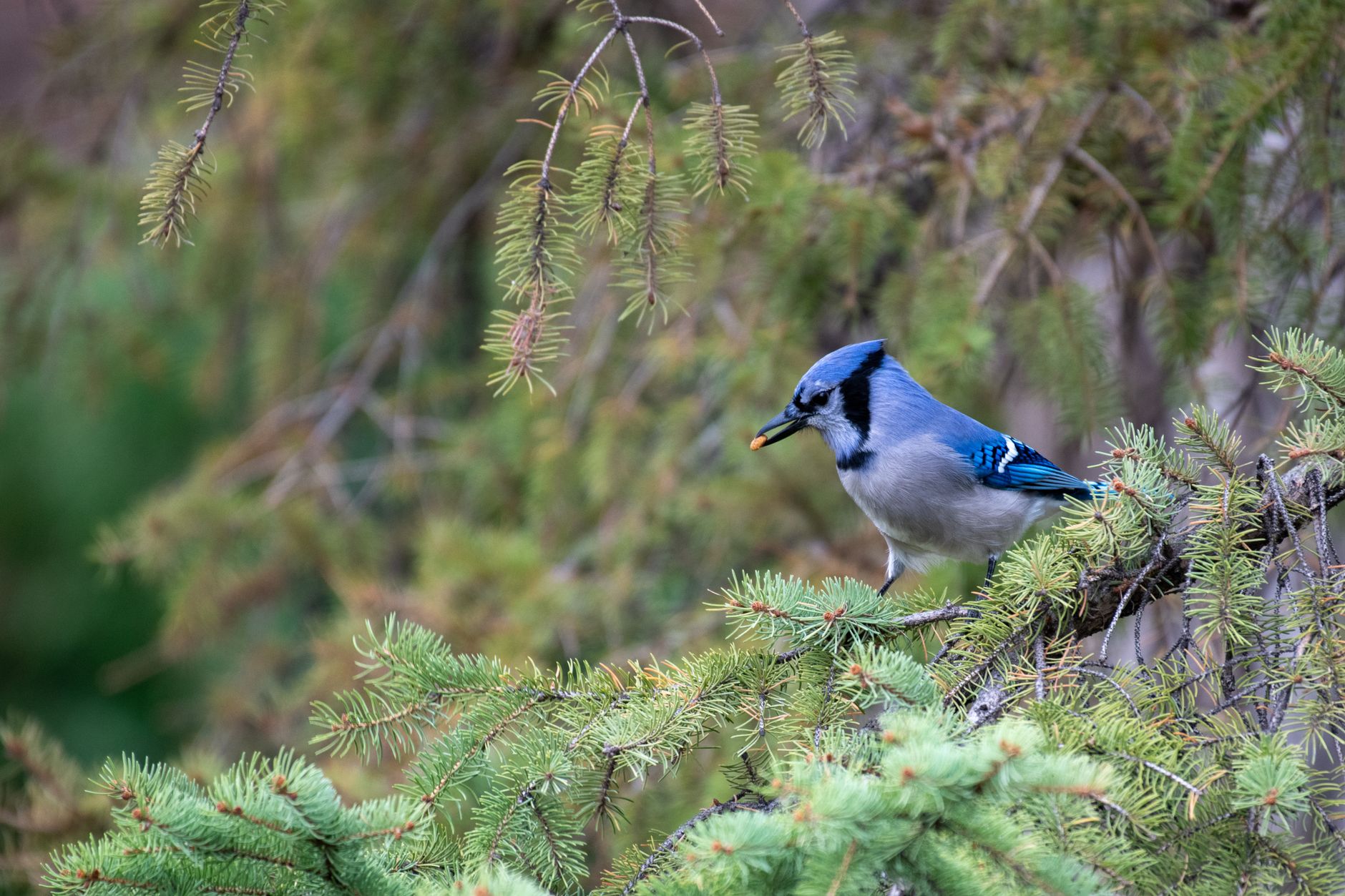
The biology is genuinely strange, in the best way. Cornell Lab of Ornithology’s life-history account reports that six radio-tagged blue jays cached approximately 3,000 to 5,000 acorns in a single autumn. One bird. Five thousand acorns. The jay carries them using its bill, its throat pouch, and its mouth simultaneously, sometimes moving them more than a mile from the source tree. Forgotten caches are credited in the ornithological literature with helping spread oak trees northward after the last glacial period.
Think about that for a moment. A bird that can’t read a map has been planting forests for thousands of years by accident.

The symbolic reading of preparation, memory, and ecological renewal is not arbitrary. It’s a reasonable inference from documented behavior. But it is an inference. No named tradition codified “the blue jay means you should plan ahead” as doctrine. The biology supports the metaphor. It doesn’t confirm it as inherited ritual.
The same goes for longevity. Cornell Lab’s overview records the oldest known wild, banded blue jay as at least 26 years and 11 months old. And migration: thousands move along the Great Lakes and Atlantic coasts in loose flocks, while other individuals skip migration entirely or migrate one year and not the next. The irregular pattern explains why an observer might read a sudden appearance as significant. The bird really is unpredictable in its movements. Biology and symbolism are two different kinds of claim. Both can be true at once.
What Is the Spiritual Meaning of the Blue Jay?
The most searched question about this bird, and the one with the most honest answer: it depends on which thread of documented tradition you’re drawing from, and you should say so when you use it.
The trickster-boundary-crosser reading from Chinook oral tradition gives you a blue jay associated with curiosity, movement between worlds, and the consequences of overconfidence. The Southern folk-belief reading gives you a bird tied to supernatural intermediary work, not all of it sanctioned or comfortable.

The modern personal-spirituality reading, blue jay as messenger, as protector, as sign of a deceased loved one watching over you, is not supported by the named folk record above. That doesn’t make it meaningless. What you bring to an encounter is real, and the mind reaching for pattern and connection is doing something genuinely human. But these are contemporary personal interpretations, not ancient doctrine. The symbolism built around the blue jay in personal spirituality writing tends to smooth out everything ambivalent and keep only the flattering readings. I’d want you to know that before you settle on one.
The blue plumage does invite sky symbolism. Blue as the color of heaven, of open space, of something above ordinary experience. But the feathers are structurally colored. They contain no pigment, only microstructures that scatter light. The color is real. The theology built on it is added later.
What Does the Blue Jay Mean as a Spirit or Totem Animal?
If the blue jay has shown up as a recurring figure for you, on walks, in dreams, just present in a way that feels like something, the most honest thing I can say is: look at what the bird actually does and ask whether any of it fits. That’s not a dodge. It’s how animal symbolism works when it works honestly.
Vocal assertion. Territorial defense. Mimicry, and this one’s worth knowing: the blue jay can produce a passable red-tailed hawk scream, used to scatter competitors from a food source. I’ve heard this at the Nature Center more times than I can count, and it still makes me look up. Irregular movement, here and then gone and then back again. Exceptional memory for where it stored things. These are the blue jay’s documented traits, and they point toward a particular kind of intelligence: strategic, adaptable, not always comfortable to be around, capable of crossing thresholds others avoid.

If those traits resonate with where you are right now, the blue jay as a totem figure makes sense on its own terms. The courage to say the uncomfortable thing. The willingness to cross into unfamiliar territory. The memory to return to what matters. These don’t require ancient doctrine to be useful. They require honest use of what the bird actually is. For a broader look at how animal symbolism operates across traditions, it’s worth understanding the framework before settling on any single reading.
What Does It Mean to Dream of a Blue Jay?
A blue jay calling in a dream, loud and insistent, reads most consistently through the bird’s documented symbolic thread as a warning or a prompt to speak up. Something is being avoided. The dream version of the bird tends to carry the same energy as the waking one: it shows up when it has something to say and doesn’t wait to be asked.
A blue jay attacking in a dream is closer to the Chinook territory. The boundary being crossed belongs to you this time. Something is entering your space that you haven’t fully reckoned with. A blue jay landing on you calmly is the rarer dream, and if anything it maps onto the protective-messenger reading that popular spirituality assigns to the species. A dead blue jay in a dream carries the weight of the Boas narrative without the comedy: the boundary-crosser has run out of road.

I don’t have a fully confident answer about dream symbolism in general. The folk record on specific species in dreams is thin, and most of what gets published is projection dressed as tradition. What I trust is the bird’s established symbolic threads: boundary-crossing, vocal warning, social disruption, and the need for honest self-assessment. Those threads hold across waking and sleeping encounters.
What Are the Most Common Misconceptions About Blue Jay Symbolism?
Misconception one: “The blue jay universally means protection, courage, truth, and divine guidance.” The sources don’t support a universal positive reading. Boas’s Chinook material documents a boastful troublemaker who dies through his own meddling. Cox’s Southern record links the jaybird to diabolical errands. The evidence supports multiple local readings, none of them simply uplifting.
Misconception two: “Blue jays are established ancestor messengers in Indigenous tradition.” This claim circulates constantly without a named nation, language, narrator, or collector. Boas’s Chinook material does place Blue Jay in a story involving the dead, but the character is intrusive and morally fallible, not a comforting intermediary. Naming the Chinook tradition specifically, with Boas as the collector and Cultee as the narrator, is the minimum standard for making this claim responsibly.

Misconception three: “The blue color proves a connection to heaven.” The historical sources focus on voice, behavior, and narrative role, not on a universal theology of blue. The bird’s feathers are structurally colored and carry no blue pigment at all. The color is an effect of light scattering off microscopic structures. Sky symbolism built on blue plumage is contemporary interpretation, not inherited doctrine.
How Does Blue Jay Symbolism Vary by Color, Behavior, and Context?
A calling blue jay and a silent one are different symbolic events. The calling jay is the one the folk record cares about: loud, assertive, making its presence known. The silence is rarer and carries a different weight. Something withheld, a threshold not yet crossed.
A migrating flock of jays in October along the Atlantic coast is a spectacle of collective movement, not a personal message. A single bird appearing repeatedly in the same spot over days reads differently from either of those.

Blue as a color symbol, separate from the blue jay specifically, carries its own layered record. In many Western traditions documented in color studies like those from Binus International’s cross-cultural color research, blue signals trust, calm authority, and sky-connection. In some East Asian contexts it carries associations with mourning. In Andean traditions it maps to water and threshold-crossing. Blue color symbolism and blue jay symbolism are related but distinct questions. The bird’s behavior and narrative history are doing the heavier symbolic work.
A juvenile blue jay is duller, less marked, less vocal. An adult in full color at a feeder is unmistakable. The symbolic register shifts accordingly. Context is always doing part of the interpretive work.
What Should You Take Away From Blue Jay Symbolism Without Distorting the Record?
The blue jay is worth taking seriously as a symbol precisely because it isn’t simple. The most documented meanings involve vocal assertion, social disruption, boundary-crossing, and ambivalent cleverness. The kind of intelligence that gets you somewhere and sometimes gets you killed. That’s a real symbolic range. It’s also more useful than a flat promise of divine protection, because it asks something back.
If the blue jay shows up as significant to you, the traditions above give you something concrete to work with. The Chinook reading asks: are you crossing into territory you don’t fully understand, and are you doing it with enough humility? The European lore asks: are you being heard, or just being loud? The natural history adds: are you storing what matters, moving when you need to, remembering what you put away?
Use the reading that fits the moment. But name where it comes from. The bird deserves that precision, and so do the traditions that spent time watching it.
Frequently Asked Questions
What does it mean when a blue jay visits you?
A blue jay visiting, landing nearby, appearing at a window, showing up repeatedly in a yard, carries no single documented meaning. If you’re drawing on Chinook oral tradition recorded by Franz Boas, the blue jay is associated with boundary-crossing and vocal assertion rather than blessing or comfort. In contemporary personal spirituality, a visiting blue jay is often read as a messenger or sign of a deceased person’s presence. That reading isn’t supported by a named folk tradition, but it reflects something real about how people use animal encounters to process loss. Name the frame you’re using.
Is the blue jay a good omen or a bad omen?
The documented record doesn’t settle this neatly. William T. Cox’s Birds in Legend, Fable and Folklore (1927) records the blue jay as a creature doing the Devil’s work on Fridays. Chinook oral tradition gives the bird a morally mixed role: curious and brave, but also boastful and prone to fatal overconfidence. Modern spirituality sources read it as protective and lucky. None of these cancel each other. They reflect different people watching the same bird and seeing different things. I’d be skeptical of any source that commits firmly to one answer here.
What does the blue jay symbolize in love?
The blue jay is not a well-documented love symbol in folk tradition. Where it appears in relation to love, the reading usually comes from the bird’s reputation for loyalty. Blue jays do mate for extended periods and often travel in pairs. That’s biology, not folk doctrine, but it’s the basis for contemporary associations with commitment, communication, and defending what matters. The “blue color meaning in love” reading draws on blue’s broader associations with trust and constancy in Western color symbolism rather than anything specific to the jay. Both are reasonable as personal associations. Neither has a named ancient source.
What does the blue jay mean in the Bible?
The blue jay does not appear in the Bible. The bird is native to North America; no biblical author would have encountered one. There is no direct scriptural passage about blue jays. Some contemporary Christian writers draw connections through the bird’s blue color, associating it with heaven or the Holy Spirit, or through its vocal boldness as a metaphor for speaking truth. But these are modern applications of biblical themes, not biblical texts. Worth being clear about that distinction.
What does a blue jay feather symbolize?
Found feathers have carried symbolic weight across many cultures, usually as a sign that something passed through a space. A blue jay feather, given the bird’s documented associations, maps most honestly onto the themes of voice, boundary-crossing, and conspicuous presence. In contemporary spirituality, blue jay feathers are often read as messages from deceased loved ones. That reading isn’t supported by named folk tradition but reflects genuine human meaning-making. The blue color invites sky and trust symbolism. The blue jay’s feather and blue as a color carry related but distinct symbolic histories.
What is the difference between blue jay symbolism and blue color symbolism?
Blue jay symbolism is grounded in the bird’s behavior, its narrative role in specific oral traditions, and documented folk beliefs. Blue color symbolism is a much wider category drawn from art history, cultural psychology, and cross-cultural color studies, covering everything from blue’s association with calm authority in Western contexts to mourning in some East Asian traditions to the sacred in medieval European religious painting. The blue jay’s plumage invites color associations, but the bird’s symbolic record is driven primarily by what it does, not what color it is.
What does a blue jay symbolize when it crosses your path?
Crossing your path specifically, moving directly across your line of sight, draws on threshold symbolism found in many folk traditions, where the direction and species of the crossing animal carries weight. For the blue jay, the Chinook narrative tradition establishes boundary-crossing as a core symbolic thread, so an animal that crosses your path is doing something consistent with its nature. Whether that crossing reads as a warning, a prompt to pay attention, or an invitation to step into new territory depends on what’s happening in your life. I don’t think there’s a universal answer here.
Are blue jays considered sacred in any Indigenous tradition?
The most thoroughly documented Indigenous engagement with the blue jay is the Chinook oral tradition recorded by Franz Boas (Chinook Texts, 1894). In that tradition, Blue Jay is a significant named culture figure, but “sacred” overstates it. He is a trickster, a boundary-crosser, a character who teaches through failure. Other nations across the eastern and central parts of North America had their own relationships with the bird. I don’t have reliable documentation for those traditions and won’t speculate. Any claim that blue jays are universal ancestor messengers in “Native American tradition” without naming a specific nation and source should be treated with skepticism.
What does it mean when a blue jay follows you?
A blue jay following a person is more likely territorial behavior than spiritual communication. The bird is watching to see if you’re a threat, if you’re near a nest, if you’re carrying food. I’ve been followed by defensive jays at the Nature Center plenty of times, and I can tell you it reads less like a message than like a very irritable neighbor. That said, the experience of being followed by a wild bird is genuinely striking. If you’re drawing on the documented symbolic threads here, the blue jay that won’t leave you alone maps most naturally onto the themes of insistent voice and persistent attention: something that needs to be noticed.
How is the blue jay different from other corvid symbols like the raven or crow?
Ravens and crows carry an older, heavier symbolic record across more cultures and more centuries. The raven appears in Norse mythology (Odin’s messengers Huginn and Muninn), in Pacific Northwest oral literature, in Celtic tradition, and in the Bible. The crow’s symbolic record is similarly wide and ancient. The blue jay’s documented symbolic history is narrower geographically, primarily North America, and younger in the written record. Where the raven tends toward wisdom, prophecy, and the weight of the otherworld, the blue jay’s documented character is louder, more comic, more socially disruptive. Related birds. Genuinely different symbolic register.
Sources
- Boas, Franz. Chinook Texts. Bureau of American Ethnology, 1894.
- Cornell Lab of Ornithology. “Blue Jay: Life History.” 2019, updated 2026.
- Cornell Lab of Ornithology. “Blue Jay Overview.” 2025, updated 2026.
- American Ornithological Society. “What’s in a (Bird’s) Name?” 2017.
- Gathering the Stories. “Blue Jay Visits Ghost Town: A Chinook Legend.” 2014.
- Birdfact. “Blue Jay Symbolism.”
- Global Birding Initiative. “Blue Jay Species Profile.”
- Binus International. “The Meaning of Colors in Cultures Around the World.” 2022.
- Online Etymology Dictionary. “Jay.”
- Wikipedia. “Blue Jay.” Cyanocitta cristata.