
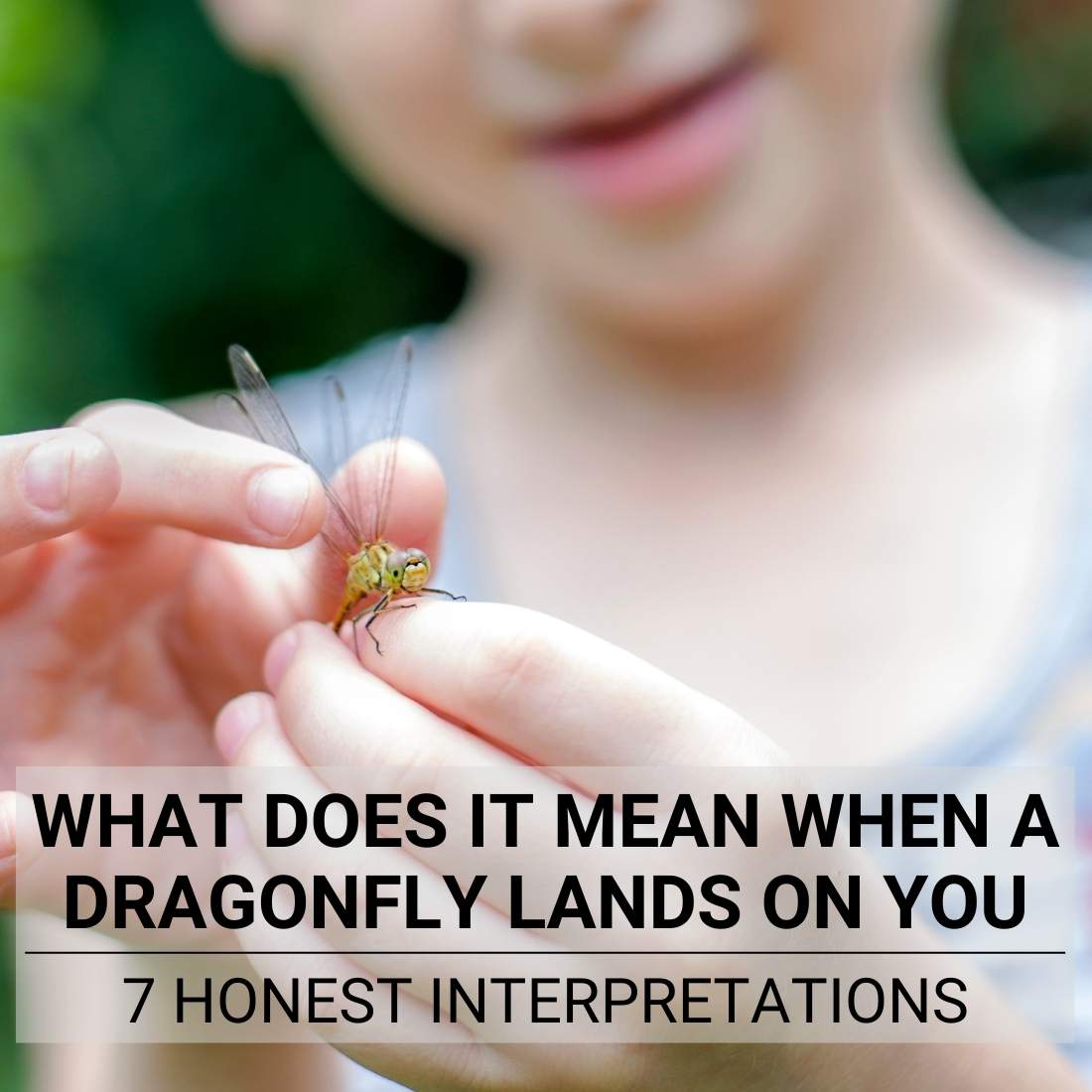
Most traditions that have recorded a dragonfly landing on a person read it as a sign of change, blessing, or moral attention, though which one depends entirely on where and when that tradition developed. The answers don’t all agree, and I’d rather give you the disagreement than pretend there’s a consensus that doesn’t exist.
Key Takeaways
- A dragonfly landing on you is read in Japanese Edo-period folk tradition and Zuni Pueblo belief as ancestral contact, renewal, or imminent blessing, tied to specific seasonal and spiritual cycles, not a generic good omen.
- 19th-century Swedish folklore frames the same encounter as moral scrutiny. The dragonfly as judge is well-documented and almost entirely absent from modern symbolism sites.
- Where it lands matters. Hand, head, and chest carry different weight across traditions.
- Color adds a second layer: blue dragonflies connect to calm and clarity in several East Asian traditions; red ones carry ancestral weight in Japanese folk belief, documented by Haga Yaichi in 1937.
- No single universal meaning exists. Cultural context shapes everything here, and I’ll tell you what each tradition actually says.
What Does It Mean When a Dragonfly Lands on You?
Across the traditions I’ve been able to trace with named sources, a dragonfly landing on a person carries one of two broad readings: blessing and renewal, or moral attention. The first comes from Japanese Edo-period practice and Zuni Pueblo religion. The second comes from 19th-century Scandinavian and English folk belief. Most sites pick one and pretend the other doesn’t exist. You deserve both.
The dragonfly is also, before any of that, a remarkable animal. According to the River Edge Nature Center’s 2020 dragonfly ecology guide, adult dragonflies take between 30 and 100 mosquitoes per day, making them one of the most efficient predators in any freshwater ecosystem. Their larvae spend two to five years underwater before emerging as adults, a timeline confirmed in the Smithsonian Handbook of Insects (2011, pp. 286-289). That protracted underwater life, followed by sudden winged emergence, is precisely why so many traditions reached for them as symbols of change. The biology earned the symbolism.

You are not making this up. The pattern of a dragonfly choosing to land and stay, especially one that didn’t flee when you shifted your weight, has been noted and interpreted across continents for centuries.
What Are the 7 Spiritual Interpretations of a Dragonfly Landing on You?
I want to give these with their cultural grounding, not as floating claims. An interpretation without a source is just someone’s preference.

- Transformation: The dragonfly’s larval-to-adult emergence is the biological fact behind this reading. It appears in Japanese agrarian poetry (haiku) and Zuni ceremonial art as a creature that crosses thresholds.
- Ancestral contact: In Edo-period Japanese folk tradition, red dragonflies (akitsubame) were understood as carriers of ancestral spirits, particularly in late summer. Haga Yaichi’s Nihon Minzoku Gaku (1937) documents this directly.
- Emotional clarity: Several East Asian traditions associate dragonflies with clearing confusion, particularly near water. I read this as downstream of their habitat; they live where the water runs clean.
- Renewal: The Zuni shumakolowa is a rain-bringer. Its landing during difficulty signals that something is about to shift.
- Divine favor: For some Christian readers, particularly those in traditions that see God speaking through nature, the encounter reads as noticed and blessed. This isn’t formal folk tradition, but it’s real for a lot of people who find this page.
- Moral reflection: Swedish 19th-century oral tradition, collected by Arne Runeberg in Ostergotlands Folkminnen (1892), frames the dragonfly as a soul-weigher. The encounter asks you something about yourself.
- Simple attention: And sometimes the reading is plainer than any of that. You were still enough, open enough, for a wild creature to rest on you. Some traditions don’t dress that up.
What Does Japanese Tradition Say About a Dragonfly Landing on You?
Japan has one of the most documented dragonfly traditions in the world, partly because the country’s historical name was Akitsushima, meaning “Dragonfly Island.” The name comes from an 8th-century account in which Emperor Jimmu described Japan’s geography using dragonflies as the image. That’s not folklore in the margin; it’s in the national founding story.
According to Haga Yaichi’s Nihon Minzoku Gaku (1937, Iwanami Shoten), dragonflies in Edo-period agrarian life were read as harbingers of rice harvest. They appeared when the season was about to turn productive, and their presence confirmed that conditions were right. Samurai incorporated dragonfly motifs into armor because the dragonfly only moves forward; it cannot fly backward, which made it a symbol of determination in battle.
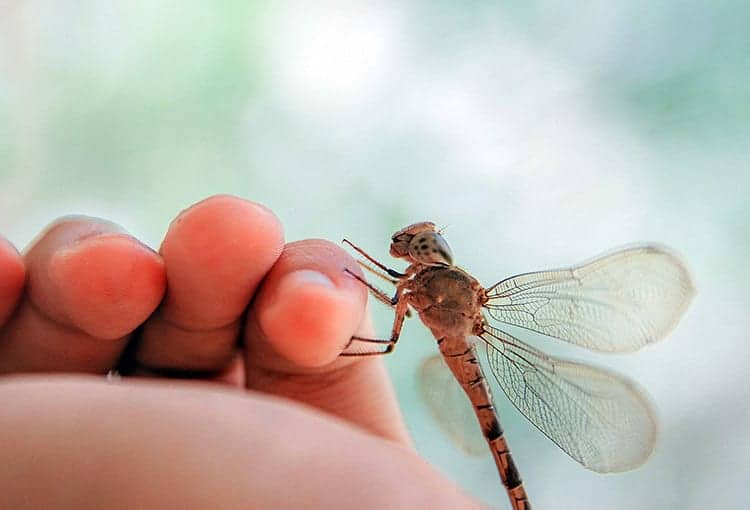
The red dragonfly (akitsubame) carries the most specific ancestral weight. In late-summer Obon traditions, when the dead are said to return for a few days each year, red dragonflies appearing around a household were understood as the ancestors themselves, checking in. A red dragonfly landing on you in that context is not an abstract blessing. It’s a visit.
I am not Japanese, and I’m citing Haga’s ethnological documentation, not personal practice. But the record here is specific and careful, which is why I trust it more than sites that say “in Asian cultures, dragonflies mean luck” and leave it there.
What Do Zuni and Indigenous Pueblo Traditions Say About Dragonfly Encounters?
In Zuni Pueblo tradition, the dragonfly is called shumakolowa and is documented by anthropologist Elsie Clews Parsons in Pueblo Indian Religion (University of Chicago Press, 1939) as a sacred healer and rain-bringer. Parsons records dragonfly prayers used by medicine practitioners to call rain during dry spells. The dragonfly’s emergence from water and flight into air made it a threshold creature, between worlds, between seasons, between drought and abundance.
Zuni pottery and ceremonial art depicted dragonflies to channel these properties, and their appearance over fields during summer was read as a signal that rain was close. A dragonfly landing on you, in this framework, is less a personal message than a moment of being touched by something that belongs to the larger cycle of renewal. You happened to be in the right place.

I want to be clear: this is drawn from Parsons’ documented ethnological record, not from any personal claim to Zuni knowledge. If you want to go further, her 1939 work is the primary scholarly source.
What Does Swedish and Northern European Folklore Say About Dragonflies Landing on You?
This is the part most symbolism sites skip, and skipping it is a disservice to anyone who wants the full picture.
In 19th-century Swedish oral tradition, collected by Arne Runeberg in Ostergotlands Folkminnen (Swedish Academy, 1892), dragonflies were called dodssjalar, which translates roughly as “soul-weavers” or “death souls.” A hovering dragonfly was understood as divine judgment circling overhead. Its needle-like abdomen was said, in some variants, to sew shut the eyes of liars. Arne Afzelius documented related beliefs in Svenska Folk-Sagor och Afventyr (C.E.G. Aberg, 1842), connecting the dragonfly to pre-Christian soul-judgment concepts.

The English folk epithet “Devil’s darning needle” comes from the same tradition, routed through Low German Teufelsnadel. Joseph Wright’s English Dialect Dictionary, Vol. 2 (1898), records regional variants of this name across northern England and parts of Scotland. As folklorist Icy Sedgwick notes in her dragonfly folklore overview, the “evil” associations in English and Low German folk belief are geographically specific and historically documented, not fringe superstition.
Does a dragonfly landing on you mean you’re being judged? I wouldn’t put it that heavily. But I find this tradition worth knowing, because it’s asking a real question: are you living honestly? That’s not a curse. It’s a mirror.
Does Where the Dragonfly Lands on You Change the Meaning?
The traditions I can trace don’t map out a formal landing-location system, but location comes up enough in the source material to be worth noting. Landings near the head connect to the perception associations in Japanese folk tradition: dragonflies have nearly 360-degree compound vision, documented in the Smithsonian Handbook of Insects (2011), and the folk cultures that noticed this before naming it symbolically read a head landing as the creature with the clearest sight choosing the same spot as its resting place.
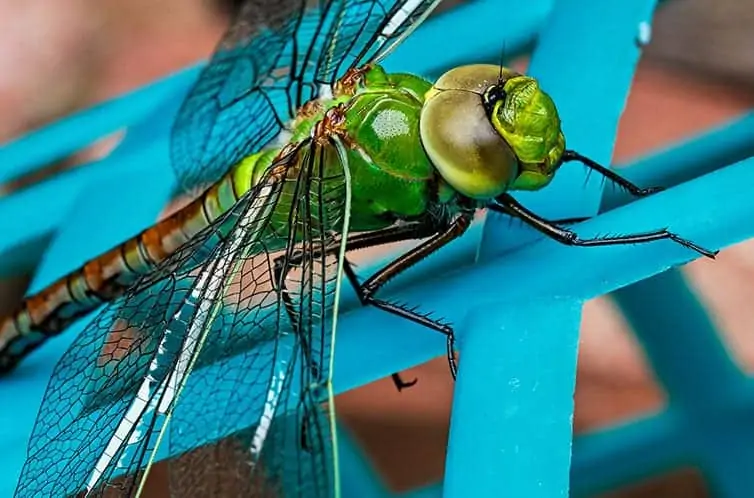
Landings on the hand read as simpler contact: you were still, it chose you. Landings on the chest tend to get read, by the people who come to this page, as more emotionally significant. I can’t trace that to a specific pre-modern source, but it maps consistently onto the Japanese reading of a dragonfly landing as ancestral contact. The chest is where that particular kind of emotion lives. My practical advice: note where it landed, and sit with the context before assigning meaning.
Are Dragonflies Good Luck or Bad Luck?
Mostly good luck, with one specific exception worth knowing. In Japanese Edo-period tradition and Zuni Pueblo religion, the two most carefully documented sources I’ve found, a dragonfly landing on you is unambiguously positive: harvest blessing, ancestral contact, rain-bringer and renewal. Those traditions are not vague about this.
The Swedish and English folk tradition documented by Runeberg and Icy Sedgwick reads the encounter differently, as moral scrutiny rather than good fortune, but scrutiny isn’t the same as bad luck. The dragonfly hovers and measures; whether you come away from that feeling blessed or unsettled depends on the finding. If you need a direct answer: across most of the world’s documented traditions, a dragonfly landing on you is read as good. The Northern European tradition is the main exception, and even there it isn’t a curse so much as a question.
What Does the Color of the Dragonfly That Lands on You Mean?
The strongest documentation is for red. Haga Yaichi’s Nihon Minzoku Gaku (1937) specifically records the akitsubame, the red dragonfly, as the species most associated with ancestral spirits during Obon. A red dragonfly landing on you in late summer carries more ancestral weight, within that documented tradition, than any other color.
Blue dragonflies connect to water clarity and calm in East Asian contexts. I find this credible because dragonflies are genuinely aquatic creatures and blue species tend to inhabit the cleanest water; folk traditions often notice ecological reality before naming it symbolically. Green and other colors appear in contemporary spiritual reading, but I can’t find pre-modern folk documentation for those specific claims. If the color of what landed on you is what you’re weighing, red and blue are on the firmest traditional ground.
What Should You Do After a Dragonfly Lands on You?
Stay still while it’s there. Dragonflies land on moving objects less readily than still ones, and if one chose you, you were already doing something right. Moving to reposition or get a better look ends the encounter before it finishes.
Note the specifics: where on your body, what color, what you were doing or thinking when it happened. The traditions I find most useful are the ones that pay attention to context. In the Zuni reading documented by Parsons in Pueblo Indian Religion (1939), the dragonfly approaches people during moments of transition. You don’t summon it; you receive it. Afterward, the question isn’t what dragonflies mean in the abstract. The question is what this one meant given what’s actually going on in your life right now, and only you can answer that.
Frequently Asked Questions
What does it mean when a dragonfly follows you?
Worth distinguishing from a one-time landing. Dragonflies are territorial hunters; one following you along a path may genuinely be tracking insects disturbed by your movement. But in Zuni Pueblo tradition, as documented by Parsons in Pueblo Indian Religion (1939), the dragonfly’s persistent presence around a person was read as the creature acting as a spirit guide or messenger. If it’s happening repeatedly, across multiple days, I’d pay attention to what’s shifting in your life rather than explaining it away.
What does it mean when a dragonfly lands on you after someone dies?
This is the question I hear most. In Japanese Edo-period folk tradition, red dragonflies in late summer were understood as carriers of returning ancestral spirits during Obon. A dragonfly landing on you shortly after a death, especially a red one in summer, falls directly within that documented tradition. I don’t claim to know whether that’s literally what happened. But the human need to find the person you lost in the natural world is ancient, and the dragonfly has carried that weight in at least one major culture for centuries. You are not alone in that reading.
Is a dragonfly a sign from a deceased loved one?
For some this is the universe speaking; for others it’s God; for others it’s a moment that resists easy naming. What I can tell you is that the association between dragonflies and the recently dead is not a modern invention. Haga Yaichi’s 1937 ethnological documentation of Japanese practice is specific and serious. Whether it crosses into literal afterlife communication is a theological question I’m not equipped to answer. What I can say is that if it felt like a visit, the tradition that frames it that way is real and old.
What does it mean when a dragonfly lands on you multiple times?
Once is easy to pass over. Multiple times in the same day, or the same week, is harder to dismiss and I don’t think you should try. The recurring encounter pattern across reader accounts tends to cluster around transitional moments: a major decision, a relationship ending or beginning, a pregnancy, a loss. I’d trust your instinct that something is asking for your attention. The question is less “what does this mean abstractly” and more “what do I already know that I’m not letting myself look at directly?”
Are red dragonflies good luck?
In Japanese folk tradition, yes, specifically. Haga Yaichi’s Nihon Minzoku Gaku (1937) documents the red dragonfly (akitsubame) as both a harvest-season blessing and a carrier of ancestral presence. That’s a positive reading with real scholarly grounding. In the European traditions that gave us “devil’s darning needle,” color isn’t the distinguishing variable, but red in general carries intensity rather than peace in most Western symbolic frameworks. My read: a red dragonfly leans positive in a Japanese or East Asian symbolic frame, and more complex in a European one.
What does it mean when a dragonfly lands on a child?
Children are often less startling to wildlife than adults; they move more slowly, breathe more evenly, and dragonflies may simply find them less threatening. But in the folk traditions that treat a landing as meaningful, a child receiving such a visit is read as a mark of openness. The Swedish tradition, which frames the encounter as moral scrutiny, would register a child’s visit as an affirmation rather than a warning. I don’t think you need to add layers onto a child’s encounter with a wild creature. The wonder is already there, complete.
Do dragonflies symbolize angels or spiritual guardians?
Not in any tradition I’ve traced that uses the specific language of angels, which is a concept tied to particular Abrahamic theological frameworks. What dragonflies carry, in Japanese and Zuni traditions, is the quality of intermediary: something that moves between worlds, between water and air, between the living and the dead. Whether you call that angelic depends on your framework. If the word “angel” is the one that fits what you felt, use it. The tradition is doing its job, which is to help you name something real.
What does it mean if a dragonfly lands on you and stays a long time?
Duration matters. A brief touch-and-go is different from a dragonfly that stays through your movement, that seems to look at you, that refuses the ordinary flight-triggers. The sustained stillness is what separates a resting insect from something that reads as chosen. In the Zuni healing tradition documented by Parsons, the dragonfly’s sustained presence near a person was the signal of blessing, not the brief appearance. If it stayed, I’d take that seriously. People remember these encounters for years, and I think that memory is worth paying attention to.
Sources
- Parsons, Elsie Clews. Pueblo Indian Religion. University of Chicago Press, 1939. (Zuni dragonfly rain rituals and healing symbolism)
- Sedgwick, Icy. “The Dragonfly in Folklore: Good Luck Symbol & Weigher of Souls.” icysedgwick.com. (European dragonfly folk tradition overview)
- Indian Traders. “Native American Symbolism: Dragonfly.” indiantraders.com. (Indigenous Southwestern dragonfly symbolism)
- River Edge Nature Center. “Bug of the Week: An Inordinate Fondness for Dragonflies.” riveredgenaturecenter.org, 2020. (Dragonfly predation and natural history data)
- Reads by Red River Banks. “Cultural Symbolism of Dragonflies.” readsbyredriverbanks.wordpress.com. (Cross-cultural dragonfly symbolism survey)
- Kampung Kreepy. “The Dragonfly: Devil’s Familiar or Sacred Messenger?” kampungkreepy.com, 2023. (European devil-association tradition)
- Haga, Yaichi. Nihon Minzoku Gaku [Japanese Ethnology]. Iwanami Shoten, 1937. (Edo-period dragonfly symbolism and ancestral associations)
- Afzelius, Arne. Svenska Folk-Sagor och Afventyr. C.E.G. Aberg, 1842. (Swedish soul-weaver tradition)
- Runeberg, Arne. Ostergotlands Folkminnen. Swedish Academy, 1892. (Dragonfly-as-moral-judge documentation)
- Wright, Joseph. English Dialect Dictionary, Vol. 2. 1898. (“Devil’s darning needle” and regional folk epithets)
- Smithsonian Handbook of Insects. Dorling Kindersley, 2011, pp. 286-289. (Dragonfly larval development and natural history)





I had a dragonfly land on my head yesterday and stayed what would that mean?
Was on the beach and on my anniversary a huge black and green dragon fly landing ony pubic bone staying there for a good hour I let him or her chill because I knew it was some kind of sign
My aunt has had the same dragonfly visit her and land on her finger 3 days in a row! She calls for it and sticks her finger out and it comes. It is beautifulo and it will only land on her and no one else!
I love my dragonflies. They often land on me. There are times there are 3 or four that land on both hands. They give me such an inner peace that is indescribable.