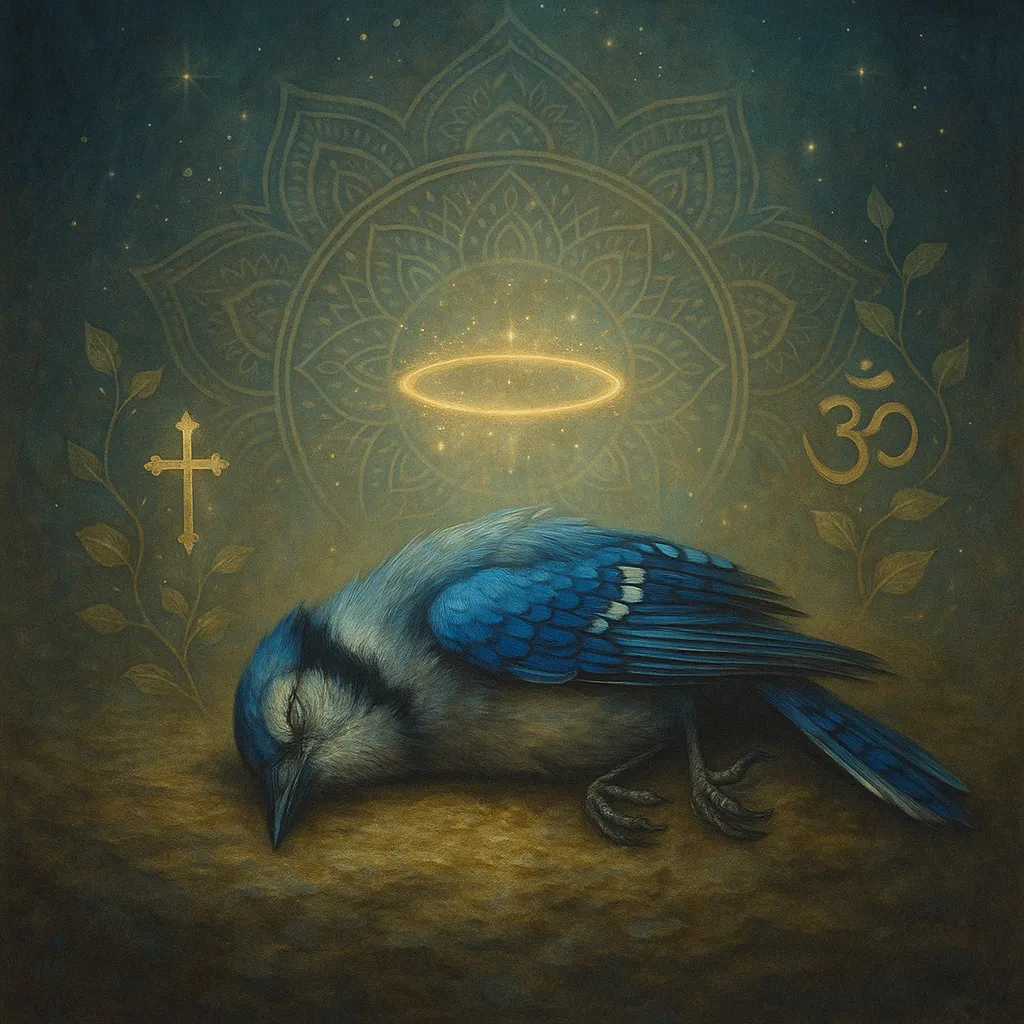
A blue jay lies on your porch or beneath a window, its bright feathers dulled against concrete or leaf litter. In African American folklore of the plantation South, the blue jay was the “bird of Satan,” a thief that carried sticks to Hell and left silence in its wake. Whether it fell at your threshold or deep in your yard shifts what that silence means.
Key Takeaways
- A dead blue jay is mostly a modern spiritual motif, not a stable omen from one ancient tradition.
- The bird’s loud, morally charged identity, trickster, gossip, fierce guardian, is what gives the death its weight. When that voice stops, something ends.
- In Chinookan oral literature recorded by Franz Boas in 1894, Bluejay is a noisy mischief-maker, not a death messenger; specific mortuary omens for this bird are not documented there.
- African American folklore of the plantation South gives the blue jay one of the darker folk reputations of any American bird, and a dead one reads differently inside that frame than it does in a New Age one.
- Location matters. Your doorstep carries a different charge than your garden.
What Does It Mean When You Find a Dead Blue Jay?
The through-line across every tradition that has an opinion: a dead blue jay is the silencing of something loud. Communication disrupted. A moral noise gone quiet. That holds across the plantation-South “bird of Satan” framework, the Chinookan trickster stories, and the Blue Jay Feathers Symbolism And Meaning in the 21st-century spirit-animal tradition that has grown up around jays in the last twenty years.
I want to be honest about what the folk record actually contains, because I’ve read it carefully and it’s thinner than most symbolism articles let on. There is no single ancient tradition that records a stable dead-blue-jay omen the way there is for, say, a dead crow in European folklore. What we have instead is a bird with a very specific cultural personality, noisy, bold, morally suspect in some frameworks and fiercely loyal in others, and a modern interpretive habit of reading the death through that personality.
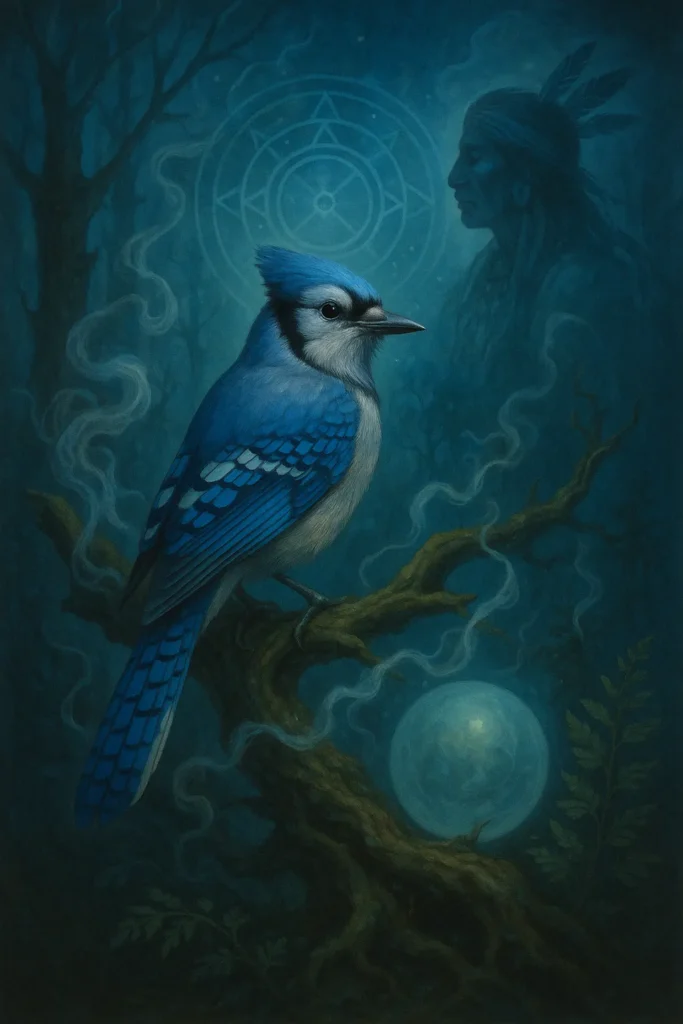
Take a breath. No version of this means someone you love is about to die. What it does mean, in most frameworks that have thought about it, is worth reading.
What Did Blue Jays Symbolize Before the “Dead” Omen Became Popular?
The living blue jay earns its symbolic reputation from behavior, not mythology. A blue jay is loud. It will mob a Cooper’s hawk three times its size, screaming until the predator leaves. It mimics other birds’ calls, including, disconcertingly, the scream of a Red-shouldered Hawk, sometimes to clear a feeder, sometimes for no visible reason. It has a memory for food caches that puts most mammals to shame. According to the Cornell Lab of Ornithology, a single blue jay can store thousands of acorns in a season, and their role in spreading oak forests across eastern North America after the last ice age is considered significant by forest ecologists.
That behavioral profile, aggressive, intelligent, loud, unpredictable, fiercely territorial around family, is what gives the blue jay its symbolic weight. Before anyone was writing about dead jays specifically, the living bird stood for bold communication, protection of the inner circle, and, in less flattering readings, gossip and moral noise. For contemporary symbolism writers, the death of such a bird signals the extinguishing or transformation of those qualities.

The word “jay” itself comes from Old French gai, meaning a noisy, brightly colored bird, and by extension a chatterbox or foolish person. That etymology is not nothing. It has been shaping how English speakers read this bird for centuries.
What Does Chinookan and Northwest Coast Tradition Say About the Blue Jay?
Among Chinookan-speaking peoples of the lower Columbia River, Bluejay is a recurring character in oral literature. Franz Boas’ Chinook Texts (1894) records multiple Bluejay tales where his impulsiveness, nosiness, and bravado lead to social lessons or outright humiliation. He is kin to Raven and Coyote: a trickster who helps and harms in roughly equal measure, mostly by being unable to keep quiet.
What Boas does not record, and what I haven’t found in other documented Chinookan or Northwest Coast sources, is a specific mortuary omen for the blue jay. The claims circulating widely that Coast Salish or Sioux traditions recorded dead blue jays as summoners of death or “dark-souled messengers” appear to be generalizations from the broader trickster profile, not documented folklore. I’ve read several versions of this claim and traced none of them to a named primary source.
That matters. A claim is not a tradition.
So: Chinookan tradition gives you a loud, mischievous, morally complicated bird. It does not give you a death omen. If that framework resonates with you, the death of such a bird reads as the end of disruption, the silencing of a chaotic energy in your life. But I’d call that a reasonable inference, not a traditional reading.
What Does African American Folklore Say About the Blue Jay’s Moral Character?
This is the most specific documented tradition, and it’s worth knowing in full.
In African American communities of the plantation South, the “jaybird” acquired a strong Christian-moral symbolism. As Laura Erickson documents in her writing on blue jays in American folklore, enslaved people told stories that the jay had refused to help shade the crucified Christ and was cursed for it, condemned to scream in the hot sun and called the “bird of Satan.” A related motif holds that jays are noisy most days because they are busy; they fall quiet on Fridays because that is when they are carrying sticks to Hell for the Devil. That is why a yard suddenly gone silent of jays was worth noticing.
You don’t have to believe the Devil employs subcontractors. You can still feel the weight of a tradition that linked this particular bird’s silence to something wrong. In this framework, a dead blue jay is the permanent silencing of a morally suspect voice. Depending on what is happening in your life right now, that might feel like a release.
What Do Contemporary Spiritual Sources Say a Dead Blue Jay Means?
The modern spirit-animal tradition is where most people find their interpretations, and I want to describe it accurately rather than dismiss it. According to contemporary summaries of blue jay symbolism, a dead blue jay is often framed as a call to courage: a message not to run from a problem but to face it with the same grit the living bird shows when it mobs a hawk. Some writers frame it as a warning about enemies, others as a signal that a phase of communication in your life is ending.
These are 21st-century psychological omens, and I say that without contempt. They map the bird’s real behaviors, aggression, vigilance, pair-bonding, loud self-expression, onto inner states. Not an ancient tradition. But not nonsense either.
The mind reaches for mirrors, and the blue jay is a particular kind of mirror: the part of you that speaks up, defends its nest, refuses to be quiet. When that goes silent, you notice. If the courage reading resonates, take it. Face what you’ve been avoiding. That’s a reasonable thing for any encounter with a dead bird to prompt.
Does Where You Found the Dead Blue Jay Change Its Meaning?
Yes. Location matters in encounter-based folk interpretation, and it matters practically too.
A dead blue jay on your doorstep or porch carries the most personal charge. In the spatial logic running through most Western folk traditions, the threshold is the boundary of your household. Something that appears there is addressed to the house, not to the neighborhood. If you found it first thing in the morning, the encounter feels chosen, and folk tradition mostly agrees with that feeling.
In your yard or garden, the reading loosens. Blue jays die in yards because Cooper’s hawks work yards, because window glass is invisible to birds, because cats are very good at their jobs. A dead jay in the open ground is a wider signal, if it is one at all: something about your life more broadly, less about what is crossing your threshold.
Against a window is its own category. A bird stopped mid-flight reads as communication interrupted: something coming toward you that didn’t arrive, or something that needed saying and didn’t get said. The practical reading and the symbolic one align here. Window strikes are the leading cause of bird death in residential areas in the US, estimated at up to one billion birds annually by the American Bird Conservancy (2019). A dead bird at your window is genuinely, practically common. That doesn’t make the encounter less striking when it happens to you.
What Should You Do After Finding a Dead Blue Jay?
Practically: wear gloves. Blue jays can carry West Nile virus and avian influenza. Double-bag the body and put it in the trash, or bury it at least a foot deep away from vegetable gardens. Don’t leave it for dogs or outdoor cats.
Frequently Asked Questions
Is finding a dead blue jay bad luck?
Not in any well-documented tradition. The African American folklore tradition documented by Laura Erickson casts the living blue jay as the “bird of Satan,” so its death could be read as the silencing of a morally suspect influence, which is closer to relief than bad luck. Modern spirit-animal sources lean toward courage and confronting difficulty. Neither reading is about luck in the simple bad-omen sense. If you’re worried about a curse, you’re not in that territory here.
What does it mean if a blue jay flies into your window and dies?
In the symbolic frame, a bird stopped mid-flight reads as communication interrupted: something coming toward you that didn’t arrive, or something that needed saying and didn’t get said. Practically, window strikes are the most common cause of bird death in residential areas, accounting for up to a billion bird deaths annually in the US according to the American Bird Conservancy (2019). Both things can be true at once. You can hold the practical explanation and still ask what was trying to reach you.
Can a dead blue jay be a sign from a deceased loved one?
I don’t have a confident answer here, and I want to be honest about that. The folk record on birds as messengers from the dead is mostly built around different species: robins and cardinals carry that association in British and American folk tradition, not blue jays. If a dead blue jay appeared around the time of a loss and the connection feels real to you, I wouldn’t argue you out of it. But I can’t tell you it’s a documented belief either. The record is genuinely thin.
What does a dead blue jay mean in a dream?
In the Jungian framework I find most useful for animal dreams, a dead bird signals the end of something vocal or expressive in your inner life: a voice you’ve been suppressing, or one that has worn itself out. The blue jay specifically, given its bold personality, might point to a part of yourself that has been fighting or defending loudly and is now exhausted. Dreams about dead blue jays seem to arise during periods of conflict. That’s worth sitting with rather than dismissing.
Is it safe to touch or move a dead blue jay?
Wear disposable gloves, or use a plastic bag over your hand. Blue jays can carry West Nile virus and, less commonly, avian influenza. Don’t let pets mouth it. Double-bag and dispose in the trash, or bury at least a foot deep away from vegetable beds. Wash your hands thoroughly after. The risk to humans is low, but the precaution takes thirty seconds and is worth taking.
What does it mean if you find a dead blue jay on your porch specifically?
In encounter-based folk interpretation, the threshold, porch, doorstep, the boundary between your house and the world, carries a specific charge. Something that appears there is understood as addressed to the household. A dead blue jay on your porch is read, in most folk frameworks, as a message directed at you personally rather than a bird that happened to die nearby. Whether that message is a warning, a release, or a call to pay attention depends on what is happening in your life right now. You’re the only one who can answer that.
Are there any legal issues with keeping a dead blue jay or its feathers?
Yes, real ones. The Migratory Bird Treaty Act of 1918 covers blue jays as a protected species. In the United States, possession of a blue jay, its feathers, eggs, or any body parts is a federal offense, even if the bird died naturally and you found it in your own yard. Fines start at $15,000 for misdemeanor violations. If you want to keep a feather for its meaning, take a photo instead. For more on blue jay feather symbolism specifically, see this article on blue jay feather meaning.
Sources
- Laura Erickson, Blue Jays in American Folklore (African American plantation-South folklore, “bird of Satan” motif, carrying sticks to Hell)
- Wikipedia, Blue Jay (natural history, habitat, range, etymology of “jay”)
- Native Languages of the Americas, Bluejay Legends (Chinookan and Northwest Coast oral tradition overview)
- Birdfact, Blue Jay Symbolism (contemporary spiritual and folk symbolism summary)
- The Minds Journal, Blue Jay Spiritual Meaning (contemporary New Age and spirit-animal readings, including dead blue jay interpretations)
- Peck and Perk, Blue Jay Meaning, Signs, and Messages (modern spiritual messenger framework)
- Birdfy, Blue Jay Spiritual Meaning (window strikes, encounter-based readings)