Hearing a lark sing in the dark feels strange, because larks belong to the morning. Skylarks often start singing before sunrise, so a lark after dark usually means dawn is closer than it seems. Shakespeare used exactly that: in Romeo and Juliet, the lark’s song is what ends the lovers’ night. What it means for you depends on where you heard it.
Key Takeaways
- Across documented traditions, the lark’s core symbolic meaning is dawn, joy, and hope, the bird that sings before the light arrives, not after.
- Greek, Roman, Persian, and English sources all map the lark’s vertical song-flight onto the soul’s ascent toward something larger than daily life.
- In English literary tradition from Chaucer through Shelley, the lark became the stable emblem of pure creative voice, inspiration that exists apart from earthly suffering.
- As a spirit animal, the lark points toward cheerfulness that is earned rather than performed, early-rising discipline, and the courage to express yourself before the moment feels safe.
- A lark seen at night or in an unexpected place is read across traditions not as a bad omen but as a threshold signal, dawn energy showing up in the dark, a call toward clarity.
What Is the Spiritual Meaning of a Lark?
The lark symbolizes dawn, joy, hope, and the bridge between the human and the divine. That answer holds up across more traditions than almost any other bird symbol I have researched. What makes the lark unusual is that the joy it represents is not passive, it is the joy of beginning, of singing before you know how the day will go.
The bird earns this meaning through behavior. A skylark (Alauda arvensis) rises from a field before sunrise, climbs several hundred feet straight up, and pours out continuous song the entire way, hovering at the top, then dropping silent back to the grass. It does this to mark territory and attract a mate. But what people see is a creature ascending toward the light while still rooted in the earth. That image is the source of nearly everything. The symbolism is not arbitrary, it maps directly onto what the bird actually does.

The lark is the opposite end of the spectrum. Small, brown, ground-nesting, nothing much to look at when it’s sitting still. And then it opens its mouth and goes straight up and the whole field changes. That contrast, between what the bird appears to be and what it becomes in flight, is half of what people have been writing about for seven centuries.
What Does the Lark Symbolize Across World Cultures?
Across traditions, the common thread is this: the lark is the herald, not the hero. It does not carry messages of danger or death. It announces that something good is coming, or that something dark is ending. In English folk belief it signals morning. In Irish rural tradition it signals fair weather. In Persian Sufi poetry it signals the soul’s longing for reunion with the divine.In Greek sources it belongs toAphrodite. The bird’s territory is hope and beginning, almost without exception.
What strikes me about lark symbolism is how consistent it is across cultures that had no contact with each other. A medieval English farmer and a Persian Sufi mystic were not reading each other’s texts. They were watching the same bird do the same thing, rise before dawn, sing continuously, disappear into the light, and they reached for the same meanings. That convergence is harder to dismiss than any single tradition’s claim on its own.

For a broader look at how bird symbolism works across cultures and species, the animal symbolism overview on this site gives useful context before going deeper on any one bird.
What Did English Medieval and Early Modern Tradition Say About the Lark?
In English literary and folk tradition, the lark is the bird that ends darkness. Full stop. That reading appears in Chaucer’s Parliament of Fowls (c.1380s), where he names the lark “messenger of day”, not messenger of spring, not messenger of love, but specifically of day. The choice is deliberate. Day means the dark is over.
Shakespeare picks up the same framing and makes it sharper. In Romeo and Juliet (c.1597), the famous dawn argument between Romeo and Juliet turns entirely on whether the bird they hear is a nightingale or a lark. Juliet argues for the nightingale because that keeps the night intact. Romeo knows it is a lark. The lark’s song means daylight, which means he must leave, which means their night together is finished. Shakespeare uses the bird to encode something real: the lark is the sound of reality breaking through the dark. Not a gentle bird in this context. An honest one.

That scene has shaped English-language lark symbolism ever since. When the lark appears in folk tradition as a good omen, part of what makes it good is precisely this honesty, the bird does not soften things, it simply announces what is coming. According to folk song and cultural history documentation of the skylark, this role as a truth-teller at dawn runs through English rural culture well beyond literary sources, appearing in traditional work songs and planting-season folklore across the Midlands and the north.
What Role Does the Lark Play in Irish Rural Folklore?
In Irish rural belief, the lark is firmly a bird of good luck. Associated with fair weather, with the fairy world in a protective rather than threatening way, and specifically not associated with death or nighttime signs of bad things to come. This matters because Irish folk tradition does contain birds of bad luck, the hooded crow, the raven in certain readings, some owl traditions. The lark is not in that company.
The Raptor Resource Project’s survey of Irish bird-lore and superstition notes that larks appearing around a home were read as a sign of coming good weather and general good fortune, not warnings. In some rural Irish accounts, the lark’s song was said to be unintelligible to most people but clear to those the fairies favored, a reading that connects the bird’s position between earth and sky to the idea of it moving between ordinary and otherworldly realms.

The key distinction from other bird folklore: the Irish lark is daytime, outdoor, and positive. It does not haunt windows at night. It does not follow people who are about to die. It rises, sings, and comes back down. The symbolic reading follows the actual behavior almost without embellishment.
How Have Ancient Greek and Roman Traditions Interpreted the Lark?
Greek and Roman traditions connected the lark to Aphrodite (Venus in Roman sources) and, through her, to the soul’s capacity for joy and ascent. The bird was not a major figure in formal Olympian mythology, but it appeared regularly in pastoral poetry and natural philosophy as a creature that demonstrated something about the relationship between earth and sky.
The lark’s ground-nesting habit was notedby Aristotle in his Historia Animalium (c.350 BCE) as a paradox worth thinking about: a bird that lives in the dirt but sings from the heights. Later writers used this paradox to argue that the lark embodied the soul’s dual nature, rooted in the material world, capable of rising toward the divine. The ascent-and-return pattern of the song-flight was read as a model for the soul’s movement in prayer or contemplation: up toward something larger, then back into the body and the daily work.

This is the foundation for a lot of what comes later in Christian and Sufi readings of the lark. The Greeks gave the bird its philosophical architecture, the vertical axis between earth and heaven, and subsequent traditions built on that frame.
What Is the Lark’s Symbolic Meaning in Eastern and Asian Traditions?
In Persian Sufi poetry, the lark’ssong is read as the soul’s cry of longing for reunion with the divine. The bird sings most at dawn, from the highest point it can reach, and the Sufi poets, Particularly in the tradition that produced Rumi and Attar, saw in that a mirror of the mystic’s own position: earthbound, reaching upward, producing sound that comes from longing rather than satisfaction.
This is a different reading from the English one. The English lark is joyful and announcing. The Persian lark is joyful and aching. Both traditions agree on the fundamental shape: the bird ascends, sings, and the song is about something it cannot quite reach. But the English reading tends toward the hopeful side of that (the dawn is coming), while the Sufi reading stays longer with the longing itself (the reunion is not yet here).

In East Asian folk traditions, larks appear less prominently than cranes, magpies, or swallows, which dominate bird symbolism across China, Korea, and Japan. Where the lark does appear in Chinese rural folklore, it tends to carry weather-sign associations similar to the Irish ones: lark song in the morning means clear skies, which in agricultural societies means good days ahead. The symbolic depth is thinner here than in the Western and Persian traditions, and I don’t want to overstate what the record actually shows.
What Does the Lark Represent as a Spirit Animal or Totem?
If the lark is your spirit animal, the core trait it points toward is cheerfulness that costs something. Not the easy cheerfulness of someone who has not been tested, but the specific kind that shows up before the day has earned it, singing before the light arrives, not because things are already good, but because you have decided to act as though they will be.
According to the lark archetype documentation at MyMythos, people drawn to the lark as a totem tend to be early risers in the psychological sense, people who get up into their work, their creative life, their relationships before they feel completely ready. The lark does not wait for perfect conditions. It goes up in the dark and starts singing. That is both the gift and the demand of this particular symbol.

Practical traits associated with the lark totem: creative voice, specifically the courage to use it without an audience yet. Discipline that comes from internal rhythm rather than external pressure. An instinct to find joy in the beginning of things rather than the completion of them. The shadow side, if you want to call it that, is the tendency to peak early and struggle with the long middle of any project. The lark is spectacular at dawn. High noon is harder.
What Does It Mean to Dream of a Lark?
A lark in a dream generally signals a shift from a heavy period toward something lighter, not the arrival of ease, but the first audible sign that it is coming. The specific scenario shifts the reading considerably.
Hearing a lark sing without seeing it is the most commonly reported lark dream, and in folk dream-reading traditions it is taken as a particularly good sign. Music from an unseen source suggests guidance or support you cannot yet identify but that is present. From a Jungian angle, the song-without-bird is the unconscious producing a signal before the conscious mind has a name for what is changing.

Seeing a lark rise in a dream tends to map onto hope and new direction, the bird doing exactly what it does, the dream not complicating the symbol. Something is lifting. A silent or fallen lark is harder. Folk traditions read a silent lark as a warning that creative voice or joy is being suppressed, not permanently lost. A fallen lark is sometimes read as grief over something that once brought happiness. Neither reading is catastrophic. Both suggest attention is needed somewhere specific.
What Does the Lark Symbolize in Poetry and Literature Beyond Shakespeare?
Shelley’s To a Skylark (1820) is where the lark’s literary identity locks in fully.The poem opens “Hail to thee, blithe spirit! / Bird thou never wert”, Shelley is arguing that the skylark is not quite a real bird, that its song is too purely joyful to belong to the physical world. He goes on to wonder what the lark knows that humans don’t, why its music doesn’t carry the weight of mortality that all human art does. The lark in Shelley is pure creative inspiration, disembodied, a form of joy that has somehow escaped suffering.
That is a complicated compliment. It sets the bird up as the poet’s muse-figure for the nineteenth century, The lark became, in English poetry, the symbol of inspiration that is not grounded in experience but somehow rises above it. Unreachable. Which is both the appeal and the problem.

The literary tradition, taken together from Chaucer through Shelley, gives the lark a very specific symbolic function: the moment before expression, the rising before the full light, the joy that is most itself when it is still becoming.
What Are the Behavioral Facts About Larks That Reinforce Their Symbolism?
The skylark begins its song flight before sunrise, often while it is still dark enough that it cannot be seen against the sky, only heard. It climbs to heights of 50 to 100 meters, hovering on rapid wingbeats while singing continuously, then drops back down in a long silent glide. The Monaco Nature Encyclopedia’s entry on Alauda arvensis notes that a single song flight can last three to five minutes, with the bird covering the same vertical distance repeatedly across a morning. Cornell Lab of Ornithology’s breeding bird documentation records peak song-flight activity in the 30 minutes before civil dawn. The bird is, quite literally, singing in the dark.
The ground-nesting habit is the other behaviorally important detail. A bird that sings from the sky but nests in the grass. The lark does not live in the heights it visits. It returns to the ground, to the ordinary, every time. And then it goes back up. That cycle, ordinary, extraordinary, ordinary again, is what makes it a useful symbol for creative and spiritual life rather than escape from it.
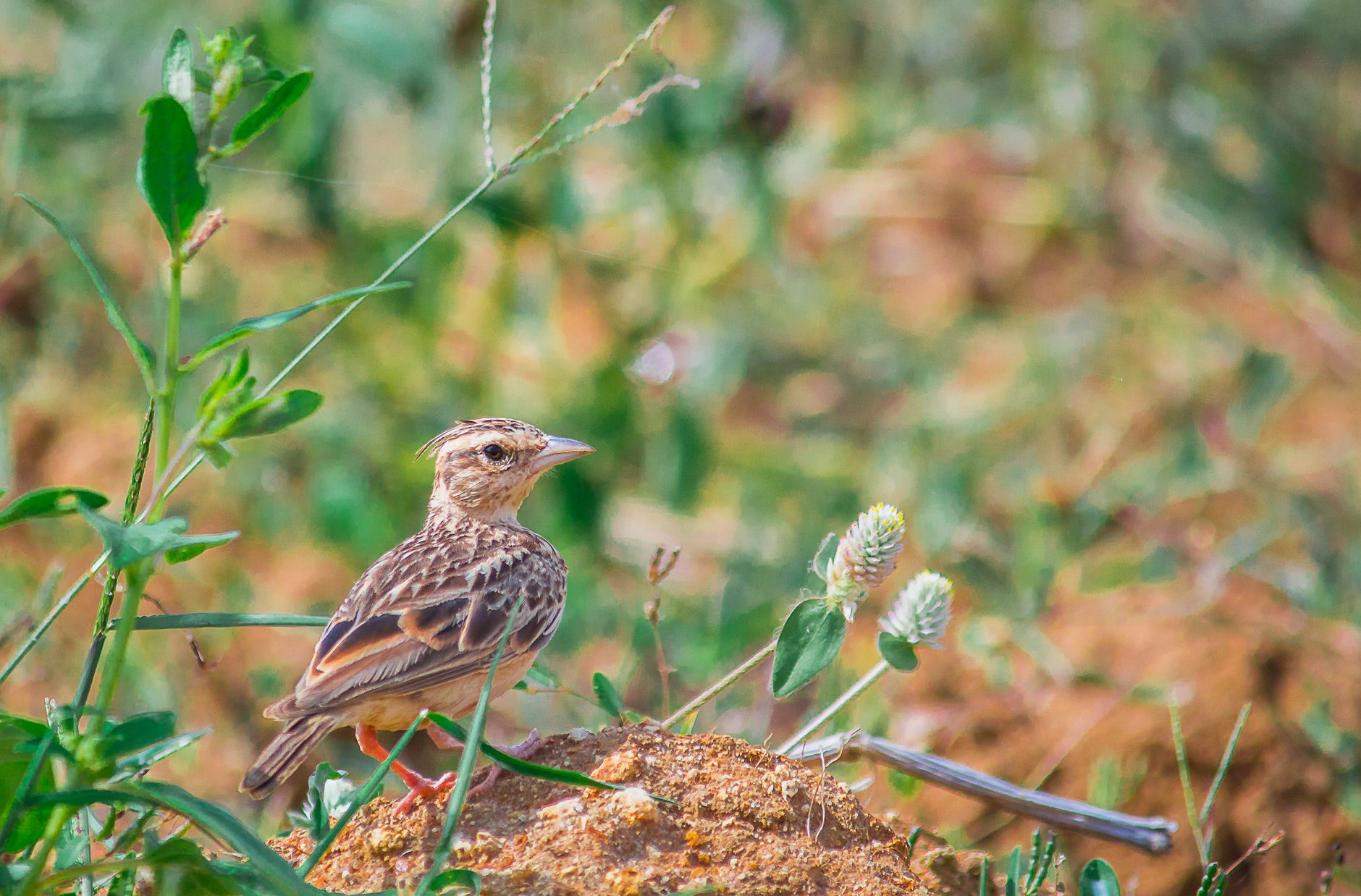
There are roughly 90 species inthe family Alaudidae worldwide, from the Horned Lark of North American grasslands to the Singing Bushlark of sub-Saharan Africa. Most share the ground-nesting, open-country, and song-flight traits that produce the symbolism. The skylark is the one that shows up in most of the cultural literature because it is the species native to Europe and western Asia, where most of the documented traditions originate.
What Does It Mean When a Lark Appears at Night or in an Unexpected Context?
This is the question behind the “lark after dark” searches that land on this page, and it deserves a straight answer. A lark seen or heard at night is not a death omen. Not a warning in any tradition I have found. The consistent reading across Irish, English, and broader European folk belief is that a lark out of its expected context, nocturnal, indoors, appearing in winter, is read as dawn energy intruding into darkness. A threshold signal. Something that belongs to hope and beginning showing up before you expected it.
The operative question in folk tradition is not “why is this bird here in the dark?” but “what is it announcing?” If the lark announces dawn, and it is appearing in your dark, the tradition reads that as a sign that your dark is ending, not that something worse is arriving. That is a real distinction from the way people often interpret unexpected animal encounters, and it is worth sitting with.

I don’t know why the lark specifically carries this threshold reading rather than some other bird. My best guess is that it follows from the bird’s own behavior: it starts before the light is there. It is always a little ahead of the dawn it announces. So when it appears out of place, the reading is “this is early, but it is coming” rather than “something is wrong.”
What Is the Lark’s Symbolic Connection to the Sun and the Divine?
The lark’s vertical song-flight, rising toward the sun and then returning to earth, has been mapped onto spiritual ascent in at least three distinct traditions that developed independently. The Greek philosophical reading (soul rising toward the divine), the Sufi reading (mystic longing for reunion), and the medieval Christian reading (the soul’s morning prayer) all use the same physical image, a small creature going straight up toward the light, and read it as a model for the soul’s movement toward the sacred.
In some medieval Christian readings, the lark’s pre-dawn song was compared to the practice of Matins, the earliest of the canonical hours, said or sung before sunrise. The bird that sings before the light was a natural image for a tradition that prized getting up in the dark to pray. This connection appears in several medieval bestiaries, which treated the lark’s behavior as intentional praise: the bird singing its dawn prayer before the monks had finished theirs.
The solar connection is older than any of these. The bird that rises toward the sun and sings continuously while doing so is a solar messenger in the most literal observational sense. It was doing that before anyone put a theological frame around it.
What Does the Lark Symbolize in Sonnet 29 and Other Shakespearean Texts?
In Shakespeare’s Sonnet 29, the lark appears in the turn, the moment the poem pivots from despair to hope. The speaker has been cataloguing everything wrong: disgrace, outcast state, envying other men’s gifts. And then memory of the beloved arrives, and he writes: “Like to the lark at breakof day arising / From sullen earth, sings hymns at heaven’s gate.” The lark here is not background. It is the exact image Shakespeare chose to represent sudden reversal, from the lowest point to the highest, from silence to song, from night to dawn. In twelve syllables.
That is a very precise use of the bird. Shakespeare is not saying the lark is pretty or that birds are nice. He is saying: you know what it looks like when something goes from the ground to the sky, from dark to light, from nothing to full song? That is what happens inside me when I think of you. The lark is doing the symbolic work of the whole poem’s emotional movement.
Across the Shakespeare canon, the lark does this consistently: it marks the transition point. In Romeo and Juliet it marks the transition from night to day, from safety to danger. In Sonnet 29 it marks the transition from despair to gratitude. The bird is always at the hinge. Always the moment things change direction.
Frequently Asked Questions
Is a lark a good or bad omen?
A lark is a good omen in every tradition I have found that records a clear reading. In English medieval tradition, it signals morning, the end of darkness. In Persian Sufi poetry, it signals the soul moving toward what it loves. There is no significant tradition that reads the lark as a warning or a death-sign. If you saw a lark and felt uneasy, the unease is not coming from the bird.
What is the difference between a lark and a skylark symbolically?
Practically speaking, “lark” and “skylark” are used interchangeably in most symbolic and literary contexts. The skylark (Alauda arvensis) is the specific species Chaucer, Shakespeare, and Shelley were writing about, because it is native to Europe and the bird their audiences would have known. When modern symbolism writing says “lark,” it usually means this same bird and the same body of cultural associations. Other lark species, the Horned Lark of North American grasslands, for instance, carry lighter symbolic weight because they appear less frequently in the documented literary and folk traditions that built the symbolism.
What does it mean if a lark visits your garden?
A lark in or near your garden is read in English and Irish folk tradition as a sign of good weather ahead and, more broadly, of a favorable period coming. The bird does not nest in gardens, it is a field and open-country species, so seeing one close to a house is somewhat unusual, which may be why people notice and remember it. In Irish rural belief, an unexpected lark appearance was read as a sign that something welcome was on its way. I find that a reasonable frame, for whatever it’s worth coming from someone who is mostly used to handling things with talons.
What does the lark symbolize in Christianity?
In medieval Christian tradition, the lark was associated with the practice of Matins, the pre-dawn prayer said before sunrise. Several medieval bestiaries compare the lark’s pre-dawn song to the soul’s morning praise, and the bird’s ascent toward the sun was read as a model for prayer: rising from earthly concerns toward the divine. The lark was not a major scriptural bird, but it had a clear devotional identity in monastic culture. The Benedictine tradition, with its emphasis on rising before dawn to pray, found the lark a natural symbolic companion.
Why is the lark associated with poets and artists?
Shelley argued that the lark’s song was purer than any human art because it came without the weight of mortality, suffering, or self-consciousness. The lark sings because it sings, not to be heard, not to be praised, not to work through its losses. That image of unselfconscious creative expression became enormously appealing to Romantic poets and has stayed in the cultural vocabulary ever since. The lark is the artist before ego got involved, which is either inspiring or maddening depending on where you are in your work.
What does a lark tattoo mean?
Lark tattoos most commonly draw on the dawn, joy, and creative voice symbolism. People choose the design to represent a new beginning after a hard period, a commitment to creative expression, or the Shelleyan idea of pure inspiration uncomplicated by self-doubt. The image of a lark in mid-flight, ascending, wings spread, is the most common form, read as aspiration in the literal sense: breathing upward, moving toward something. Some people choose it specifically for the Sonnet 29 connection, as a reminder that the lowest point is also the moment before the turn.
What does it mean spiritually to hear a lark singing but not see it?
In folk dream-reading traditions across England and Ireland, music from an unseen source was consistently read as a favorable sign, guidance or support present but not yet visible. A lark heard but not seen carries that reading in its most optimistic form: the dawn announcing itself before the light is there to prove it. From a more psychological angle, hearing without seeing suggests that something is changing in you or around you that you can register but not yet identify. I find that distinction useful regardless of whether you hold a spiritual frame around it or not.
How does lark symbolism differ from swallow or robin symbolism?
The swallow is primarily a symbol of return and loyalty, it comes back to the same nest, the same place, year after year, and its arrival marks the true beginning of spring. The robin carries more protective and threshold associations, particularly in British folk tradition, where it was linked to the dead and to the boundary between the living world and whatever comes after. The lark is neither of these. It marks the beginning itself, not the return of something known, but the arrival of something new. Three distinct positions on the calendar of hope: the lark announces the dawn, the swallow confirms the season, the robin holds the door.
What does a dead lark symbolize?
The folk record on dead larks specifically is thin, thinner than for ravens, crows, or owls, which carry more weight in death-omen traditions. Where dead lark symbolism appears at all, it tends to be read as the silencing of joy or creative voice, a warning to attend to something that was once a source of happiness but has been neglected. Closer to: something in you that used to sing has gone quiet. The question the symbol asks is whether that silence is rest or suppression. I don’t have a confident answer beyond that. The record is genuinely sparse here, and I won’t pretend otherwise.
What is the lark’s symbolic meaning in heraldry?
In European heraldry, the lark appears occasionally as a charge and carries associations with staying alert and waking up early, traits valued in military and noble contexts where being the first to act was a practical virtue. The lark in heraldry typically faces the viewer directly or is shown in the rising position, wings extended. It appears more frequently in English and French heraldic records than in German or Iberian ones, which reflects its stronger cultural presence in the folk and literary traditions of those regions.
Sources
- MyMythos, Lark Archetype
- No Sleeping Dogs, What Is So Special About the Skylark?
- Lotti Brown Designs, Skylark Folklore
- Monaco Nature Encyclopedia, Alauda arvensis
- Cornell Lab of Ornithology Publications
- Bird Cultural Symbols, Skylark Meaning
- Bird Cultural Symbols, Lark Bird Meaning
- Raptor Resource Project, Birds in Superstition and Folklore (2017)
- Raptor Resource Project, Spooky and Not-So-Spooky Birds in Folklore (2015)
- Academia.edu, The Lark in the Morning: An Awesyth
- SlideShare, Shelley, To a Skylark (text and commentary)
- Folk Song and Music Hall, Skylark, Skylark
- Nebraska Game and Parks Commission, Horned Lark
- www.birdwords.co.uk
- canaropedia.com
- penelope.uchicago.edu
- realitypathing.com
- www.britannica.com
- writoryofficial.com
- www.britannica.com
- www.enotes.com
- www.enotes.com