

In ancient Egypt, flamingos were painted on tomb walls as a sign for the color red and the sun’s power. When you see a pink flamingo today, you’re looking at a bird that meant something totally different to the people who first watched it. Whether it stands for balance and self-love or for wealth and status depends on which old story you’re actually holding.
Key Takeaways
- Flamingo symbolism is not one thing. It shifts from color-sign to luxury emblem to communal joy depending on which tradition you’re reading.
- In ancient Egyptian hieroglyphics, the flamingo (Gardiner G27, dshr) was documented by Sir Alan Gardiner as a color-determinative for red, not a worshipped deity or cult figure.
- Greco-Roman writers, including Pliny the Elder and Martial, tied the flamingo to extravagant consumption, not spirituality. The bird’s tongue was a Roman delicacy and a moral example of wasteful excess.
- The phoenix-flamingo connection is an etymological hypothesis based on the shared Greek root phoinix (crimson). Modern scholars treat it as an interesting linguistic overlap, not settled ancient belief.
- Contemporary spirit-animal readings, balance, sociability, vibrant self-expression, are a late-20th-century construction worth engaging thoughtfully, but not one to present as timeless or ancient.
What Is the Spiritual Meaning of a Flamingo?
The flamingo’s spiritual meaning shifts depending on where you look: solar vitality in Egypt, conspicuous excess in Rome, communal belonging in contemporary practice. No single tradition holds all three at once.
What they share is attention to color and numbers. The bird’s red-pink is almost impossible to ignore, and flamingos almost never appear alone. Both facts have driven symbolism across every culture that encountered them.

I find it more honest to say: the flamingo means what the tradition you’re drawing from says it means, and those traditions disagree in interesting ways. If this species has caught your attention recently, here is what people have made of that. The answer depends on which framework feels true to your own life. The bird can’t answer that for you.
What Does the Flamingo Symbolize Across World Cultures?
Across traditions, the common thread is color and community. Every culture that spent time around flamingos noticed the same two things: the improbable redness, and the fact that these birds gather in colonies of tens of thousands.
Egypt made the redness into a hieroglyphic tool. Rome made the bird a luxury product and a moral warning. Contemporary New Age writing made it a symbol of self-expression and social harmony. The gap between those readings tells you something about the animal, and about what people bring to encounters with it.

What I’d caution against is the unified modern story that collapses all of this into “the flamingo symbolizes love and beauty.” That reading exists. But it’s thin. The richer story is messier and more interesting.
What Did Ancient Egyptians Believe About the Flamingo?
The Egyptian record is more specific than most symbolism writing suggests. In Sir Alan Gardiner’s Egyptian Grammar (3rd ed., 1950), the flamingo hieroglyph, catalogued as Gardiner G27 and read as dshr, functions as a color-determinative for red. It marks the Red Crown of Lower Egypt and the word for the desert, which the Egyptians also called “the red land.”
The flamingo was useful as a sign precisely because its body color was so distinctive and consistent. In predynastic marsh scenes, flamingo silhouettes appear among other wading birds, where the vivid plumage made them convenient symbols for a specific band of red, particularly the red of sunrise and sunset over the Nile marshes.

There is no separate flamingo deity. No distinct flamingo cult documented in the primary record. Some secondary sources, including a 2021 interpretive essay by Botalova, loosely connect the flamingo to the solar pair Shu and Tefnut. I’d treat that with caution. Gardiner’s sign-list is the more reliable foundation, and the documented role, color-sign and marsh bird, is genuinely interesting without needing embellishment.
How Did Ancient Greeks and Romans Interpret the Flamingo?
The Greek name for the flamingo is phoinikopteros, a compound of phoinix (crimson) and pteron (feather): “red-feathered.” The name passed into Latin as phoenicopterus, still the scientific genus name today. Greek writers were describing a color, not a myth. There was no flamingo cult in ancient Greece, no oracle, no symbolic associations comparable to those built around the eagle or the owl.
Rome is where the flamingo gets strange. Pliny the Elder, in his Naturalis Historia, attributes the fashion for eating flamingo tongues to the famous gourmand Apicius. The tongue, Pliny notes, was considered a delicacy of unusual luxury. That detail is not incidental. It is the entire Roman symbolic meaning of the bird. The flamingo appears in Roman writing as proof that wealth had gone too far.
Martial makes the same point in his Epigrams, putting words in the bird’s own mouth: the flamingo complains that epicures value its tongue above all else. It is a dark joke, and it lands. Not quite sacred, not quite profane. A status symbol with a built-in critique.
Is There a Real Connection Between the Flamingo and the Phoenix?
There is an etymological overlap, and it is genuinely interesting. Both the flamingo’s genus name phoenicopterus and the word phoenix share the Greek root phoinix, meaning crimson or purple-red. The flamingo is, literally, “the crimson-feathered one.” The phoenix is the crimson fire-bird. Both animals are defined by their color, and both are associated with solar imagery.
But modern scholars are careful about what this overlap actually proves. The two traditions developed along separate tracks. The linguistic connection is real. The symbolic inheritance is not well-documented. According to scholars who have examined the phoenix-flamingo link (flagged in sources [38] and [44] of the research record underlying this article), the connection is a hypothesis, not settled ancient belief.
I don’t have a confident answer about whether ancient Egyptians consciously connected the two. The folk record is thin on this specific question, and the academic record is careful not to overclaim. What I can say is that the etymology of the word flamingo runs through this same crimson root, the Spanish flamenco, the Portuguese flamingo, all tracing back to flame-colored, fire-colored, the color that defines both birds in every tradition that named them.
What Does the Flamingo Mean as a Spirit Animal or Totem?
In contemporary practice, the flamingo as a spirit animal carries readings around balance, sociability, and self-expression. These are late-20th-century Anglophone constructions, developed in Euro-American spirit-animal literature from the 1980s onward. They are not ancient. They are not drawn from a specific indigenous tradition.
That said, the readings are not arbitrary. According to contemporary spirit-animal literature documented at SpiritualAnimals.com, the flamingo totem is associated with finding your social circle, standing in uncomfortable environments without losing yourself, and being visible without apology. Each of those readings maps onto something real about flamingo behavior: the one-legged stance, the alkaline lake habitats, the mass colonies.
If the flamingo has been showing up as a persistent image in your life, the contemporary reading offers a usable framework. Just hold it as what it is. A modern interpretation, built by people who were paying attention to the animal, not a transmission from an ancient source that never existed.
What Does It Mean to Dream About a Flamingo?
Flamingo dreams tend to cluster around two themes in the psychological literature: social belonging and conspicuous visibility. The bird’s color is impossible to miss, and dreams that feature it often carry some question about being seen, whether you want to be, if you’re afraid of it, whether you’ve been hiding.
The watery environment matters too. Flamingos live in alkaline lakes and salt flats, places that look beautiful from a distance but are chemically hostile. In Jungian frameworks, dreams set in or near water often connect to emotional processing. The flamingo in that water suggests something about surviving conditions that should, by rights, be too harsh. That reading I find more grounded than the generic “love and beauty” gloss.
If your interest is specifically in dream symbolism, the full treatment is beyond what this article covers. That deserves its own space.
What Does a Flying Flamingo Symbolize?
A flying flamingo adds movement to the existing color-and-community symbolism. Flight shifts the reading toward transition: the bird is no longer rooted in the water but moving between the earthly, watery realm and the upper, solar one.
In Egyptian terms, the imagery connects directly to the bird’s role as a color-sign for sunrise. A flamingo in flight, red-pink against the sky, is already doing what the hieroglyph was designed to evoke.
In contemporary spirit-animal practice, a flying flamingo is read as a call toward action after a period of stillness, the move from contemplation to open air. And the symbolism is not arbitrary here. BirdLife International documents the greater flamingo (Phoenicopterus roseus) traveling hundreds of miles between breeding and feeding grounds. The image of a flamingo in flight is, behaviorally, an image of a bird choosing its conditions.
Flying: freedom, transition, the move from one kind of environment to another. That’s the reading with the most grounding across sources.
What Does a Purple Flamingo Symbolize?
Purple flamingos do not exist in nature. Every flamingo species ranges from pale pink to deep coral-red, depending on diet and age. The color comes from carotenoid pigments in the algae and crustaceans they eat. A purple flamingo is an invention, which means its symbolism is entirely modern and cultural.
In contemporary usage, the purple flamingo shows up most consistently in two contexts: nonconformity (the impossible color as a mark of being different by choice) and LGBTQ+ pride iconography, where the combination of flamingo energy and a queer-coded color makes for a recognizable symbol.
Neither of these is ancient. Neither comes from Egypt or Rome or Greece. They are genuine modern meanings, developed by communities who needed a symbol and chose one deliberately. If a purple flamingo has meaning in your life, those contemporary readings are the honest ones to work with. The modern construction is interesting enough on its own. You don’t need a fake ancient pedigree.
What Do Flamingo Behavioral Facts Reveal About Its Symbolic Meaning?
The symbolism is not arbitrary. It maps directly onto observed behavior. This is worth saying plainly, because a lot of animal symbolism writing treats the connection between biology and meaning as coincidental. With flamingos, it is not.
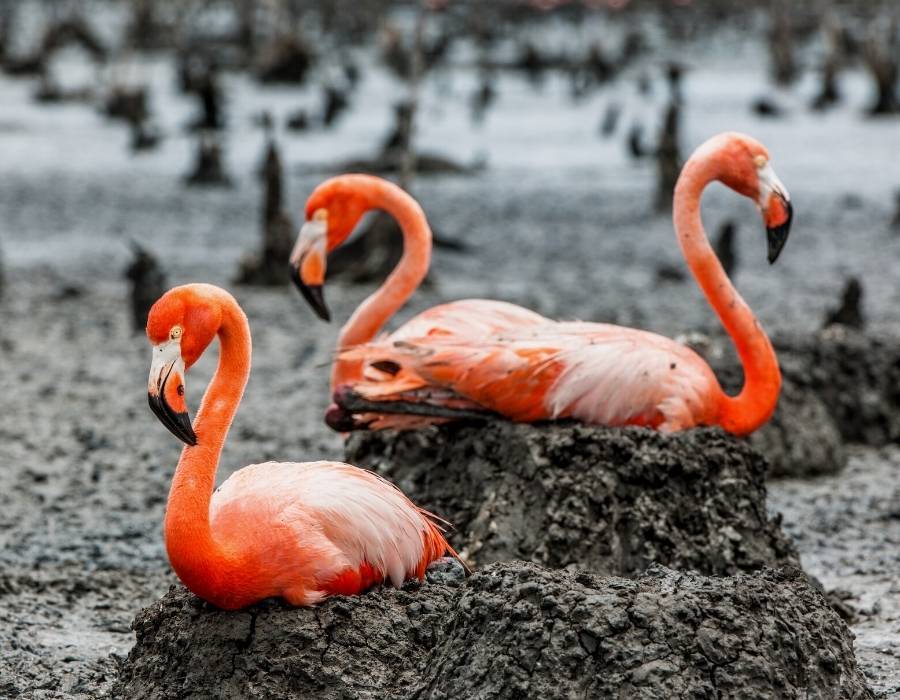
Greater flamingos nest in colonies that can exceed 20,000 pairs at a single site, according to the University of Michigan’s Animal Diversity Web documentation of Phoenicopterus roseus. A flamingo alone is an unusual and stressed animal. The community reading comes directly from this. The species is built for collective life.
The one-legged resting posture, which humans find puzzling and elegant, is a thermoregulation behavior: one leg tucks under the body to conserve heat from the water. The “balance” reading in spirit-animal literature lands here. The bird maintains composure in a physically demanding environment through a specific, practiced stance.
Flamingos can live 30 to 40 years in the wild, sometimes longer in managed care. They feed by holding their bills upside-down and filtering algae and brine shrimp from alkaline water, an environment most birds cannot tolerate. Resilience in hostile conditions is not a metaphor grafted onto the animal. It is what the animal does, every day, in a lake that would burn your skin.
How Has Flamingo Symbolism Evolved in Modern and Popular Culture?
The modern flamingo’s symbolic life is strange and worth tracing. It runs from Roman dinner table to mid-century lawn ornament to contemporary spirit-animal publishing, and the meaning has been re-assigned at each stop rather than carried forward.
The plastic pink flamingo lawn ornament was designed by Don Featherstone for Union Products in 1957, originally as affordable Americana. By the 1970s and 1980s it had picked up a second layer as camp. John Waters used it deliberately in his 1972 film Pink Flamingos. Then a third layer as ironic kitsch, then a fourth as genuine affection, now a fifth as nostalgia object. The bird did not change. The cultural conversation around it did.
Contemporary New Age spirit-animal literature, developed largely in English-speaking countries since the 1980s, brought a different set of readings: balance, sociability, self-expression, the courage to be colorful. These are coherent readings. Some are grounded in real animal behavior, as I noted above. But they should be held as what they are: a late-20th-century construction, not a transmission from antiquity.
Theresa’s leather notebook sits on my desk as I write this, her grandmother’s Bavarian animal stories from the 1920s, written in German cursive on pages that have started to stick together. It does not mention flamingos. Not once. They are not a mountain-forest bird. They are a Mediterranean, African, and South American bird, which is part of why their symbolism is so scattered. No single folk tradition grew up alongside them the way European traditions grew up alongside ravens and owls. The flamingo’s symbolic life is urban, literary, and modern in ways that most animal symbolism writing doesn’t acknowledge. I find that honest, and kind of interesting.
Frequently Asked Questions
What does it mean when you see a flamingo in real life?
Most people encounter flamingos in zoos or wildlife reserves, not the wild. Outside of Florida, the Caribbean, and Mediterranean coastal wetlands, a flamingo sighting is rare enough to notice. In contemporary spiritual practice, the reading is a call toward community and visible self-expression. The more grounded version: flamingos are highly social birds that have survived by committing fully to their flock. Whether that carries symbolic weight in your encounter is a question you get to answer.
Are flamingos considered good luck?
No consistent “good luck” tradition around flamingos appears in the primary historical sources I’ve read. Egypt treats the bird as a color-sign, not an omen. Roman writers used it as a symbol of excess. Contemporary spiritual writing is generally positive, but “good luck” is not the specific framing. In modern Caribbean and South American folk traditions I’ve encountered, the flamingo is more often associated with beauty and vitality than with luck as such. The folk record is thin on this specific question, and I won’t pretend otherwise.
What does a flamingo tattoo symbolize?
Flamingo tattoos carry several layers depending on what the wearer intends. In contemporary body art, the flamingo most often represents standing out, belonging to a chosen community, or surviving difficult conditions with some grace intact. The color pink adds its own layer depending on context: bold visibility, femininity reclaimed, deliberate camp. Some wearers choose the flamingo specifically for its connection to LGBTQ+ iconography. In the end, the meaning of a flamingo tattoo is what the person wearing it brings to it.
What is the symbolic meaning of a flamingo in love and relationships?
Flamingos are genuinely monogamous during breeding season and perform elaborate, synchronized courtship displays as a group before pairing off. This behavioral fact has driven the romantic reading in contemporary symbolism: the flamingo as a symbol of finding your person within your community, of love that happens in public and with intention. But the “flamingo as love symbol” reading is modern. It does not appear in Egyptian or Greco-Roman sources. It is built from the bird’s actual behavior, which makes it more honest than most.
What does a pink flamingo lawn ornament mean?
Don Featherstone designed it for Union Products in 1957 as affordable American kitsch. Over the following decades it accumulated layers: camp, irony, affection, nostalgia. In some contexts, a pink flamingo in the yard signals a sense of humor about suburban conformity. In others, it is a straightforward declaration of affection for mid-century Americana. The ornament’s meaning has been re-assigned so many times that it now functions as a kind of cultural Rorschach. What someone intends by displaying one tells you more than the object itself.
What does a flamingo symbolize in Christianity or the Bible?
Flamingos do not appear in the Hebrew Bible or the New Testament. The birds inhabit Mediterranean and African wetlands, but they were not part of the symbolic vocabulary that shaped Jewish or early Christian writing. Some contemporary Christian symbolism sites draw loose connections between the flamingo’s red-pink color and themes of grace or spiritual warmth, but these are modern constructions with no scriptural grounding. If you’re looking for a bird with documented biblical symbolism, the dove, the eagle, and the raven have far more textual support.
What chakra is associated with the flamingo?
In contemporary chakra-based spiritual practice, the flamingo is most often associated with the sacral chakra (Svadhisthana), linked to creativity, sensuality, and social connection, and sometimes with the heart chakra because of the pink coloration. These associations come from late-20th-century New Age literature rather than classical Indian chakra texts, which predate the modern flamingo symbolism tradition by centuries. I’m not in a position to say which chakra is “correct.” The association is a modern interpretive choice, not a documented transmission from any ancient system.
Is the flamingo a symbol of any particular country or national identity?
The West Indian flamingo (Phoenicopterus ruber) is the national bird of the Bahamas, and the species nests on Inagua, the third-largest island in the Bahamian chain. It appears on Bahamian currency and is deeply tied to national identity there. Cyprus also has a significant relationship with the greater flamingo, which winters at salt lakes near Larnaca in large numbers. In both cases, the national meaning is ecological and civic rather than spiritual. These are birds that belong to the land in a documented, visible way.
What is the difference between flamingo symbolism and phoenix symbolism?
The phoenix is a mythic fire-bird of regeneration: it burns, dies, and rises from its own ashes. That is the whole symbolic narrative. The flamingo is a real animal that acquired symbolic meaning through its color, its social behavior, and its ability to survive in hostile environments. Both share the Greek root phoinix (crimson), which is why modern writers sometimes treat them as connected. But the phoenix tradition is a myth with a defined story arc. The flamingo tradition is built from observation of a living species. Similar in color and root-word. Not the same symbol.
What does it mean if a flamingo is your birth totem?
The concept of a birth totem is primarily drawn from certain Native American traditions, adapted and widely popularized in Euro-American New Age publishing since the 1980s. Flamingos do not appear in most traditional Native American totem systems, which are geographically specific and tied to animals native to particular regions. In the adapted New Age version, a flamingo birth totem is associated with sociability, resilience, and the courage to be visible. Whether you find that useful is a personal question. I’d hold the “birth totem” framing lightly. It’s a modern framework, not an ancient transmission.
Sources
- Wikipedia: Flamingo, general species overview and cultural history
- Online Etymology Dictionary: “flamingo”, word origin and linguistic history
- Wiktionary: phoinikopteros, Greek etymology of the flamingo name
- Animal Diversity Web, University of Michigan: Phoenicopterus roseus, behavioral and ecological data
- BirdLife International: Greater Flamingo species factsheet, range, migration, and breeding documentation
- SpiritualAnimals.com: Flamingo spirit animal, contemporary spirit-animal readings
- Ancient Origins: Flamingos in historical and ancient traditions
- Egypt Mythology: The Bennu Bird, context for Egyptian solar bird iconography
- Animals Around the Globe: The animal that inspired the phoenix myth, flamingo-phoenix hypothesis
- WorldBirds.com: Flamingo symbolism overview
- The Popular Flamingo: Flamingo symbolism in popular and cultural contexts


My favorite bird ?