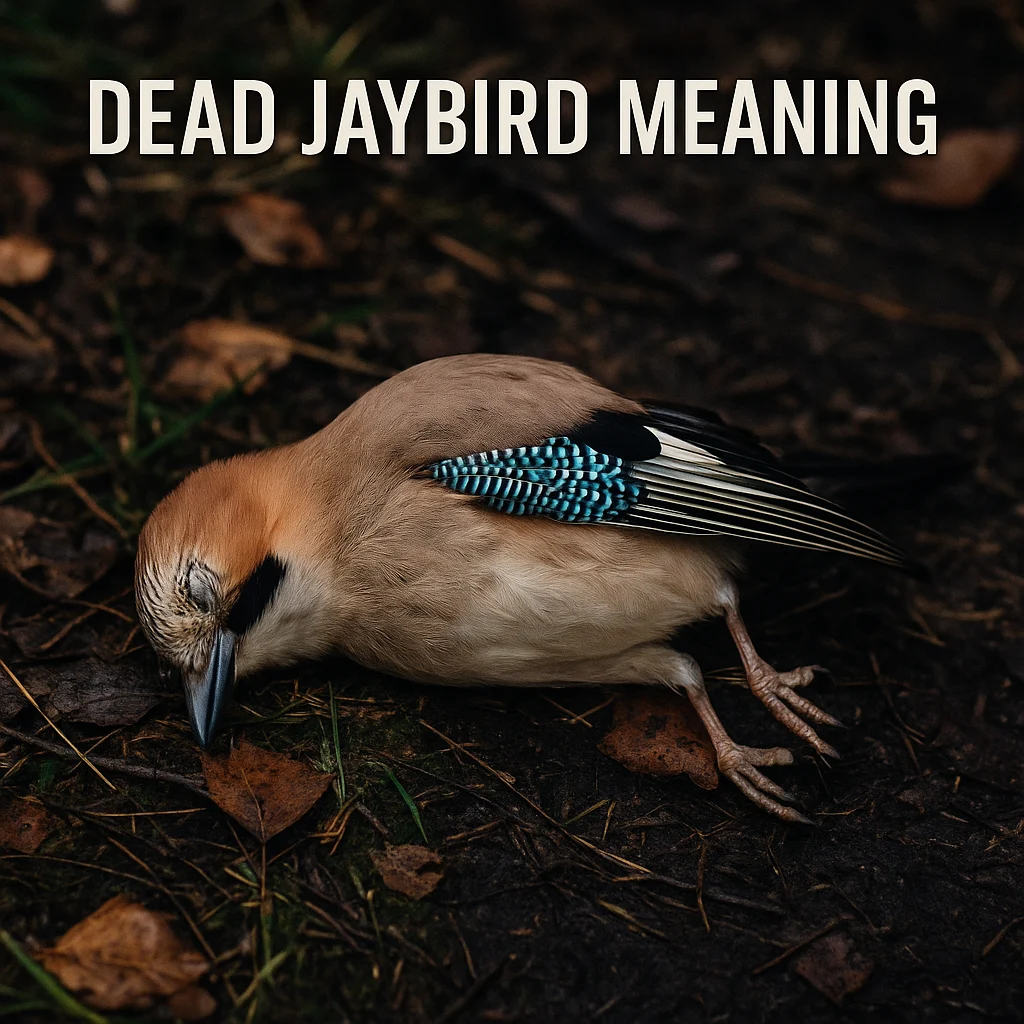
You found a dead jaybird and went straight to Google: does this mean something bad is coming? In African American oral tradition, the jaybird carried its own past mistakes, not yours. What shifts the reading is where it lay, whether it was whole, and what has felt stuck in your life lately. There is a respectful way to move forward.
Key Takeaways
- A dead jaybird is not a straightforward death omen. Most traditions read it as a threshold marker, something restless or unresolved finally going quiet.
- In 19th and early 20th-century African American folk belief from the plantation South, the jaybird was spiritually excluded and morally cautionary. A dead jay amplifies that: something with unresolved consequences has reached its end.
- European literary tradition ties the jay’s death to the silencing of mischief or cunning, something noisy in your social world going still.
- Contemporary neopagan practice reads a dead blue jay as a signal that a protective or communicative force has finished its work, or that your own voice needs attention.
- Location matters more than most people expect. A dead jaybird on a doorstep or windowsill carries different weight than one found in an open yard.
What Does It Mean When You Find a Dead Jaybird?
A dead jaybird marks a threshold. Not a catastrophe. A threshold.
Something loud, restless, or unresolved has reached its end, and the bird is, in the way these things tend to work, the thing your eye landed on at the moment you needed to notice. I want to say that plainly, because the folk record on jays is richer and stranger than the generic “bad omen / transformation energy” split that most searches return.

These birds, Cyanocitta cristata in North America, Garrulus glandarius in Europe, have been read as morally complicated creatures across traditions. Not simply good or bad. Noisy. Watchful. Excluded from certain places. Protective in others. A dead one silences all of that at once.
You are not making this up. The fact that you noticed it is already part of the answer.
Is Finding a Dead Jaybird a Bad Omen?
Not exactly. Or rather, not in the way that phrase usually means.
A bad omen typically predicts something external coming toward you. A dead jaybird reads differently in most of the traditions I’ve found: it points inward, or backward, rather than forward. Something unresolved. Something that needed to end.

The sign is morally ambivalent. The traditions that take jays seriously treat the bird’s death as a moment of reckoning rather than a warning about someone else’s fate. General folk readings of dead birds across cultures lean toward endings and transitions rather than pure misfortune, and the jaybird carries its own layer of moral weight that most generic dead-bird articles skip entirely.
Take a breath. There is no version of this that means you should be afraid.
What Do African American Folk Traditions Say About the Jaybird?
This is the tradition with the most specific, and least flattering, take on the jay. It deserves to be named directly rather than softened.
According to Laura Erickson’s summary of plantation-South lore, the jaybird occupies a troubled spiritual position: in 19th and early 20th-century African American oral tradition, the jay was sometimes described as a bird that could not enter heaven, carrying its sins down to a place of reckoning every Friday. The bird’s constant noise was not celebrated. It was read as the sound of spiritual unease.

Alan Dundes, in his 1973 anthology Mother Wit from the Laughing Barrel, provides broader context for this kind of moral folk taxonomy, in which certain animals serve as warnings about consequence rather than comfort. Within that frame, a dead jaybird doesn’t simply mean “something is ending.” It means something spiritually unresolved has arrived at its reckoning. The noise has stopped. What was owed has been paid.
I read that as a prompt for honest self-examination rather than something to dread. What in your life has been noisy and unresolved? Not a curse. A question.
What Does European Tradition Say About the Jay?
The Eurasian jay is Garrulus glandarius, and that genus name, meaning “chattering,” tells you most of what you need to know before you even open the folklore.
Bird-lens’s survey of the Eurasian jay in literature traces the bird as a figure of cunning, conspicuous beauty, and mischief: the thief of bright objects, the gossip of the hedgerow, beautiful and untrustworthy in roughly equal measure. Edward A. Armstrong, in The Folklore of Birds (Collins, 1958), situates corvids broadly as birds associated with social disruption, birds that see too much and say too much and are rarely entirely welcome. The jay fits this category sideways: too colorful to be purely ominous, too loud to be trusted.

A dead jay in this tradition signals the quieting of something mischievous or scheming in your social environment. The gossip stops. The cunning player leaves the field. Whether that feels like relief or loss probably tells you something about your own relationship to that particular noise.
How Do Contemporary Neopagan and Esoteric Traditions Interpret a Dead Blue Jay?
Modern neopagan and esoteric communities in North America read the blue jay quite differently from the older folk traditions. Here the bird is a protector: bold, loud, and boundary-enforcing in the way that blue jays actually are in the wild.
Anyone who has watched one chase a Cooper’s hawk twice its size knows what I mean. Contemporary practitioners name the blue jay as a guardian of seers, a symbol of truth-telling, and a communicator between the seen and unseen, attributes catalogued in cross-cultural bird symbolism surveys and across neopagan discussion communities.

Within that frame, a dead blue jay carries a specific reading: the guardian has finished its work. Or rather, it signals that the protective role is complete, and that you may now be asked to protect or speak for yourself. Some practitioners read it as a push toward self-expression that has been delayed too long. The bird who spoke loudly on your behalf has gone quiet; the question is whether you can now speak for yourself.
I don’t personally work within this framework. But I find it the most psychologically coherent of the modern readings. It asks something of you rather than simply predicting something at you.
Does the Location Where You Found the Dead Jaybird Change Its Meaning?
Yes. In most threshold-based folk traditions, location carries more interpretive weight than the death itself.
On your doorstep or porch. The threshold is the most symbolically loaded location. In both European and African American folk tradition, the threshold marks the boundary between the domestic and the outside world. A dead bird here is read as something arriving at the border of your life, a conclusion that has come to your door rather than passing you by.
On a windowsill or directly under a window. Window strikes kill birds regularly. A 2014 estimate from the U.S. Fish and Wildlife Service put annual window-strike deaths in the United States between 365 million and 988 million birds, which is a number worth sitting with for a moment. Practically, a jay under your window probably hit the glass. Symbolically, windows have been read across traditions as the eyes of the house, and a dead bird beneath one carries an older resonance about what the house has been witnessing.
Inside the home. This is the location that tends to produce the most distress, and I think that reaction is reasonable. Most folk traditions treat a dead bird inside the house as more significant than one found outside. If a cat brought it in, that changes the practical explanation but not necessarily the symbolic one, since the cat is also a creature of the threshold in many traditions.
In the open yard, away from any structure. The plainest reading. Birds die in yards for ordinary reasons. The symbolic weight is lower here, though not absent.
What Should You Do After Finding a Dead Jaybird?
Practically: use gloves or a plastic bag to pick it up. Do not handle any dead bird with bare hands. You can bury it in the yard if you have one, a few inches down, away from places where dogs dig. Some people prefer to wrap it in a paper bag and put it in the trash, and there is nothing disrespectful about that.
My grandmother Theresa kept a leather notebook of animal lore from the Bavarian Forest, and one thing that runs through nearly every entry is a small gesture of acknowledgment before moving on. Not a ritual. A pause. She would have said stop, look at it, say something true. That instinct is old and it costs you thirty seconds.
If you want to cleanse the space afterward, salt across the threshold, open windows for a few minutes, whatever your practice includes, do that. If you don’t have a practice, cleaning the spot where the bird lay is sufficient. The action matters more than the specific form.
Frequently Asked Questions
Is a dead jaybird different in meaning from a dead blue jay?
In the United States, “jaybird” and “blue jay” usually refer to the same bird, Cyanocitta cristata. “Jaybird” is older and shows up more in Southern and Appalachian speech, which is also where the plantation-South folklore about the bird’s troubled spiritual status comes from. In Europe, “jay” refers to Garrulus glandarius, a distinct species. So the name difference reflects regional speech more than a meaningful distinction, but if you are looking at the African American folk tradition specifically, “jaybird” is the term the lore uses, and that carries its own weight.
What does it mean if a jaybird dies on your porch specifically?
The porch and doorstep are threshold spaces, the border between your private world and the outside, and most folk traditions treat them as symbolically heightened locations. A dead bird at your threshold is generally read as a conclusion arriving at the boundary of your life. In the African American plantation-South tradition documented by Laura Erickson, this would carry the jaybird’s specific moral weight: something with unresolved consequences has reached its end. I read that as an invitation to look at what has been sitting unresolved in your own life, not as a warning about something coming toward you.
Does finding a dead jaybird mean someone close to me will die?
No tradition I have found specifically makes that connection for jaybirds. Generic dead-bird lore sometimes gets read that way, but the jaybird’s symbolic history points inward and backward, toward moral reckoning and restless things finally going quiet, not toward predicting the deaths of others. The folk record on this specific bird does not support a death-prediction reading. If you found it on the same day someone in your life died, that is a different kind of experience, and the coincidence is real and worth honoring. But the bird did not cause it.
What does it mean if a jaybird flies into my window and dies?
Window strikes are the most common cause of wild bird deaths near homes. The U.S. Fish and Wildlife Service estimates hundreds of millions of birds die this way every year. So the practical explanation is nearly always the right one. Symbolically, windows have been read across folk traditions as the eyes of a house, the place where the inside and outside see each other, and a bird that dies at that specific boundary is sometimes read as a moment of heightened attention, something trying to get through that didn’t quite make it. Whether that means anything for your situation is something only you can judge.
Can a dead jaybird be a message from a deceased loved one?
I don’t personally believe animals carry messages from the dead, and I think it’s worth saying that plainly. What I do believe is that grief sharpens attention, and that a grieving person who sees a bird and feels something is not wrong to feel it. The experience is real even if the mechanics I’d assign to it differ from what some traditions claim. If the bird felt like a message from someone you’ve lost, sit with that rather than arguing yourself out of it. The meaning you make from the encounter is yours to make.
Is there a difference in meaning if the bird appears injured versus already dead?
I think so, though the folk record is thin here and I won’t pretend otherwise. An injured bird that you find while it is still alive introduces agency, yours and the bird’s. You can act. You can bring it somewhere. What you do next becomes part of the encounter in a way that finding something already still does not. An injured blue jay, in the neopagan frame, might be read as a guardian asking for help rather than departing. A bird already dead has already completed whatever it came to complete. The emotional texture of the two encounters is genuinely different.
What should I say or do spiritually after finding a dead jaybird?
You don’t need a script. Stop for a moment before you move the bird. If you want to say something out loud, say something true. Thank you is enough. Bury it if you can, even shallowly, rather than bagging it, though bagging is fine if that’s what you have. If you want to cleanse the space, salt across the threshold or open a window for a few minutes. What matters is that you paused and paid attention. The action is the meaning, not the specific words.
Does the time of year or season affect the meaning of finding a dead jaybird?
In practical terms, yes. Blue jays are year-round residents in most of North America, but fall migration brings them through in larger numbers, and window strikes increase when birds are moving. Finding a dead jay in October is more likely to have an ordinary cause than finding one in July. Symbolically, the season adds texture but doesn’t change the core reading. Autumn carries its own associations with endings across most Northern Hemisphere traditions, so a dead jay in fall lands in already-prepared emotional soil. Spring is harder, and I think that harder feeling is worth paying attention to on its own terms.
Sources
- Laura Erickson, “Blue Jays in American Folklore and Jaybelline Eye Cosmetics”
- Bird-lens, “The Eurasian Jay in Literature: A Symbol of Beauty and Mischief”
- Peck & Perk, “Dead Bird Meaning: Spiritual and Cultural Interpretations”
- FeatherSnapCam, “Bird Symbolism in Different Cultures”
- Wikipedia, “Jay” — taxonomy and species overview