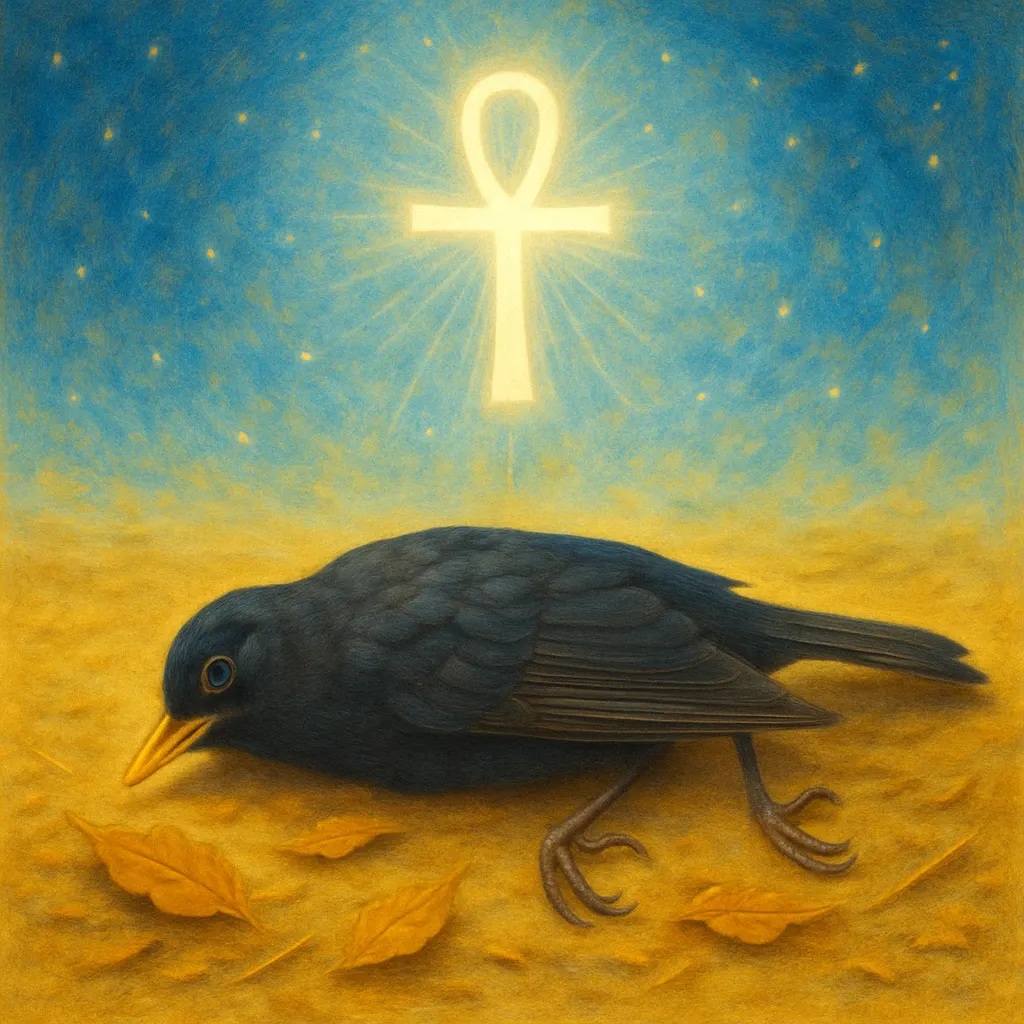
You see the blackbird motionless on your doorstep, and dread floods in before you can think. In Old Irish verse, the blackbird sang at the Otherworld’s edge as a messenger between worlds, not a harbinger of your death. But whether it fell at your threshold or sang from the garden oak changes everything about what it came to tell you.
Key Takeaways
- A dead blackbird reads across most European folk traditions as a marker of transition or ending, not a forecast of death.
- In Celtic and Welsh tradition, the blackbird is an Otherworld threshold singer; its death near you sharpens that liminal quality rather than delivering a death sentence.
- English and Lowland Scottish folklore, documented by Edward A. Armstrong in The Folklore of Birds (1958), connects odd blackbird behavior near the home to household omens. Routine encounters follow general omen rules, not a fixed formula.
- In Christian tradition, the blackbird’s role is spiritual shadow and temptation, not prophecy.
- You can respond to this practically and symbolically without alarm. Both options exist and neither one requires certainty about what happened.
What Does a Dead Blackbird Mean?
The short answer: a marker of transition, not a forecast of death. But “transition” is not vague comfort-speak. It names something specific. The blackbird in Irish and English folk thought was always a bird of edges: garden walls, hawthorn thickets, the hour before full light. Its death near you sharpens that edge quality. Something is ending. Something is shifting. The folk record is fairly consistent on that, even when it isn’t comfortable.
What it does not consistently say is that someone close to you will die. I’ve read that claim repeated across a dozen sources, and I don’t trust most of them. The traditions that do link a dark bird near the house to household death are specific about context: the bird must be behaving strangely, repeatedly, at the window or threshold. A single dead blackbird in the yard is a different thing from a blackbird tapping at glass three mornings running.

Your stomach dropped before your brain caught up with what you were seeing. That instinct is not irrational. It is older than rationalism, and it is worth taking seriously.
What Do Celtic and Welsh Traditions Say About the Blackbird and Death?
The Celtic and Welsh material is more careful than the word “Otherworld” usually suggests, and I want to be precise here because that word gets thrown around. According to Proinsias Mac Cana’s Celtic Mythology (Thames and Hudson, 1970), birds perched on hawthorn trees or at the edges of water in early Irish narrative reliably signal proximity to the Otherworld. Not death, exactly. A threshold. A place where ordinary rules of time and mourning suspend.
The Old Irish poem Lon Dubh Loch Lao, “The Blackbird of Belfast Lough,” places a blackbird singing on a thorn-bush at the edge of a lake. The poem is not a death omen. It is a meditation on the contrast between mortal transience and something that abides. The bird sings at the edge. The human listener stands on this side of it. That is the whole poem, more or less.

In the Welsh Mabinogion, the birds of Rhiannon sing so sweetly that warriors forget time, grief, and the passage of years. Mac Cana and other scholars of Welsh medieval literature identify these birds as blackbird-type songbirds mediating between mortal sorrow and something beyond it. The blackbird here is not warning you. It is holding a door open.
So a dead blackbird, read through this frame: the threshold singer has gone quiet. Something that stood at the edge between what was and what comes next has moved. That is change with weight behind it. Not catastrophe.
What Does English and Scottish Rural Folklore Say About a Dead Blackbird?
Edward A. Armstrong’s The Folklore of Birds (Collins, 1958) is the best single source I’ve found for sorting out which beliefs have real documentation behind them. Armstrong records that the blackbird held two distinct reputations in rural England: a welcome herald of spring and good weather when first heard singing, and a potential ill omen when it behaved oddly close to the home, fluttering repeatedly at a window, entering the house uninvited, appearing in an unusual place near the threshold.
The key word is “oddly.” Jacqueline Simpson and Steve Roud’s A Dictionary of English Folklore (Oxford University Press, 2000) makes the same distinction: the household death beliefs attach to strange behavior, not to finding a dead bird in the garden during migration season. Blackbirds die in ordinary ways. Window strikes kill an estimated 600 million birds per year in North America alone, according to a 2014 study in the Condor: Ornithological Applications. Most dead birds at the base of a window are there because of glass, not because a house was marked.

But I won’t dismiss what you felt. Placement mattered in these traditions, and it matters now. A blackbird found dead directly at your threshold, your door, your step, the entry only you use, carries more weight than one found in the far corner of the lawn. Armstrong records that liminal locations amplified whatever bird omen was being read. That hasn’t changed as a framework, even if the theology behind it has mostly dissolved.
What Does Christian Tradition Say About the Blackbird as a Spiritual Messenger?
Here the bird’s meaning shifts almost entirely. Pope Gregory the Great’s Dialogues, written in the late sixth century, recounts a story about St. Benedict at prayer: a small black bird came close to his face, hovering. Benedict recognized it as a demonic illusion, made the sign of the cross, and the bird vanished, followed immediately by a violent temptation. In the monastic tradition that grew from this account, the blackbird became an emblem of intrusive thought, carnal temptation, and spiritual danger. Not death. Not prophecy. Shadow.
This matters for understanding how the “blackbird as dark omen” idea spread through European folk culture. The bird tapping at the window in eighteenth-century English rural belief was drawing, at least partly, on this older Christian association with something unwelcome pressing close. The modern “shadow work” readings of a dead blackbird, the ones that frame it as an invitation to look at what you’ve been avoiding, trace their line back here, through the monastery more than through the forest.

I find that reading honest. Not because I’m particularly Christian, but because the shadow interpretation doesn’t promise you something terrible is coming. It asks what you’ve been not-looking-at. That is a harder question, and a more useful one.
What Does It Mean When a Dead Blackbird Appears Near Your Home?
Location matters. Near the home, the threshold reading sharpens. The Celtic, English, and Christian threads converge on this same point: a dead or strange bird at your door was read as a sign that something from the other side of a threshold, death, change, the unseen, your own interior life, was pressing close.
Armstrong’s survey and the Simpson and Roud record both make this clear: the threshold location was specifically what elevated a bird encounter from a passing omen to a household one. A blackbird dead in the road meant almost nothing in nineteenth-century English folk belief. A blackbird dead on the step, or found at the window you face every morning, was different.
So if you found yours at the door, or beneath the window you open first thing: the old traditions would say to pay attention to what is ending in your life right now. Not as a warning. As a question worth sitting with. What are you standing at the edge of?
And if you found it in the middle of the lawn or driveway: it probably flew into something. The Turdus merula, to use its Latin name for a moment, is one of the most common birds in Britain and Ireland, with a breeding population of roughly five million pairs as of the RSPB’s 2021 survey. They die in ordinary places. The location is what shifts the reading, not the fact of the death itself.
What Should You Do After Finding a Dead Blackbird?
Practically: don’t touch it with bare hands. Use gloves or a plastic bag turned inside out. Wild birds can carry salmonella and other pathogens. Bury it or bag it for yard waste disposal. If you want to bury it, a few inches of soil in a garden corner is enough.
Symbolically: you don’t need to perform a ritual unless that genuinely feels right to you. What most traditions actually recommend, when you strip away the ceremony, is acknowledgment. You saw the bird. You noticed it. You took a moment. That is already the response the old beliefs were pointing toward. Not a formula. Attention.
Frequently Asked Questions
Is a dead blackbird a sign that someone will die?
No, not reliably. The English and Scottish folk beliefs that connect a dark bird to household death are specific: the bird must be behaving strangely near the home, repeatedly, at a window or threshold. A single dead blackbird in the yard does not meet that threshold in the documented traditions. According to Simpson and Roud’s A Dictionary of English Folklore (2000), the death-omen reading requires unusual behavior, not simply a dead bird. Finding one is unsettling. It is not a forecast.
What does it mean if a blackbird dies on my doorstep specifically?
Location sharpens the reading. In eighteenth and nineteenth-century English rural belief, the threshold, your door, step, window sill, was where household omens concentrated. A bird found dead at your doorstep carries more weight, in those traditions, than one found in the far end of the yard. I read it as a marker of transition in something close to your home life, not a warning about an external event. Something is ending or shifting near the center of your daily world. That is worth sitting with.
Does the number of dead blackbirds change the meaning?
Honestly, I don’t have a confident answer here. The folk record is thin on numbers for blackbirds specifically. General European bird-omen traditions do treat repeated encounters differently from single ones. If you’re finding dead blackbirds repeatedly in the same spot over days or weeks, first check for a practical cause: a window strike zone, a neighborhood cat, a local disease cluster. If no practical explanation fits, the traditional reading would treat the repetition as amplification. The signal is louder, not more catastrophic.
What does it mean spiritually if a blackbird flies into a window and dies?
Window strikes kill hundreds of millions of birds every year in North America alone. Most are accidents of glass and reflection. But in the folk traditions that attach meaning to threshold behavior, a bird striking the window was among the most commonly recorded household omens, documented in both Armstrong’s Folklore of Birds and regional English collections. The window is the eye of the house. A bird hitting it and dying was read as something pressing against the boundary between inside and outside. A knock. Not a sentence.
Is there a difference in meaning between a male and female blackbird found dead?
The documented folk traditions I’ve found don’t make this distinction consistently. The male’s solid black plumage is what gave the bird its name and its association with shadow and the Otherworld in Celtic material. A female blackbird, brown and speckled, resembles a thrush more than a “blackbird” in the symbolic sense. My honest read is that the folk record was built around the male. If you found a brown bird and weren’t certain of the species, the reading may not apply in the same way. If you’re certain it was a female blackbird, I’d treat the symbolism similarly but hold it a little more loosely.
What should I do if I keep seeing dead blackbirds repeatedly?
Start with the practical. A single window strike zone can kill multiple birds in the same location over weeks. A neighborhood cat with hunting territory. A local disease event. These are real and common. If no practical cause explains it, the traditional reading would treat repetition as a sustained signal: something at a threshold in your life is asking for attention over time, repeatedly and persistently. What is it? The old traditions would say you probably already know, even if you’re circling around it rather than looking at it directly.
Does finding a dead blackbird mean a loved one is sending a message?
I don’t believe that personally. I think the mind reaches for meaning in animals because it is wired to, and that the reaching tells you something true about what you need even when the bird is just a bird. If you’re grieving and found a blackbird today, the connection you’re feeling is real. But I’d locate it in you, not in the bird as carrier. The Celtic tradition I trust most on this frames the blackbird as a threshold marker, not a messenger. It marks where you’re standing. It doesn’t carry letters from the other side.
Sources
- Proinsias Mac Cana, Celtic Mythology (Thames and Hudson, 1970)
- Edward A. Armstrong, The Folklore of Birds (Collins, 1958)
- Jacqueline Simpson and Steve Roud, A Dictionary of English Folklore (Oxford University Press, 2000)
- Pope Gregory the Great, Dialogues (late 6th century), St. Benedict episode, Book II
- Old Irish poem Lon Dubh Loch Lao (“The Blackbird of Belfast Lough”), cited in Mac Cana (1970)
- Welsh Mabinogion, Birds of Rhiannon passages, discussed in Mac Cana, Celtic Mythology (1970)
- Richard Alois, “Blackbird Meaning and Symbolism”, richardalois.com