In ancient Egypt around 1750 BCE, tomb-makers placed hedgehog amulets in burial chambers to guard the dead and bring them back to life. That choice reveals the hedgehog was never just cute, it was a shield people trusted with their souls. Whether you read its spines as armor or its curling as rebirth depends on which culture shaped your idea of it first.
Key Takeaways
- Hedgehog symbolism is culturally specific and sometimes contradictory, not a single global message of luck or healing.
- Its strongest documented meanings are protection and rebirth (ancient Egypt), clever tricks and sneaky plans (Brothers Grimm), being in between two worlds and changing shape (northern Chinese folk religion), and seasonal renewal (Irish folklore and observable biology).
- The apple-carrying image comes from Pliny the Elder’s first-century CE Naturalis Historia and was repeated in medieval art. Hedgehogs don’t actually carry fruit on their spines.
- The hedgehog’s hibernation cycle, disappearing for months and returning in spring, is the credible natural basis for Egyptian rebirth symbolism, not a spiritual invention.
- Totem and dream readings are most useful when grounded in these specific traditions, not assembled from generic spiritual-website language.
What Is the Core Spiritual Meaning of Hedgehog Symbolism?
Across the traditions that documented it carefully, hedgehog symbolism clusters around three ideas: protection through self-containment, cyclical return after disappearance, and the power of the small and underestimated. These are not abstract concepts someone invented for a spirit-animal quiz. They map directly onto the animal’s observable behavior, the spine-ball defense, the months-long hibernation, the nocturnal habits that made it seem to vanish and return.
The Egyptian amulet-makers read that biology as protective power. The Irish read it as seasonal wisdom. The Brothers Grimm’s Low German source material read it as cunning. Different emphases on the same creature. None of them adds up to the blanket claim that hedgehogs mean abundance or universal good fortune.

The symbol is only as good as what the tradition that made it actually observed. And the hedgehog earns its symbolic weight honestly. It just earns something more specific than most popular writing allows.

What Do Hedgehog Behavioral Facts Reveal About Its Symbolic Power?
The symbolism is not arbitrary. The RSPCA’s 2026 species guidance records that West European hedgehogs typically hibernate from October or November through March or April. During that torpor, body temperature drops dramatically, metabolism slows to a near stop, and the animal is effectively invisible to the world for four to five months.
That disappearance and return, seasonal, reliable, observable, is exactly what Egyptian funerary symbol-makers were working with when they placed hedgehog amulets in tombs. You don’t need to invent supernatural meaning when the biology already provides a credible image of death and return.
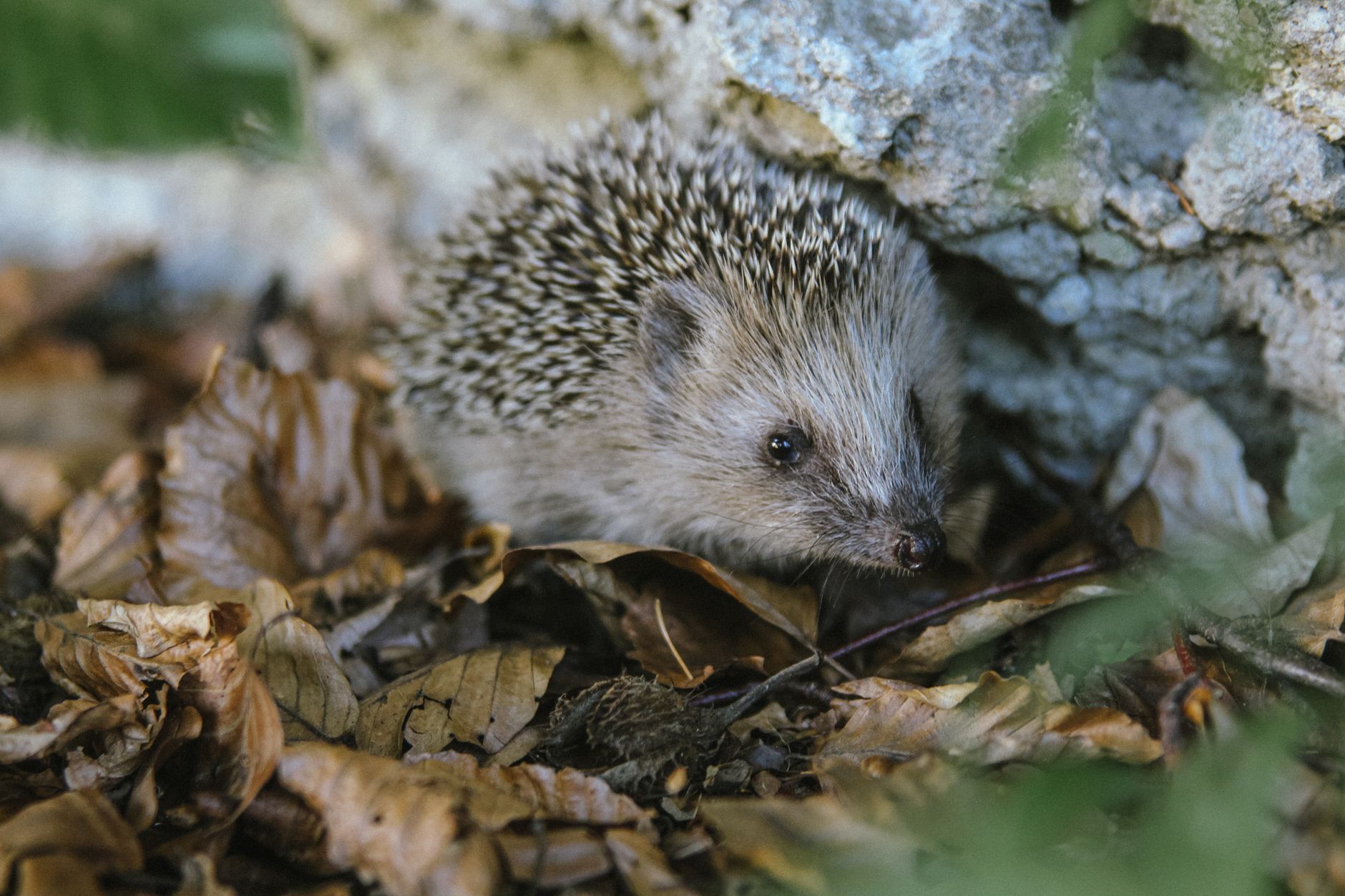
The lifespan data adds another layer. According to the People’s Trust for Endangered Species’ 2022 hedgehog factsheet, wild British hedgehogs average about two years of life, with only a small proportion reaching five. A short, precarious life for an animal that survives entirely on wit and spines. The combination of physical vulnerability and effective defense is, I think, the most honest foundation for the protective symbolism. Not that the hedgehog is invincible, but that it makes the most of what it has.

What Did Ancient Egyptian Religion Say About the Hedgehog?
Ancient Egyptian hedgehog amulets appear from the Predynastic period through the New Kingdom, a span of roughly three thousand years. That’s a long time for any symbol to persist, and it argues for something more than casual association. The hedgehog’s ability to survive in harsh desert terrain around cemeteries, and its habit of retreating underground and re-emerging, connected it in the Egyptian religious imagination with endurance and cyclical return from apparent death.
The Art Institute of Chicago’s 2025 exhibition essay on animal amulets is careful on this point: the exact meaning of hedgehog amulets remains debated. The essay identifies plausible associations with defensive power and rebirth but stops short of claiming a formally worshipped hedgehog deity. That caution is worth respecting. The Metropolitan Museum holds a Middle Kingdom hedgehog amulet dated approximately 1750–1700 BCE; the museum record notes the animal may have been valued precisely because it thrived in the desert terrain surrounding Egyptian burial grounds.

So: protective, regenerative, apotropaic (meaning thought to ward off harm). Not a fertility symbol, not a luck charm, not a major deity. An amuletic image attached to survival in dangerous ground and return from apparent disappearance.

What Does Chinese Folklore Say About the Hedgehog as a Household Spirit?
In northern Chinese folk religion, the hedgehog (ciwei, 刺猬) belonged to a category of animal spirits capable of assuming human form and attaching themselves to households. This tradition belongs especially to local spirit cults and zhiguai literature, the “tales of the strange” genre that flourished in late imperial China. It is not a single standardized doctrine, and it should not be read as a China-wide belief.
Aleksandr Mazo’s 2020 study, “Were-Hedgehogs in Chinese Texts of the 10th–19th Centuries” in Folklore: Structure, Typology, Semiotics, identifies hedgehog narratives in Taiping guang ji, Taiping yu lan, and Li Qingcheng’s 1892 Zuicha zhiguai. In Tianjin specifically, the white hedgehog connected with a household cult thought to bring prosperity and eventually attain a form of immortality through sustained devotion. The animal in these stories is uncanny, capable of shapeshifting, and occupies a threshold position between the wild world and the domestic one.

This tradition supports themes of in-between spaces, household protection, and transformation. But it does not support the modern claim that every hedgehog encounter is a benevolent prosperity sign. The ciwei spirit in these texts could be generous or disruptive depending on how it was treated. The relationship required care.
What Does Irish Folklore Say About the Hedgehog?
Irish folk tradition held two somewhat incompatible views of the hedgehog, and both are worth knowing. Documented Irish oral tradition treated the hedgehog’s emergence around St Brigid’s Day on 1 February as a weather sign, roughly the same function as the North American Groundhog Day tradition that descended from it. A hedgehog that retreated back underground suggested continuing cold; one that remained above ground pointed to a mild spring. Practical seasonal observation dressed in folk belief, not supernatural prophecy.
On the other hand, hedgehogs were accused in Irish rural folklore of stealing cow’s milk, especially around May Eve, and were sometimes suspected of being witches in animal form. This suspicion contributed to actual persecution of the animals. The Irish language also preserves the proverb cnuasach na gráineoige, “the hedgehog’s store,” for something impossible to find, a thing that doesn’t exist. I don’t know the exact origin of that proverb, but it suggests Irish speakers saw the hedgehog as secretive and unreliable as much as they saw it as a weather prophet.

Neither simply positive nor simply negative. It’s the record of people trying to make sense of a nocturnal, spiny animal that appeared and disappeared with the seasons and seemed to operate by rules nobody fully understood.
What Does the Brothers Grimm Tale “The Hare and the Hedgehog” Reveal About Its Symbolic Meaning?
The 1843 Brothers Grimm tale “Der Hase und der Igel” is a Low German literary folktale in which the hedgehog defeats the faster hare in a race by planting his wife at the finish line. The hare runs the course over and over; the hedgehog always appears to have won, because there is always a hedgehog already there. The hare eventually collapses from exhaustion.
The symbolic force here is not speed, not physical strength, not divine favor. It’s planning, local knowledge, and the willingness to work with what you have rather than what you wish you had. The hedgehog wins because it understands the terrain and thinks ahead. The hare loses because it assumes its advantages will be enough.
A social and strategic moral, not a spiritual doctrine. It should not be generalized into a universal “hedgehog vibration” of cunning or trickster energy. It is one story from one place, collected by scholars doing early German folklore work, and it reflects the values of the rural Low German communities it came from: ingenuity, cooperation, not letting the fast and arrogant have everything their way.
What Does the Etymology of “Hedgehog” Tell Us About Its Symbolic Associations?
The word hedgehog is late Middle English, recorded in forms like heyghoge around the fifteenth century. The Oxford University Press etymology blog traced the compound in April 2026: hedge for the hedgerow habitat, hog for the pig-like snout. The animal was named for where it lived and what it looked like.
That’s useful to know, because the modern habit of reading “hedge” as a threshold or boundary symbol, and therefore the hedgehog as a “threshold guardian,” is an etymological backformation, not a medieval belief.
The older English names are interesting in their own right: urchin, hedgepig, fuzzpeg. French calls it hérisson, German Igel, Irish gráinneog. Each name traces a different set of human observations. The German and Irish names have no “hedge” in them at all, which makes the boundary-symbol reading even more specifically English than it might appear. The hedgerow habitat does embed the animal in an ecology of edges and margins, places between field and forest, between the cultivated and the wild. That’s a real cultural association. It arrived through geography, not medieval symbolic intent.
What Are the Most Persistent Myths and Misconceptions in Hedgehog Symbolism?
Three misconceptions appear repeatedly in popular hedgehog symbolism writing, and all three are worth correcting directly.
First: hedgehogs do not actually carry apples, grapes, or mushrooms on their spines. Pliny the Elder’s Naturalis Historia (c. 77 CE) described a hedgehog rolling over fallen fruit to impale it and carry it home. Medieval manuscript illustrators repeated this image enthusiastically. It was a literary natural-history error, not an observation. Contemporary species guidance describes the hedgehog as an insectivorous omnivore that forages for invertebrates, worms, and other food on the ground. No fruit impalement.
Second: hedgehog symbolism is not universally positive across cultures. The Irish accused hedgehogs of milk theft and witchcraft. The ciwei household spirit in northern Chinese folk tradition could be disruptive as well as beneficial. The Egyptian amulet record is about protection against danger, not abundance or happiness.
Third: ancient Egyptians did not worship the hedgehog as a major deity. The amulet evidence is real and substantial, but as the Art Institute of Chicago noted in 2025, the exact meaning is debated. Protective funerary object is the most defensible reading. Formal cult deity is an overreach the museum evidence doesn’t support.
What Is the Hedgehog as a Spirit Animal or Totem?
I want to answer this carefully, because I think the symbolism is most useful when it’s grounded in what the actual traditions documented rather than assembled from general “energy” language.
If the hedgehog has shown up repeatedly for you, in dreams, in the wild, in images you keep returning to, here is what the documented traditions actually suggest it stands for. Defense through self-containment: the spine-ball response is not aggression, it’s a complete withdrawal into the self until the threat passes. That’s a different kind of strength than attack. The Egyptian funerary tradition valued exactly this, the ability to survive in hostile terrain by becoming temporarily impenetrable.
Patient strategy over brute force. This is what the Grimm tale encodes. The hedgehog doesn’t try to outrun the hare. It thinks. If this animal keeps appearing in your awareness, the tradition most worth sitting with is probably the one that asks: where in your life are you trying to win through speed or size when what’s actually needed is a better plan?
Cyclical retreat and return. The hibernation pattern is the deepest and most consistent symbolic fact about the hedgehog across every culture that encountered it. Disappearing is not failure. Coming back from apparent absence is the hedgehog’s primary survival skill. If this symbol has meaning for you, that’s the one I’d start with.
What Does It Mean to Dream of a Hedgehog?
Dream readings for the hedgehog tend to follow the same symbolic threads as the waking traditions. A curled hedgehog in a dream, fully balled up and spines out, most often connects to themes of self-protection and guardedness. The question worth asking after that dream is not “am I safe?” but “what am I protecting, and is that protection still serving me?”
A hedgehog moving freely through a garden or field maps more closely to the seasonal renewal reading: something dormant becoming active, something hidden ready to surface. A dream in which you are pricked by a hedgehog’s spines carries the Chinese ciwei resonance more than the Egyptian one, contact with something uncanny, an encounter that required more care than you gave it.
I’ll say plainly that dream interpretation is thin ground for certainty. The folk record is thin and the academic record is thinner. What these symbolic traditions offer is a vocabulary for thinking about the dream, not a fixed translation of it.
How Has Hedgehog Symbolism Appeared in Literature and Media Over Time?
Pliny the Elder set the template in 77 CE: the fruit-carrying hedgehog, industrious and clever, preparing for winter. Medieval European manuscripts picked this up and illustrated it with evident delight, images of hedgehogs laden with grapes and apples appear in illuminated books across several centuries, entirely divorced from any actual hedgehog behavior but very satisfying as an image of small-creature ingenuity. The animal was projecting human virtues back at the reader: industriousness, foresight, thrift.
The Grimm tale gave the hedgehog its most enduring European literary role: the clever underdog. The twentieth century then did something slightly odd with the symbol.Beatrix Potter’s Mrs. Tiggy-Winkle (1905) transformedthe hedgehog into a domestic figure, maternal, tidy, comforting.And then the 1990s gave theworld Sonic the Hedgehog, whose symbolic meaning is essentially pure speed, which is about as far from the actual hedgehog’s character as it’s possible to get.
Each era, as Ancient Origins has noted in its overview of hedgehog folklore, projected its own anxieties and values onto the same small animal. The ancient world saw survival and endurance. The medieval world saw industriousness. The modern world alternates between cozy domesticity and frenetic speed. The actual hedgehog, nocturnal, solitary, quietly insectivorous, living two years on average, is somewhere underneath all of that.
What Symbolic Lessons Does the Hedgehog Offer for Modern Life?
Three things, grounded in the traditions above rather than invented for the occasion.
The hedgehog’s defense is not a wall. It’s a temporary posture that the animal exits when the threat is gone. Knowing when to curl up and when to move again is the skill. The Egyptian reading valued this as survival in dangerous terrain. It translates reasonably well to knowing which situations genuinely require retreat and which require re-engagement.
The Grimm moral is about local knowledge over general speed. The hedgehog wins because it knows its own ground better than the hare does. If this symbol has caught your attention, the question it raises is practical: what do you know about your own terrain that you’re not using?
And third, the one I think is most honest: the hedgehog is a short-lived animal that disappears for months and comes back. The tradition that made the most of that fact was Egyptian funerary practice, people sitting with death and finding in this small, spiny, unremarkable creature a reason to believe in return. That’s not nothing. It’s not a guarantee. But it’s a real thing that real people found in this animal for three thousand years, and that’s worth something even without the supernatural scaffolding.
My grandmother Theresa kept a leather notebook of animal lore from the Bavarian Forest. Hedgehogs don’t appear in it, as far as I can tell, the pages are German cursive and some have stuck together over the years. But the posture she brought to every animal in that book was the same: take the creature seriously before you take the symbol. The hedgehog earns that.
Frequently Asked Questions
Is a hedgehog a symbol of good luck?
In some specific traditions, yes, but not as a universal rule. In northern Chinese folk religion, the white hedgehog was associated with a household spirit that could bring prosperity, as documented in Aleksandr Mazo’s 2020 study of were-hedgehog narratives in late imperial Chinese texts. In Irish tradition, a hedgehog seen around St Brigid’s Day on 1 February was sometimes read as a sign of mild weather ahead. Neither reading is a blanket luck-charm. In British rural folklore, hedgehogs were also suspected of stealing milk and consorting with witches, which is not luck by any measure.
What does a hedgehog symbolize in the Bible?
The hedgehog appears in several Bible translations as a creature associated with desolate or ruined places. The Hebrew word qippod, translated variously as “porcupine,” “bittern,” or “hedgehog” depending on the version, appears in Isaiah 14:23 and Zephaniah 2:14 in descriptions of abandoned cities returning to wilderness. The association is desolation and the reclamation of human-built spaces by wild things, not protection or luck. I should note that the exact Hebrew species identification is debated among biblical scholars.
What does it mean when a hedgehog crosses your path?
There is no strong or consistent folk tradition I know of that assigns a fixed meaning to a hedgehog crossing your path, the way black cat crossings were codified in Western superstition. The hedgehog in Irish folklore was more significant as a seasonal marker than as a path-crossing omen. In practical terms, a hedgehog crossing your path at dusk or dawn is simply doing what hedgehogs do, they travel surprising distances each night, sometimes a mile or more. If you are looking for meaning in the encounter, the traditions that support it most honestly are the ones about seasonal return and patient movement through familiar ground.
Are hedgehogs considered sacred in any culture?
“Sacred” is a strong word, and I’d use it cautiously here. Ancient Egyptian culture produced substantial evidence of hedgehog amulets placed in tombs and worn as personal charms across roughly three thousand years. The Metropolitan Museum of Art records a Middle Kingdom hedgehog amulet dated approximately 1750–1700 BCE. The Art Institute of Chicago’s 2025 essay on Egyptian animal amulets identifies plausible protective and regenerative associations. Whether “sacred” is the right word depends on how you define it; “amuletically significant” is more defensible than “formally worshipped.”
What does a hedgehog symbolize in Quillwork traditions?
The European hedgehog is not nativeto North America.The species familiar from European folklore, Erinaceus europaeus, is absent from the Americas entirely, so there is no authentic indigenous North American tradition of hedgehog symbolism built on encounter with this animal. Some North American porcupine symbolism occasionally gets conflated with hedgehog readings in popular spiritual writing, but porcupines and hedgehogs are unrelated animals. If you have read that hedgehogs carry specific meaning in Lakota, Cherokee, or other Native traditions, I’d treat that claim with real skepticism and look for a named primary source before accepting it.
What is the difference between hedgehog symbolism in Eastern and Western cultures?
The sharpest difference is what each tradition noticed. Western traditions, Egyptian, Irish, Low German, tended to read the hedgehog through its defensive behavior (spines, balling up) and its seasonal disappearance and return. Protection, cunning, and cyclical renewal are the dominant Western themes. Northern Chinese folk tradition, by contrast, focused on the hedgehog’s uncanny quality and its capacity for shapeshifting into human form. The ciwei household spirit in Tianjin-area folklore was an in-between figure, capable of attaching to a family and conferring prosperity, but also capable of disrupting it. The Eastern record is more interested in transformation; the Western record is more interested in endurance.
Why is the hedgehog associated with witches in British folklore?
Several practical reasons combined to make the hedgehog suspect in British rural tradition. It was nocturnal, which already placed it in the category of things that operated while honest people slept. It appeared mysteriously and disappeared into the undergrowth. It made unusual sounds, hedgehogs produce a range of grunts and snuffles that could seem strange to someone who had never heard one before. The accusation that hedgehogs suckled from cows’ udders (which they cannot do, anatomically) was widespread enough that it contributed to active persecution, as The Conversation’s 2024 piece on hedgehog persecution history documents in detail.
What does a white hedgehog symbolize?
According to Aleksandr Mazo’s 2020 study of Chinese were-hedgehog texts, the white hedgehog held particular significance in the Tianjin-area household spirit tradition. A white hedgehog was associated with a spirit of higher status, one that had lived long enough to accumulate power and advance toward something like immortality. In European traditions, albino or unusually pale animals have historically been treated as rare and therefore significant, though I don’t know of a specific documented British or Irish folk tradition that assigned fixed meaning to white hedgehogs as distinct from white animals generally.
Is the hedgehog a symbol of introversion or sensitivity?
This is a modern psychological reading rather than a traditional one, and it’s worth naming as such. The hedgehog’s defensive curl and its solitary, nocturnal habits do make it a reasonable metaphor for introversion, the person who needs to retreat before re-engaging, who has a soft interior protected by an exterior that looks off-putting. That mapping is intuitive and I don’t think it’s wrong. But it is a contemporary interpretation built on observable behavior, not a traditional symbolic doctrine from any particular culture. Use it if it resonates. Just know it’s a metaphor you’re constructing, not one you’re inheriting.
How do I know if the hedgehog is my spirit animal?
I’m not the right person to tell you that, and I’d be wary of anyone who claims they can. The concept of a spirit animal as a personal spiritual guardian comes primarily from specific indigenous North American traditions that most of us reading this article don’t belong to. If you’re drawn to the hedgehog as a personal symbol, if its qualities of patient defense, strategic thinking, and cyclical return feel like something you’re working with or aspiring to, that’s a legitimate way to use the symbolism. The traditions that support it most honestly are the ones documented in this article. Start there, rather than with a quiz.
Sources
- Aleksandr Mazo, “Were-Hedgehogs in Chinese Texts of the 10th–19th Centuries,” Folklore: Structure, Typology, Semiotics, 2020
- Metropolitan Museum of Art, “Hedgehog Amulet,” Middle Kingdom, c. 1750–1700 BCE (record updated 2022)
- Art Institute of Chicago, “Animal Amulets: Ancient Egyptian Art and the Natural World,” 2025
- People’s Trust for Endangered Species, “Hedgehog,” 2022
- RSPCA, “Hedgehogs in the UK,” 2026
- Oxford University Press, “Hogs, Hedges, Hedgehogs,” OUP Blog, April 2026
- The Conversation, “Why Hedgehogs Used to Be Hated,” 2024
- Wildlife Matters, “Hedgehogs in Folklore,” episode 064
- Ancient Origins, “Luck or Misfortune? Hedgehogs in Folklore and Tradition”
- Art Institute of Chicago, “Scaraboid in the Form of a Hedgehog” (collection record)
- Woodland Trust, “Hedgehog Species Guide”
- www.edp24.co.uk
- www.bbc.co.uk
- wol.jw.org
- animaldiversity.org
- www.iucnredlist.org