

A black-and-white feather signals being stuck between choices, but old stories disagree. In Chinese and Scottish tradition, the magpie itself brings luck or bad news based on how many you see, not the feather alone. A single feather’s meaning depends on context, did you find it or see the bird first?
Key Takeaways
- Black-and-white feathers are read across traditions as threshold markers: you are between two states, and the feather names that place.
- The meaning is strongly culture-dependent. English and Scottish folk traditions lean toward warning and ambiguity; Han Chinese folk religion reads the same bird as a herald of joy.
- The species matters. A magpie feather, a woodpecker feather, and an osprey feather carry different histories and different folk associations.
- The pattern on the feather, white tip on black, black tip on white, half-and-half, polka dots, shifts both the identification and the symbolic nuance.
- Repetition changes the weight. Most grief traditions and folk systems read a feather found more than once as deliberate, not random.
What Is the Meaning of a Black-and-White Feather?
A black-and-white feather means you are at a threshold. That is the one reading that holds across traditions that otherwise disagree sharply. Black has stood for the unseen, the night, what we haven’t yet understood. White has stood for clarity, spirit, what comes after. Together in one object, those two colors encode something that shows up in nearly every folk system that pays close attention to birds: this is a moment between states.
I want to be honest about what I can and can’t offer here. A single fixed meaning that applies to every person who finds one, I don’t have that. What I can tell you is that people have been finding black-and-white feathers and attaching meaning to them for a very long time, across cultures that never had contact with each other, and the central theme is consistent. Duality. Balance. A message from somewhere between the visible and the invisible.

The specific meaning, good news or warning, grief or joy, protection or change, depends on which tradition you’re standing in, which bird left the feather, and what’s happening in your life right now. This article works through all of that.
What Does the Black-and-White Color Combination Symbolize Spiritually?
In folk systems from very different parts of the world, stark two-tone contrast in a bird marks it as something between categories. Not quite of this world, not quite of the next.
Carl Jung wrote about shadow andlight as two halves of a whole self, neither one good nor bad on its own. He wasn’t writing about feathers, but the structure is the same. Black is not evil in that framework. It is what we haven’t yet seen. White is not safety, it is what has been made visible. The feather that carries both is a visual shorthand for holding opposites together.

In color symbolism recorded across European, East Asian, and African traditions, white feathers are almost universally associated with the spirit world, with ancestors, with what persists after death. Black feathers with mystery, protection, the night side of things. A feather that is both is doing more than one thing at once.
You’re not losing your mind for feeling that.
What Do English Rural Traditions Say About Black-and-White Feathered Birds?
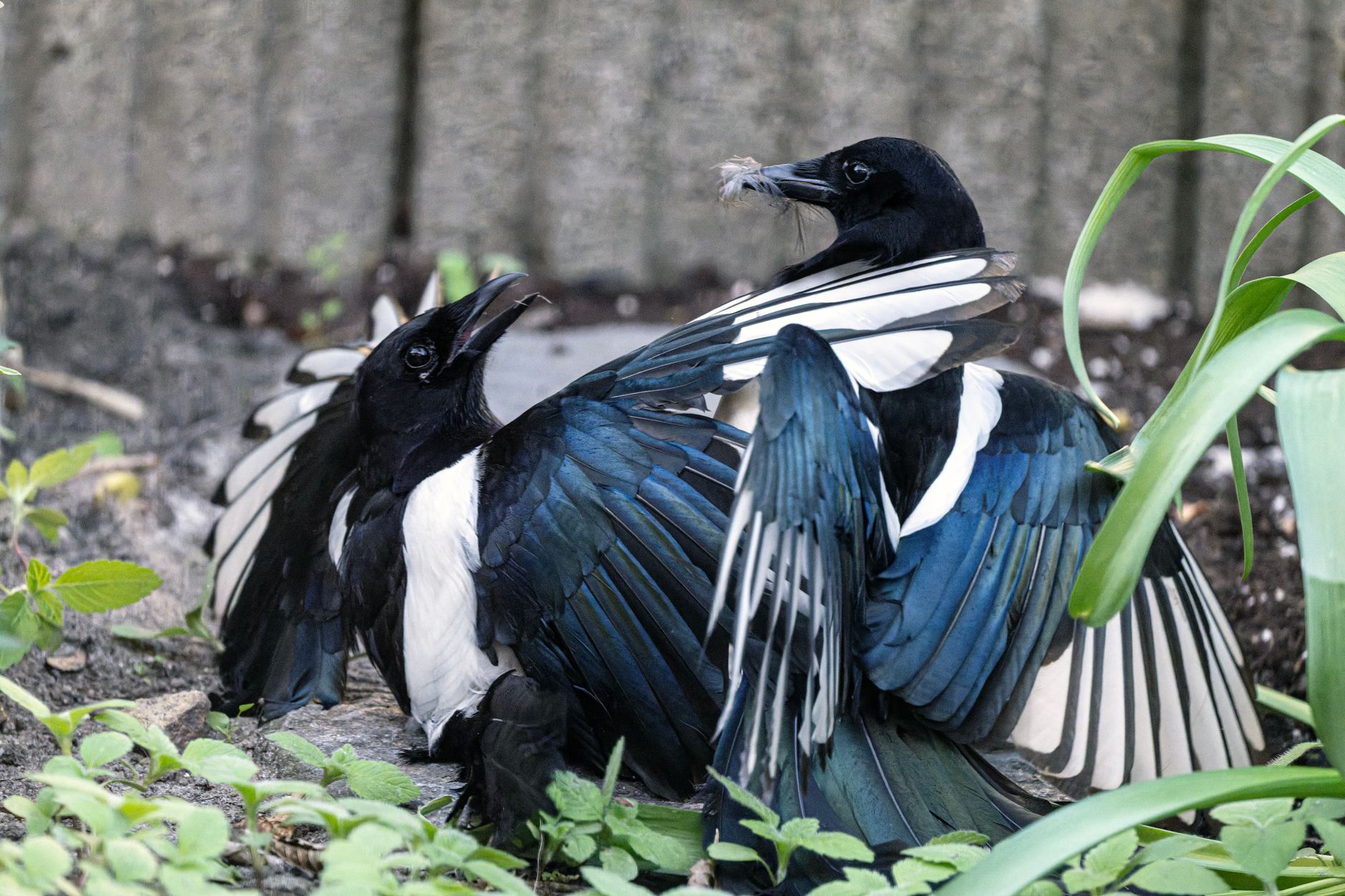
In English rural tradition, the bird that defines black-and-white feather lore is the magpie, and its meaning is more complicated than most “bad omen” summaries suggest.
The counting rhyme, “One for sorrow, two for joy, three for a girl, four for a boy,” is not simply a list of bad luck. It’s a fortune-telling system. You count what you see and read from there. According to documented English magpie folklore, a single bird spotted near the house or at a threshold was the trigger for concern. Two together meant the opposite. The tradition was not about the magpie being cursed. It was about paying attention to how many.

Simpson and Roud’s Oxford Dictionary of English Folklore (Oxford University Press, 2000) records the ritual responses to a lone magpie as some of the most widespread vernacular superstitions in England: greeting the bird by name (“Good morning, Mr. Magpie, how are Mrs. Magpie and all the little magpies?”), saluting it, spitting over the left shoulder, crossing oneself. These were not passive responses. Active negotiations with an omen that hadn’t finished speaking yet.
The bird also carried a Christian shadow in some English tales, the only bird that refused to enter Noah’s Ark, the only one that did not weep at the Crucifixion. English magpie superstition was built partly on that narrative: the bird exists slightly outside the order of things, which is why it knows what other birds don’t.
What Does Scottish Highland and Lowland Folklore Say About Black-and-White Birds?
Scottish tradition takes the English magpie’s ambiguity and leans hard into the dark end. In Highland and Lowland communities documented by John Gregorson Campbell in Superstitions of the Highlands and Islands of Scotland (James MacLehose, 1900), the magpie was sometimes called “the devil’s bird” outright, said to carry a drop of Satan’s blood under its tongue, which explained its chatter, its restlessness, its tendency to appear at the worst moments.
A magpie at the window. A magpie on the roof of a house where someone was already sick. These were not neutral sightings in Campbell’s records. The protective responses were more urgent than English practice: crossing oneself, spitting three times, carrying an onion as an apotropaic object to counteract the bird’s influence.

And yet, even within Scottish tradition, the magpie was not simply evil. Campbell’s records also document it as a messenger, a bird that arrived when the threshold between the living and the dead was already thin. The darkness in the Scottish reading is not cruelty. It is seriousness. The bird shows up because something is happening that deserves your attention.
If the feather you found arrived during a time of grief or illness, Scottish tradition would say: yes. A marker. Not a verdict.
What Does Han Chinese Folk Religion Say About Black-and-White Feathered Birds?
This is where the same bird, the same black-and-white plumage, flips completely.
In Han Chinese folk religion, the magpie (xǐquè, 喜鹊) is a herald of joy. The name carries it: the character xǐ means happiness or good news. The bird’s name is the message. According to Han decorative arts and folk religion documentation, hearing a magpie call in the morning meant a good visitor was coming, a letter was on the way, or something long hoped-for was about to arrive.

This made it into Chinese decorative arts in a big way. Magpies appear on wedding textiles, porcelain, and jade carvings paired with plum blossoms or the character for double happiness. Two magpies facing each other is one of the most recognized auspicious patterns in traditional Chinese visual culture. The same bird that English rural tradition watched with narrowed eyes was, in Han folk religion, exactly what you wanted to see.
I find this useful to hold in mind when someone asks me whether a black-and-white feather is good or bad. The honest answer is: it depends on which grandmother’s tradition you’re standing in. Both readings are old. Both have been lived seriously by a lot of people. Neither is wrong about the weight of the encounter.
How Do Other World Traditions Interpret Black-and-White Feathers and Birds?
Japanese and Korean traditions share some of the Chinese magpie’s positive reading. In Korean folk belief, the magpie (까치, kkachi) is a bird of good news, its call on New Year’s morning was considered a sign the year would go well.In Japan, magpies appear in thelegend of Tanabata as bridge-builders: they form a living bridge across the Milky Way so that two separated lovers, Orihime and Hikoboshi, can meet once a year. The black-and-white bird as connection across separation. As bridge between worlds.
Among various Plains peoples of North America, the magpie’s boldness, it follows large animals, scavenges at kills, moves without fear near humans, made it a watcher and a talker in traditions that read animal behavior closely. I want to be careful here. I am not a scholar of those traditions, and I am not Cherokee or Lakota. What I can say is that in many traditions that attend to birds as messengers, the bird that moves between the living and the dead without flinching is the one that gets assigned the task of carrying word across.

In some South Asian traditions, pied plumage in sharp contrast has been associated with the sacred and the set-apart. The pattern itself, not just the species, doing symbolic work.
What Kind of Bird Left a Black-and-White Feather, and Does the Species Change the Meaning?
Yes. The species changes the meaning, and it also helps you figure out what you actually found.
The most common sources of black-and-white feathers in the UK and Europe are the magpie, the great spotted woodpecker, the pied wagtail, and the oystercatcher. In North America, you are more likely holding a feather from a black-and-white warbler, a downy or hairy woodpecker, a common loon, an osprey, or a black-billed magpie.
Magpie feathers are long and iridescent, the black shifts to green or blue in sunlight. If the feather has that oil-slick sheen, it’s almost certainly a magpie. The whole body of omen lore above applies most directly here.
Woodpecker feathers, downy or hairy, are smaller and show a black-and-white barred or spotted pattern. The downy woodpecker is about the size of a sparrow; the hairy is larger but identical in coloring. Woodpeckers appear in several traditions as birds that knock on the boundary between the living and the dead. The knocking behavior got translated into folk belief early and stayed there.
A bird with a red head and black-and-white feathers is almost certainly a woodpecker: the red-headed woodpecker, the pileated, or (in males) the downy or hairy with their red cap patches. The red-headed woodpecker has a fully red head and stark black-and-white body, one of the most visually striking birds in eastern North America. If you found a feather from one, it likely carries the woodpecker’s messenger symbolism with added intensity from the red, which in many folk systems signals urgency.
Osprey feathers are large, with a white base and dark barring or a dark tip. If the feather is big, soft, and white with a dark brown edge, osprey is a strong candidate.
Black feathers with white polka dots or spots most often come from guinea fowl (if you’re in or near farm country), a spotted towhee, or occasionally an escaped helmeted guineafowl. Guinea fowl feathers are unmistakable: small, dark grey-black with even white spots, like dark fabric scattered with white stars.
One practical note: under the Migratory Bird Treaty Act in the United States, it is illegal to possess feathers from most wild birds without a permit, magpies included. If you want to keep what you found, check your local regulations first.
What Does the Pattern on a Black-and-White Feather Mean?
The pattern is worth looking at closely. It shifts both the identification and the meaning.
A feather that is half black, half white, divided cleanly down the middle or across the shaft, is the most direct encoding of duality you can hold in your hand. In traditions that read feathers as messages, this one says: you are between two things. A decision, a transition, a change that hasn’t resolved yet. Finding it is not a push toward resolution. It is permission to stay in the in-between a little longer.
A white feather with a black tip most commonly comes from a seabird, gannet, tern, certain gulls, or the wing of a larger wading bird. In folk terms, white-bodied with dark-tipped reads as primarily a light message with a shadow at the edge. Many people who find this feather while grieving read it as: mostly okay, with an acknowledgment that it still hurts. I don’t think that’s wrong.

A black feather with a white tip reverses it: mostly in the dark, but light at the end. This comes from a magpie’s tail feather, or from a corvid. The white tip is the signal. Whatever you’re going through, this is not where it ends.
Black feathers with white polka dots point almost certainly to guinea fowl or a very worn spotted woodpecker feather. In folk traditions, spotted or dappled markings on a bird were sometimes read as a sign that the boundary between realms was particularly porous, the spots themselves as windows.
Where you found the feather matters too. One found at a grave, at the threshold of the house, or in a place that carried meaning to someone you lost carries more weight in grief traditions than one found in a parking lot. Not because the parking lot feather is lesser. Because the other location has already been loaded with meaning by you.
What Is the Spirit Animal or Totem Meaning of Black-and-White Feathered Birds?
If the magpie or woodpecker has been showing up repeatedly, the bird itself, beyond just a feather, many traditions read that as a longer-term relationship rather than a single message.
The magpie as a totem bird is associated with people who are comfortable holding contradictions. Intelligence that borders on cunning. The ability to find what is valuable in what others overlook. The “magpies steal shiny objects” reputation is largely a myth, studies have found they’re actually wary of new objects, not drawn to them. What is true is that they are highly social, they remember faces, and they are among the very few non-mammal species that recognize themselves in a mirror. If the magpie is your bird, you are probably someone who sees yourself clearly, even when that is uncomfortable.
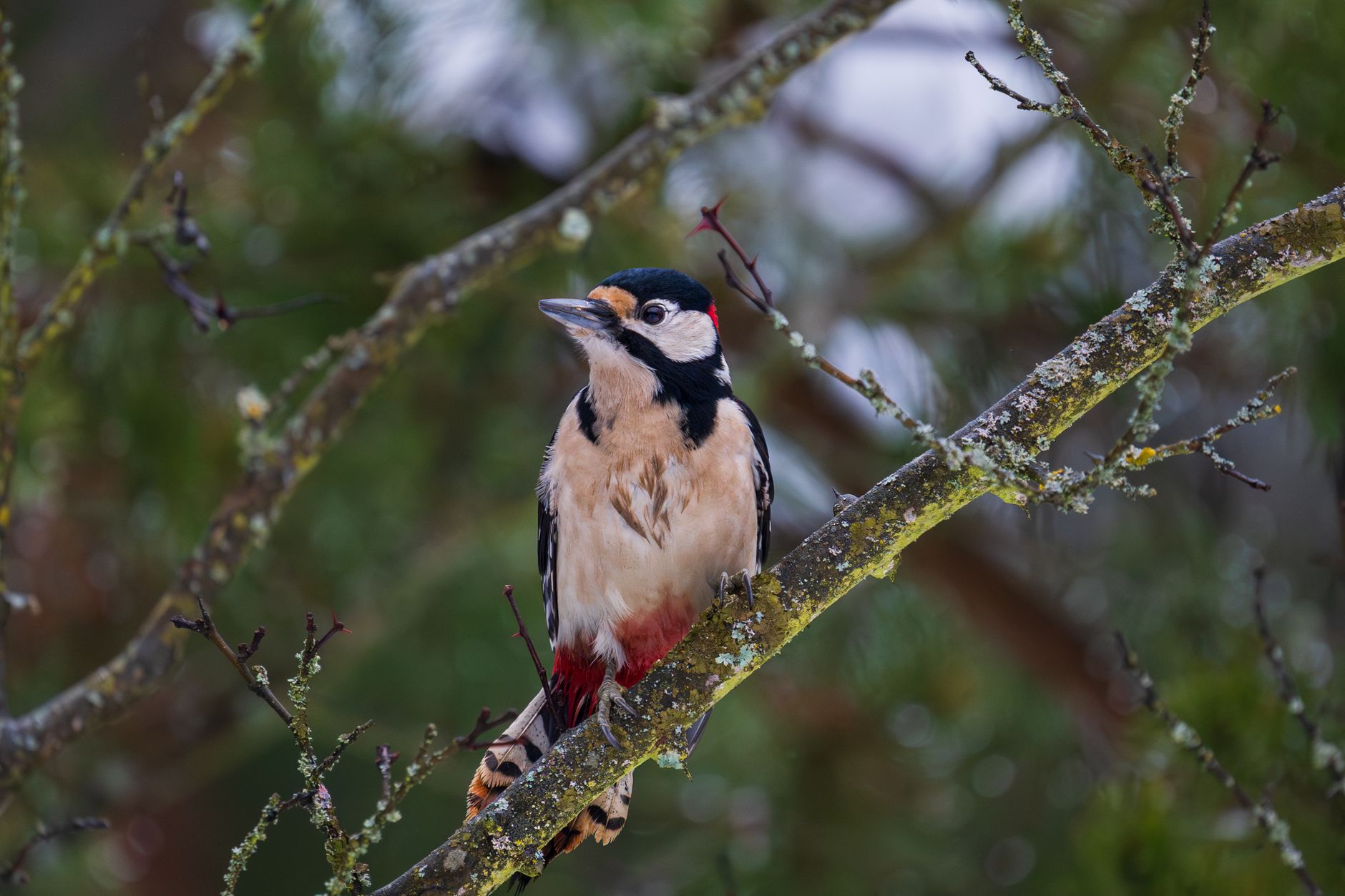
The woodpecker as a totem is about persistence and rhythm. Woodpeckers drum to communicate, territory, mating calls, presence. A pileated woodpecker in the hand is not scared of you. It is busy. If one keeps appearing for you, the folk tradition across several cultures says the same thing: keep going. The knocking is the message.
For people whose loved ones felt an affinity with black-and-white birds, who kept a picture of a magpie, who always pointed one out, the totem reading becomes personal. The animal that meant something to the person who died becomes the vehicle through which that person seems to return. I don’t think this is projection, exactly. Or rather, I don’t think it matters whether it’s projection. The encounter is real. The feeling it carries is real.
What Do Black-and-White Feathers Mean in Dreams?
Dreaming of a black-and-white feather floating down, or finding one in your hand, or being given one by someone, these tend to carry a specific feeling: calm. Not neutral. Calm. The dreamers who describe these often wake up feeling that something has been settled, or that someone has been near.
In Jungian terms, the black-and-white feather in a dream is an image of integration, the unconscious offering a picture of two things held together that the waking mind has been struggling to reconcile. Grief is a primary context for this. The person is gone and also, somehow, present. The feather in the dream holds both without contradiction.

If the feather was given to you by someone you have lost, most grief traditions would say: receive it. Write down what they said, if they spoke. Write down how you felt when you woke. That feeling is the message, not the color of the feather.
If you want to go deeper on dream symbolism specifically, white feather dream meaning covers related territory in more detail, including the history of white feathers as spirit-contact signs across grief traditions.
What Does It Mean to Keep Finding Black-and-White Feathers?
Once is a feather. Twice is something to notice.
Three times, and most people stop calling it coincidence, not because they are foolish, but because pattern recognition is one of the most fundamental things a human mind does. And a mind in grief is finely tuned for it.
In English rural tradition, repetition of an omen changed its weight significantly. A single magpie at the window was a concern. A magpie at the same window three mornings running was considered a direct address. The bird was trying to tell you something specific, not something general.
In grief traditions across cultures, repeated feather-finding, especially when the feathers appear in places that feel intentional, near photographs or graves or favorite chairs, is read as contact. Whether you call that heaven, the universe, spirit, or the part of love that does not end, it is real to the people who experience it. “Yesterday a white feather floated down from nowhere, and I knew it was my guardian angel,” one griever wrote (via Psychology Today). Another: “I lost my daughter earlier this year and kept asking for a sign. One day I looked outside the back door hoping, and there was a white feather on top of a plant pot.”
Talking back is allowed. So is sitting in silence. If you have been finding these feathers and wondering whether to speak, to say the name, to say thank you, to say “I know it’s you”, you are allowed. You are not losing your mind.
Frequently Asked Questions
Is finding a black-and-white feather good luck or bad luck?
It depends entirely on which tradition you’re asking. In English rural folklore documented by Simpson and Roud, a single magpie feather leaned toward caution, but two together meant joy was coming. In Han Chinese folk religion, a black-and-white magpie feather is straightforwardly good news. I don’t think the feather itself is either good or bad. It’s a threshold marker. What you do at a threshold is up to you.
What angel is associated with black-and-white feathers?
The most commonly cited association in Christian-influenced grief traditions is Archangel Gabriel, the messenger, whose iconography often includes white feathers and whose role is to carry word between the divine and the human. Black-and-white feathers appear in some Catholic and Protestant folk traditions as signs that a guardian angel is near. I’ve seen this claimed widely but I can’t point to a single authoritative theological source that establishes it, it seems to have developed through popular devotional practice rather than formal doctrine.
What does a black feather with a white tip mean specifically?
A black feather with a white tip most commonly comes from a magpie’s tail, a corvid’s wing, or, near the coast, certain seabirds. In folk terms, the white tip on a dark feather is read as light at the end of something dark. Many people who find this feather during a hard time read it the same way: not that the difficulty is over, but that the end is visible. The white is at the tip. You are moving toward it.
What bird has black feathers with white polka dots?
The most likely candidate in both North America and Europe is the guinea fowl, a domestic bird that often escapes farm settings, with small grey-black feathers covered in even white spots. If the feather is very small, a spotted towhee or a juvenile European starling (which has white-tipped feathers creating a spotted effect in winter plumage) is possible. The great spotted woodpecker in Europe has some white spotting on black wing feathers. If you found something that looks like dark fabric scattered with white stars, guinea fowl is the first place I’d look.
What does a half-black, half-white feather mean?
A feather divided cleanly between black and white is the most direct visual image of duality you can hold in your hand. In traditions that read feathers as messages, this one says: you are between two things. A threshold, a decision, a change still in progress. It’s not telling you to choose. It’s acknowledging that you are in the place where the choice lives. Many people find this one during transitions, after a death, after a relationship ends, during the period when nothing has settled yet.
Is a black-and-white feather a sign from a deceased loved one?
Many grievers believe it is, and I’m not going to tell them they’re wrong. The folk record across English, Scottish, Chinese, Korean, and Japanese traditions all treats the birds that carry black-and-white plumage as messengers between the living and the dead. A feather from one of those birds, arriving at a meaningful moment, has been read as contact for a very long time by people who were not naive about it. Permission is part of the gift, you are allowed to believe what your heart already knows.
What does it mean when a black-and-white bird lands near you?
A bird that lands close and stays, that looks at you directly, that doesn’t startle when you move, is read differently from a bird passing overhead. In English folk tradition, a magpie that came close and held its ground was considered to be delivering a specific message rather than a general omen. The closer the bird, the more personal the address. If a black-and-white bird landed near you in a significant place or during a moment of grief, most traditions that attend to birds would say: it came to you. That distinction matters.
Do black-and-white feathers have different meanings in different religions?
Yes, significantly. In Christian folk practice, white feathers and by extension black-and-white feathers are often associated with angels and the presence of the Holy Spirit. In some strands of folk Islam, birds near the grave or home of the recently deceased are read as the soul returning. In Shinto practice, certain birds near shrines are treated as divine messengers. In Han Chinese folk religion, the black-and-white magpie signals joy. I don’t know of any major religious tradition that treats black-and-white feathers as purely negative, even the darker Scottish folk readings treated the bird as a messenger, not an enemy.
What should you do with a black-and-white feather you find?
First, check local regulations. In the US, most wild bird feathers are protected under the Migratory Bird Treaty Act, and possession without a permit is technically illegal for many species, including magpies. Rules differ in the UK and other jurisdictions. Feathers from domestic birds (guinea fowl, for instance) carry no restriction. For many grievers, keeping the feather somewhere meaningful, near a photograph, on a windowsill, inside a journal, is the most natural response. There is no prescribed ritual. You can hold it, speak to it, or simply let it sit where it feels right.
Does the size of the feather affect its spiritual meaning?
I don’t have a confident answer here. The folk record is thin on size as a variable, most traditions attend to color, species, number, and location before they attend to size. What I can say is that a large feather from a large bird tends to feel like a more deliberate message to the person who finds it, simply because it’s harder to overlook. Whether that reflects something real in the tradition or something real in the finder’s attention, I genuinely don’t know. Both seem worth taking seriously.
What does it mean to find black-and-white feathers repeatedly in different places?
Repetition changes the reading in most folk systems. A single magpie sighting was a concern; three mornings in a row at the same window was considered a direct address. Finding black-and-white feathers in different locations over days or weeks, especially in places that carry personal meaning, is read in grief traditions as sustained contact rather than a one-time message. The locations themselves may be worth noting. Some grievers keep a small record of where and when, not to prove anything, but because the pattern, once written down, often tells them something they already half-knew.
Sources
- British Trust for Ornithology, Magpie Bird Facts
- Magpie Folklore, Legends, and Superstitions, Haeretico
- The Magic of Magpies, Night Walks (2026)
- Magpies and Superstition, Birdspot
- Magpie Motif in Chinese Decorative Arts, Koh Antique
- How to Salute a Magpie, Country Life
- The Folklore of Magpies, Owlcation
- The Magpie: A Much Misunderstood Bird, The Scotsman
- Magpies: A Story of Seven, Order of Bards, Ovates & Druids
- Magpie, The Wildlife Trusts
- Simpson, J. & Roud, S. Oxford Dictionary of English Folklore. Oxford University Press, 2000.
- Campbell, J.G. Superstitions of the Highlands and Islands of Scotland. James MacLehose, 1900.
- scienceinsights.org
- www.nao.ac.jp



Good lecture
Amazing information thank you for sharing ?