

In Roman times, augurs watched starling flocks to read omens, tracking how they moved and turned. When you see a flock wheel as one body now, you’re watching what those observers saw. But whether that unified motion speaks for your community or warns of forces beyond your control splits the old readings in two.
Key Takeaways
- Starlings primarily symbolize community, voice, adaptability, and collective intelligence, not individual guidance.
- Roman augurs documented starling flocks as omens in formal divination practice, one of the few bird species named specifically in that tradition.
- The murmuration, thousands of birds turning as one, carries its own spiritual meaning, distinct from a single starling sighting.
- A dead starling signals the close of a social cycle, not a personal curse; the folk reading points toward renewal of connections rather than loss.
- The shadow side of starling symbolism is real: noise without meaning, and losing yourself in the crowd.
What Does a Starling Symbolize?
Community, adaptability, communication, collective intelligence. Those four are the core, and they aren’t arbitrary, they come from what the bird actually does.
The European starling is one of the most social birds on earth. Rarely alone. Capable of learning and mimicking dozens of sounds. Able to coordinate with thousands of others in flight with no visible leader directing any of it.

That last part is what keeps pulling people back. A murmuration isn’t a flock following someone. Every bird responds to its seven nearest neighbors, and the result looks like a single organism making decisions. That’s not a metaphor I’m adding, it’s the structural reality of the behavior. Across traditions, the common thread is that the starling represents something you can only do together.
What Is the Spiritual Meaning of Seeing a Starling?
Seeing a starling is generally read as a prompt to look at your social bonds, who you’re moving with, and whether the group you’re in is actually coordinated or just loud.
A single starling showing up near you is sometimes read as a messenger asking about your people: are you isolated when you shouldn’t be, or tangled in a group that isn’t moving toward anything? The broader reading, starlings as signs of purposeful belonging, shows up in British and Continental European folk belief documented by Edward A. Armstrong in The Folklore of Birds (1958, Collins). Armstrong records starlings as weather omens and social indicators in rural communities, where their arrival in numbers meant the season was turning and people needed to prepare together.

It’s usually less about a personal message and more about where you stand in relation to others. Not a warning. A question.
What Did Ancient Cultures Believe About Starlings?
Roman augurs, the priests whose job was to read omens in bird behavior, paid specific attention to starling flocks. Pliny the Elder records observations of starling flock behavior in Naturalis Historia as part of the Roman practice of auspicy. The flock’s movement, direction, density: these were data. A tight, fast-moving flock toward the city meant one thing; a scattered, low flock meant another.
The Romans weren’t being mystical about this. They were being careful observers of a bird that responds to atmospheric conditions before humans can detect them, barometric pressure, wind shifts, approaching storms. The Audubon Society’s account of how starlings spoke to the gods of ancient Rome documents how seriously Roman civic life took these readings. The god’s will arrived through the birds because the birds knew things the priests didn’t.
In Celtic folk tradition, starlings were linked to the Otherworld as shape-shifting messengers, birds whose ability to mimic any voice made them natural go-betweens for the living and the dead. I don’t have a scholarly source on the specific Celtic starling tradition that’s as well-documented as the Roman record. The folk record here is thin, and I’d rather say so than dress it up.
What Does European Folklore Say About Starlings?
British folk belief, documented by Armstrong, held that starlings arriving in unusual numbers before winter signaled a hard season ahead, useful agricultural information dressed in the language of omen.
In Germanic tradition, starlings carried associations with trickery and mimicry: a bird that could sound like anything was not to be fully trusted, but also not dismissed. My grandfather Josef’s family came from the Bavarian Forest, and they had a word for this kind of creature, not evil, but verschmitzt, which means sly in a knowing way. The notebook my grandmother Theresa kept doesn’t have an entry for the starling specifically, but it has several for birds that speak with borrowed voices, and the posture toward them is the same: cautious respect.

Shakespeare reached for the starling specifically when he needed an image of relentless, targeted speech. In Henry IV, Part 1 (Act 1, Scene 3), Hotspur plans to teach a starling to repeat one word endlessly to torment his enemy. He chose the starling because everyone in that audience knew: starlings learn words. They repeat them. They don’t stop.
That’s not folklore. That’s observed behavior, and Shakespeare’s audience would have recognized it immediately.
What Does the Starling Murmuration Mean Spiritually?
The murmuration carries a spiritual meaning separate from the single-bird sighting, and the science behind it is strange enough to earn its own attention.
Researchers Cavagna et al., in a 2010 study in PNAS on scale-free correlations in starling flocks, found that each bird responds to its seven nearest neighbors, and that a change in direction moves through the flock at the speed of sound. No leader. No central command. Just response, response, response, and something that looks like one organism thinking.

I find the science deepens the spiritual reading rather than flattening it. If you’re watching a murmuration and feeling something, you’re not wrong to feel it. The thing it’s showing you is real.
What people tend to land on: the murmuration represents what becomes possible when you stop trying to lead and start responding. Not passivity. Active, fast, total response to the people beside you.
What Does It Mean When a Starling Comes Near Your Home?
A starling near your house, landing on the sill, tapping at the window, nesting in the eaves, is read in British and Germanic folk tradition as a message about the household’s communication. Not danger. A question about whether the people inside are actually talking to each other, or just making noise in the same space.
If a starling comes to your window or yard repeatedly, the folk reading is consistent: look at who you’re surrounding yourself with and whether that group is functioning the way a murmuration does, responsive, coordinated, moving together, or whether it’s broken down into competing voices with no shared direction.

A single starling on your doorstep is sometimes read as an invitation to reach out to someone you’ve lost contact with. I’m not going to tell you that’s definitely what it means. But if the thought of a specific person arrived when the bird did, that’s worth paying attention to.
What Is the Spiritual Meaning of a Dead Starling?
A dead starling signals the close of a social cycle. Not a death omen for a person, that’s not how the folk tradition reads this.
The reading, consistent across British and Continental European folk belief, is that a social bond or group dynamic has reached its natural end. A friendship that’s run its course. A group you’ve outgrown. A way of being with people that no longer fits who you’re becoming. Folk tradition doesn’t call this bad. It calls it a threshold.

If you find a dead starling: treat it with simple respect. Don’t leave it where it’ll be scattered. Bury it or move it somewhere natural. Then ask yourself honestly which social bond in your life has been feeling strained or finished. That’s the question the bird is handing you. You don’t have to answer it today.
What Does the Starling Represent as a Spirit or Totem Animal?
If the starling is your totem, the starling’s known traits map fairly directly onto what that means: you have a gift for communication, you move well in groups, and you adapt faster than most people to new environments and new social situations. You probably learn by listening, closely, longer than others realize, before you speak.
The shadow side is worth naming. A bird that can mimic anything can also lose its own voice. A creature that thrives in large flocks can disappear into one. If the starling keeps showing up for you, the question it keeps asking is: are you genuinely part of this group, or are you just very good at sounding like you are?
That’s not an accusation. It’s the bird’s own tension, and it belongs to the people who carry it.
And there’s a warning about noise. Starlings are loud. Sometimes what looks like communication is just volume. The starling asks: is what you’re saying actually landing, or are you filling space?
Frequently Asked Questions
What does it mean when a starling taps or flies into your window?
Usually territorial behavior, the bird sees its reflection and treats it as a competitor. That said, in British folk tradition documented by Armstrong in The Folklore of Birds , a bird striking a window was read as a household communication: something inside needed to be said and wasn’t being said. I hold both at once. The practical explanation tells you the bird’s state of mind; the folk one asks about yours. Check first for reflective surfaces the bird might be reacting to.
Are starlings considered good luck or bad luck?
Neither, cleanly. In Roman augury, starling flocks were read as significant rather than good or bad in themselves, direction, density, and timing shaped the reading. In British and Germanic folk belief, large numbers arriving were weather omens, which could go either way depending on the season. The starling is a social omen, not a personal fortune omen. What it points to is collective: your community, your connections, your group. Whether that feels like luck depends entirely on what’s happening in those relationships right now.
What does seeing two starlings together mean?
Two starlings together shift the emphasis from collective movement to partnership. In several European folk traditions, paired birds near the home were read as a sign of a relationship that needed attention, not necessarily in trouble, but asking to be tended. Two starlings are also sometimes read as a signal that a conversation you’ve been avoiding is ready to happen. Starlings mate for a season and communicate constantly. The pair is less a symbol of romance than of sustained, honest back-and-forth.
What does a starling symbolize in dreams?
A starling in a dream most often signals something happening in your social world that your waking mind hasn’t fully processed. A single starling may point to a voice in your life, yours or someone else’s, that isn’t being heard. A murmuration in a dream is worth sitting with as a feeling: were you watching it with wonder, or were you inside it, unable to see where you were going? The emotional tone of the dream matters more than the visual.
What is the biblical or Christian meaning of starlings?
The starling doesn’t appear by name in the Bible. The relevant Christian reading comes through the broader tradition of small birds as signs of God’s provision, the sparrow passages in Matthew 10:29-31 are the most cited. Some Christian folk interpreters have extended this to starlings, reading one near the home as a reminder of care and watchfulness. This is folk spirituality layered onto scripture, not documented church teaching. I think that’s fine, as long as you know that’s what it is.
What does a black starling specifically symbolize compared to a common starling?
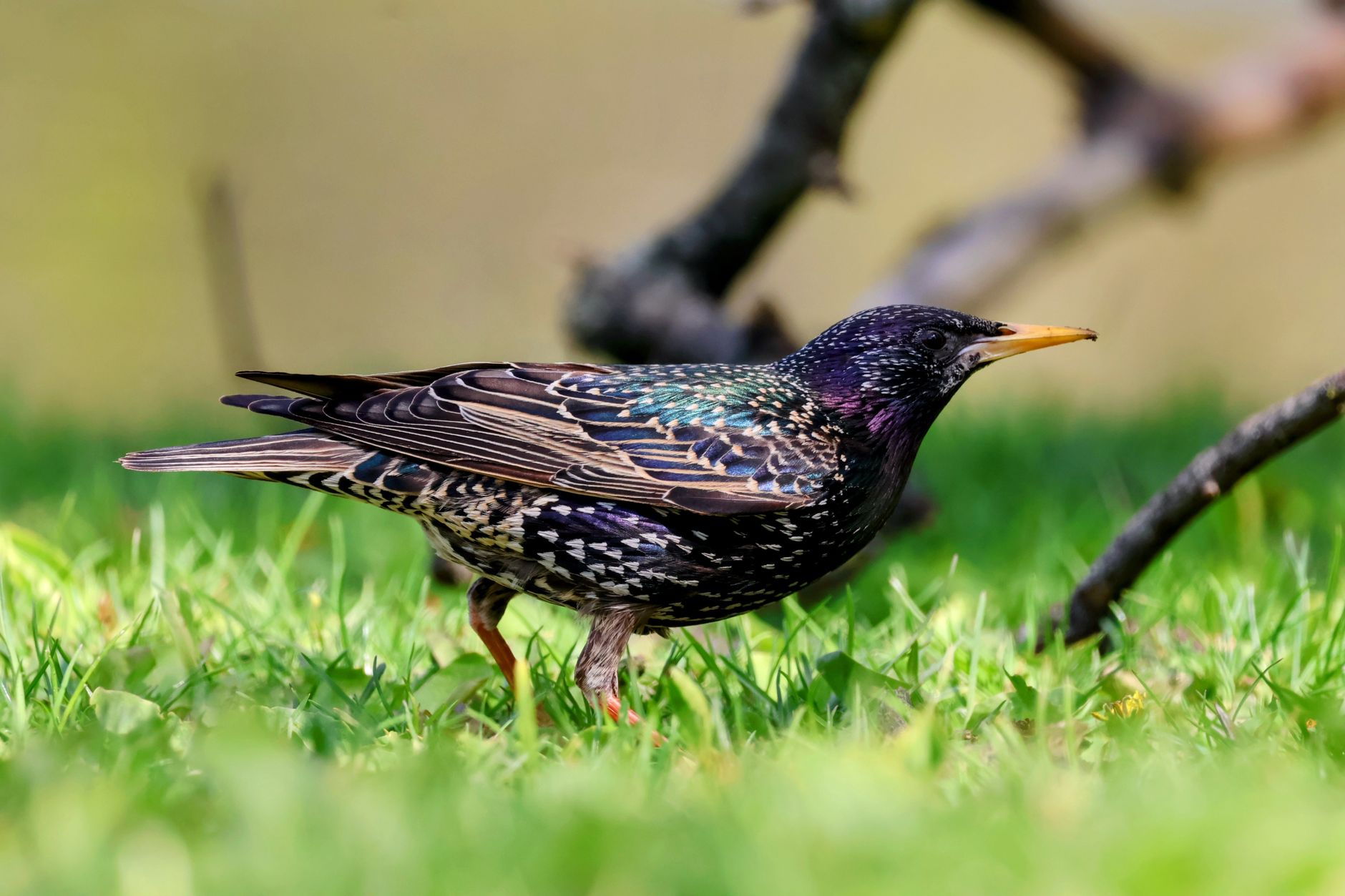
The common European starling looks black from a distance but is iridescent green and purple up close, worth knowing before you assign it meaning. A bird that appears one way until you’re close enough to see it clearly carries its own symbolic logic: things that look simple until you’re actually near them. Some folk traditions read this as hidden value or misread character. But get closer first. The color may surprise you.
Is the starling a symbol of anything negative or a warning sign?
The shadow readings are real. In Germanic folk tradition, the starling’s gift for mimicry carried a warning about insincerity, a person who sounds right but says nothing of their own. A flock behaving erratically around a building was sometimes read as a sign of disorder within: broken communication, a household not functioning as a unit. But these aren’t curses. They’re observations. The starling as a warning sign is asking a specific question about voice and community, not predicting harm.
What does it mean if a starling keeps appearing repeatedly in your life?
Repeated encounters shift the question from “what does this mean” to “what is this asking.” A starling appearing once is a symbol. A starling appearing repeatedly is probably pointing at something you already sense about your social life but haven’t addressed directly. The starling’s consistency across traditions is about community and voice. If it keeps showing up, the question it’s probably asking is: who are your people, are you actually with them, and are you saying what you mean when you are?
Sources
- Audubon Society, “How Starlings Spoke to the Gods of Ancient Rome”
- Cavagna et al. (2010), “Scale-free correlations in starling flocks,” PNAS
- USDA Invasive Species Info, European Starling
- AVI Birds, Common Starling species profile
- Birdful, The Folklore of the Starling Bird
- Peak Boxes, Folklore of the Starling (2021)
- Armstrong, Edward A. The Folklore of Birds. Collins, 1958.
- Shakespeare, William. Henry IV, Part 1, Act 1, Scene 3.
- Pliny the Elder. Naturalis Historia.
- www.hoap.co.uk
- attalus.org
- spiritualityshepherd.com
- lingolandedu.com
- www.folger.edu
- christianfaithguide.com


Anyone have an explanation….
A sterling was in my girls room, doors been closed since they went to school 7.30am and windows closed and locked plus been closed for months as its cold weather. No holes in ceiling, so where did it come from? I was upstairs all morning as I work from home, suddenly at 12.30pm I heard rustling in the girls room, I was scared as there was no one else home but I braved it and opened the door. It was their fluttering around on the curtain and around the room.
It’s quite a mystery how the starling found its way into your girls’ room. Sometimes birds can find small openings or gaps that we may not even notice. It must have been an unexpected surprise for you! Thank you for bravely handling the situation. Nature has its own way of surprising us sometimes!
a black starling bird come visit me often. There are two. But the one day he sit on top of my trellor door. and start making a noise like the sound of a crow. i Was standing about 2 and a half meters away. I said hello and he still making the noise so i said hello again and then he fly away.
I want to know what message did he want to tell me.
How fascinating! The black starling bird’s behavior, like making a crow-like noise and flying away, could be its way of communicating. Symbolically, black starlings represent mystery and intuition. It might have wanted to capture your attention, reminding you to trust your instincts and explore life’s hidden realms. Embrace its message of inner wisdom and intuition.