
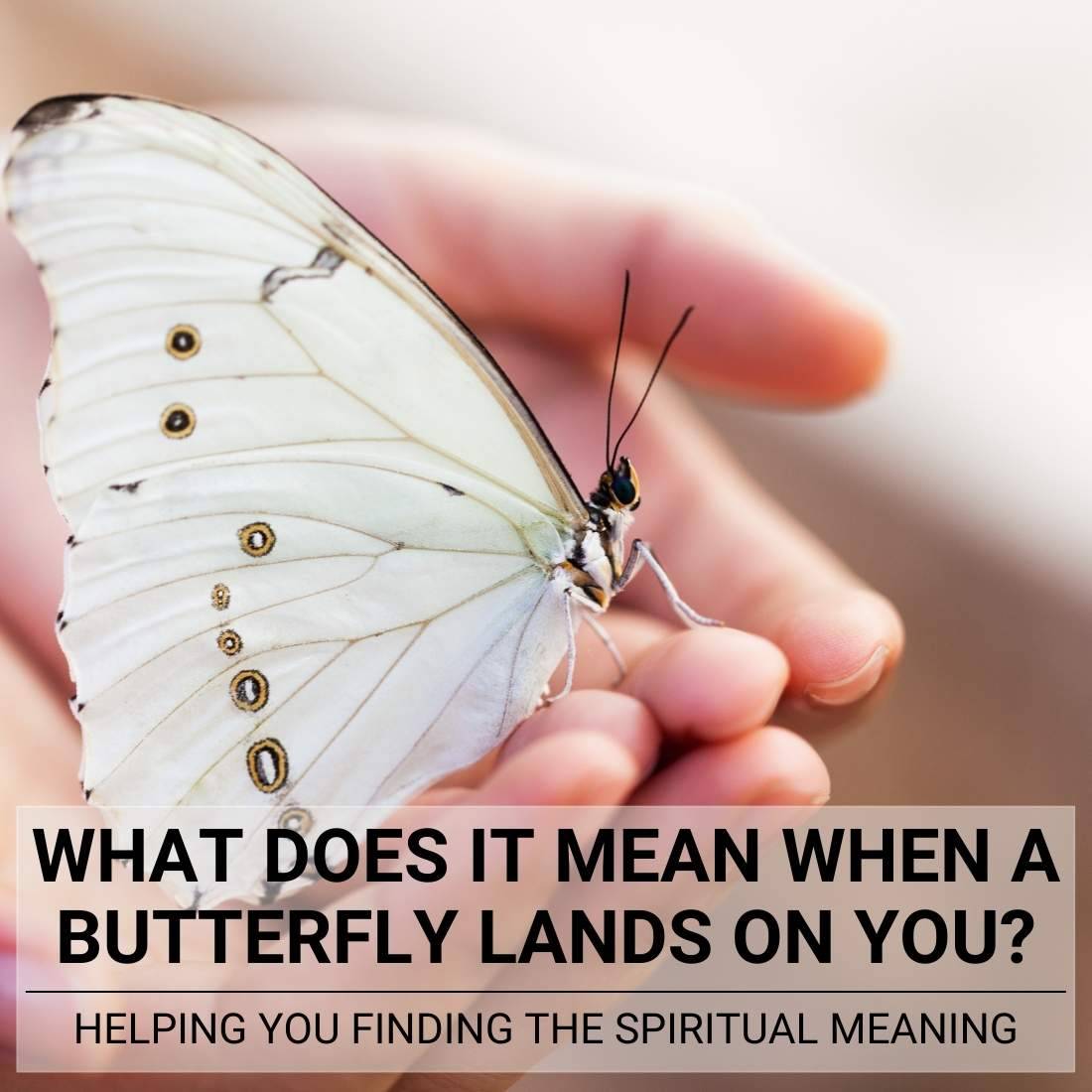
A butterfly landed on you and stayed. It walked your skin, stopped, maybe turned toward your face. Whatever you were doing before that moment, you stopped doing it. The instinct to ask what that means is older than most of what currently calls itself spiritual, and you are not making it up.
There are three honest answers to the question, and the traditions that have thought longest about it don’t ask you to choose. Irish folk Catholic belief reads a lingering butterfly as a soul, probably a kinsman’s, that hasn’t gone far yet. Ancient Greek thought made butterfly and soul the same word. And straightforward natural history says the butterfly is drinking sodium from your sweat, a behavior called puddling. All three can be true at once. The biology describes the mechanics of how the encounter happened. What you make of it after that is yours.
Key Takeaways
- Butterflies land on humans and stay because of puddling behavior: they need sodium from sweat. This is documented biology, and it doesn’t make the encounter less worth examining.
- The oldest traceable basis for reading a butterfly as a soul is the ancient Greek word psyche, which meant both “soul” and “butterfly” at once, not as metaphor but as a single word carrying both meanings.
- Irish and Japanese folk traditions offer the strongest historical evidence for a lingering butterfly as a departed soul; both treat a butterfly entering a house or resting near a person as a kinsman who has not yet left.
- The body-location charts on spiritual websites (head means awakening, shoulder means a new guide, hand means creativity) do not appear in any premodern Greek, Irish, Japanese, or Mexica source I have found. They are recent inventions.
- Modern New Age vocabulary, “vibrational energy,” “messenger frequency,” is largely 20th-century framing layered over much older traditions that simply called butterflies souls. The older word is cleaner.
What Does It Mean When a Butterfly Lands on You and Won’t Leave?
In Irish folk Catholic tradition documented by folklorist Lady Jane Wilde in Ancient Legends, Mystic Charms, and Superstitions of Ireland (1887), a butterfly that lingers near a person was read as a soul, probably a kinsman’s, that had not yet gone on. In ancient Greek thought, a butterfly and a soul were the same word. And in natural history, a butterfly on your skin is feeding on the sodium in your sweat, a behavior called puddling. Those are the three frames. None of them cancels the others.
The persistence is what matters across traditions. A butterfly that lands and leaves in two seconds is different from one that walks your arm for five minutes, pauses, and turns toward your face. Staying is the significant quality in both the Irish and Japanese readings. A soul that stays is one that has something to do here.
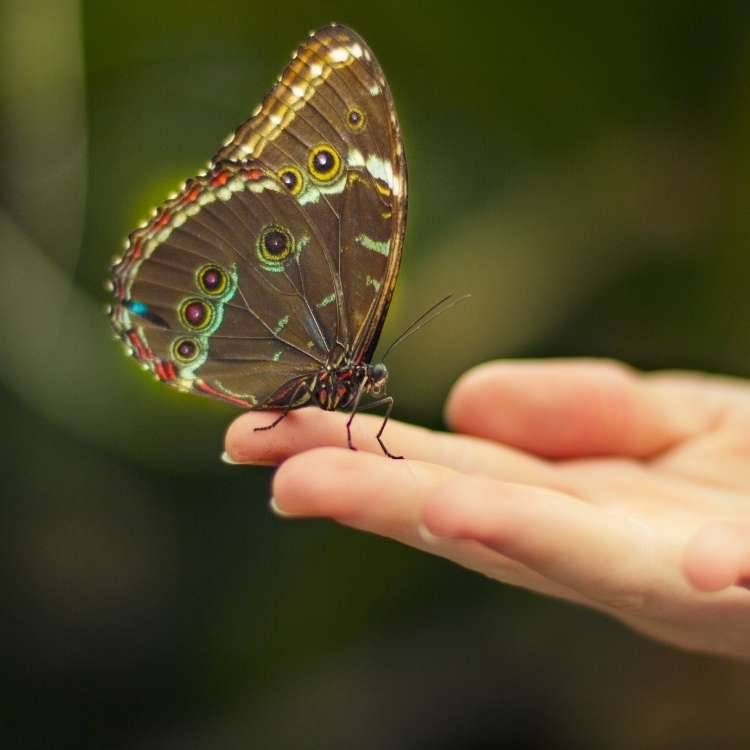
My grandmother Theresa’s notebook from the Bavarian Forest has an entry about white butterflies and souls in passage. It’s written in a German cursive that’s getting harder to read every year, and I can’t be certain of every word. But the posture is the same one I find in Wilde and in W.Y. Evans-Wentz: the butterfly near a person is not random. It is present.
Why Do Butterflies Land on Humans and Stay?
Adult butterflies need more than nectar. They need sodium and minerals, and human perspiration is a reliable source. The Smithsonian Institution’s National Museum of Natural History documents this behavior, called puddling, as routine for swallowtails, monarchs, and many other species. A butterfly that lands and then walks rather than flies is working the surface. It came for something specific.
This isn’t a reason to dismiss the encounter. It’s a reason to understand what you’re seeing. The butterfly wasn’t lost or disoriented. It chose you because you were there, warm and still. Some people find that more grounding than mysterious. Others find it changes nothing about how the moment felt. Both are fair.
Monarch butterflies (Danaus plexippus) are worth naming here because they account for a large portion of these encounters in North America, and their biology is strange in a way that matters. According to the Monarch Joint Venture’s 2020 biology overview, the migratory “supergeneration” lives up to eight months, far longer than the four-to-six-week summer generations. These are the individuals people encounter in late summer and early fall, often calm, often slow. Their age probably contributes to how unhurried they seem.
What Do Ancient Greek Ideas About the Soul Tell Us About a Butterfly That Lingers?
The Greek word psyche (ψυχή) meant breath, then life-force, then soul, and also butterfly. Not metaphorically. The same word. Liddell-Scott-Jones, the standard Greek-English Lexicon revised in 1940, documents both meanings without ranking them as primary and secondary. H.M. Burrage, in “The Mythology of Insects” published in The American Naturalist in 1909, traces how Greek vase paintings from the 5th and 4th centuries BCE showed the soul leaving the body at death as a small winged figure that looks unmistakably like a butterfly rising from a mouth.
So when you look at a butterfly that has landed on you and won’t leave, and something in you says soul, that is not projection. That is a language doing what it was built to do. The Greek framework isn’t about a butterfly delivering a message. It’s about a butterfly being what a soul looks like when it is close.
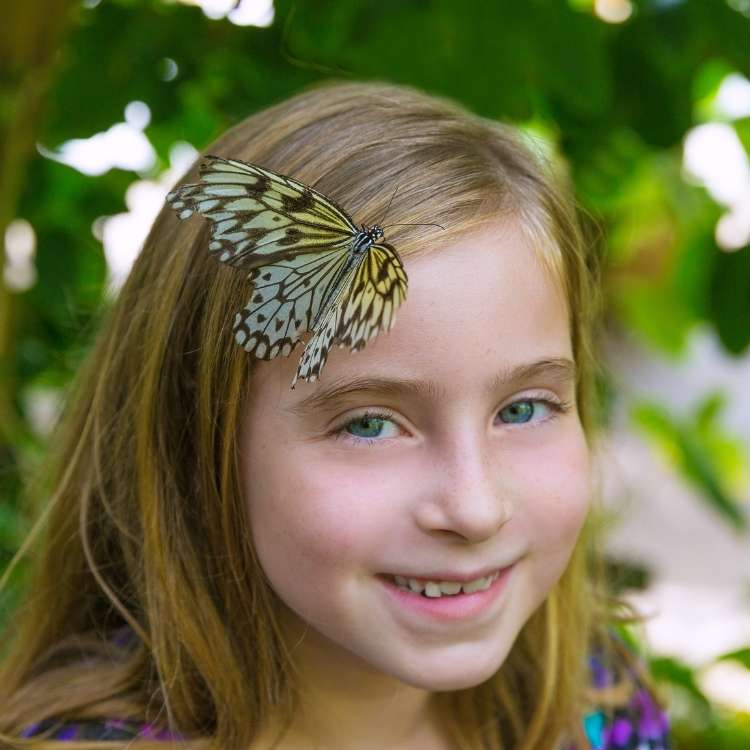
What a lingering butterfly means in that frame: a soul staying near. Not passing through. Staying.
What Does Irish and Celtic Folklore Say About a Butterfly That Won’t Leave You?
In Irish folk belief, the butterfly (feileacan in Irish) was the soul of a human being, often one in Purgatory or in transition. Lady Jane Wilde records in Ancient Legends (1887) that killing a white butterfly was regarded in rural Ireland as harming a soul on its way toward heaven. W.Y. Evans-Wentz, gathering folk material for The Fairy-Faith in Celtic Countries (Oxford: Henry Frowde, 1911), documented stories in which a butterfly entering a home or circling persistently near a person was understood as a departed relative who had come back, either to offer comfort or to seek prayer.
The Irish reading is specific about context. A butterfly inside the house, or one that follows a particular person, is almost always read as kin. Not a random spirit. Someone who knew you. Someone who has not gone far enough away to stop coming back.
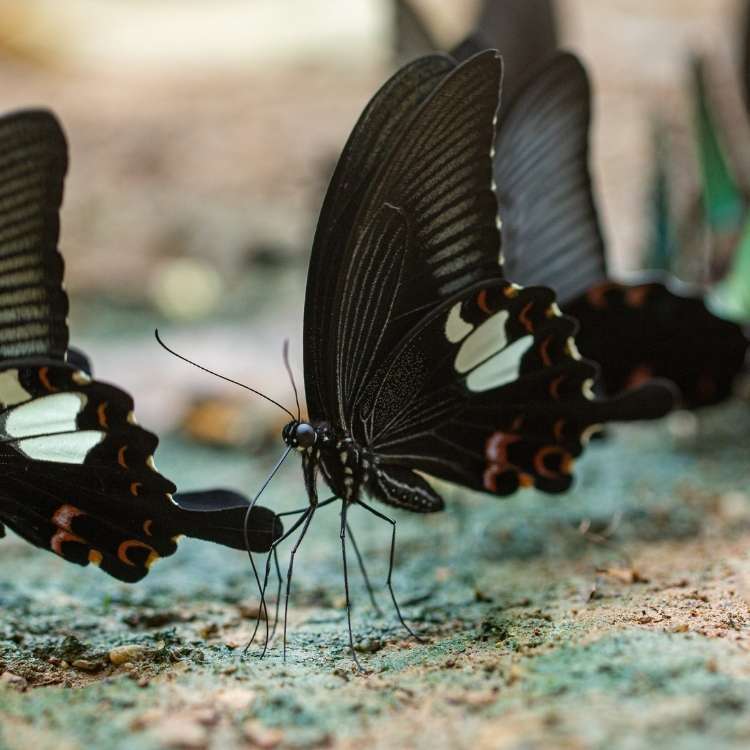
And the persistence matters here more than anywhere else. A butterfly that won’t leave is, in this reading, a kinsman who refuses to depart. Not because something is wrong, but because the connection hasn’t finished yet. I find this reading the most honest about what grief actually feels like: not an appearance and a message, but a presence that keeps returning because it isn’t done.
How Do Japanese and Aztec Traditions Interpret a Butterfly Resting on a Person?
Two traditions, developed independently, arrived at similar places.
In Japanese folk religion, the butterfly (cho or chocho) carries the soul of either the living or the dead. Lafcadio Hearn’s “Butterflies” in Kwaidan (Boston: Houghton Mifflin, 1904) retells a story in which a butterfly is the soul of a dying man’s wife, returning to him at her death. Ethnologist Yanagita Kunio, in commentary gathered around the same period, documents beliefs about small winged creatures as tamashii, soul-bearers. In Shinto-influenced popular religion, an object or creature that a spirit repeatedly returns to is called a yorishiro, a temporary perch. A butterfly that lands on you again and again is offering its body as the landing place.
Frequently Asked Questions
Is it good luck when a butterfly lands on you?
In Irish folk tradition documented by Lady Jane Wilde in Ancient Legends (1887), a butterfly near a person is benevolent, associated with a soul in passage, not with misfortune. Japanese and Greek readings are similarly non-threatening: a soul present, a presence near. The Mexica tradition frames the butterfly as a warrior’s soul, which carries honor rather than luck in the Western sense. None of the older traditions I’ve read attach bad fortune to this encounter. The weight of the folk record puts it in the good column.
What does it mean when a butterfly lands on you and flies away quickly versus stays?
A butterfly that lands and leaves quickly is almost always puddling: it checked, found what it needed or didn’t, and moved on. Spiritually, the Irish tradition treats the brief visit differently from the lingering one. Staying is the significant quality in most folk readings. A butterfly that won’t leave, that walks your skin and pauses, is behaving in a way both Irish and Japanese traditions associated with a soul that has unfinished presence near you. The departure, when it comes, is the release. The staying is the thing.
Does the color of the butterfly that lands on you change the meaning?
Yes, in traditions where color is tracked. In Irish folk belief, the white butterfly (feileacan ban) was specifically linked to souls in Purgatory, distinct from other colors. In broader European folk tradition, white butterflies near the recently dead were read as signs of the soul’s passage. Black butterflies carry different weight across several traditions, associated with transition rather than arrival. I write about color meanings separately for white butterfly meaning, black butterfly meaning, and yellow butterfly meaning if the color matters to you.
What does it mean when a butterfly lands on you after someone dies?
This is where the Irish and Japanese traditions are most specific, and most honest. In both, a butterfly appearing near a grieving person, entering the house, landing on someone at a graveside, following a person after a loss, is read as the soul of the deceased making itself known. Not delivering a message in any dramatic sense. Present. Still near. Evans-Wentz’s fieldwork in The Fairy-Faith in Celtic Countries (1911) documents this reading across multiple Irish counties. You are not imagining the connection. The butterfly came because the person you are grieving has not gone entirely out of reach yet.
Is a butterfly landing on you a sign from God or an angel?
I honestly don’t know how to answer this in a way that works for everyone who asks, and I’d rather say so plainly. The butterfly-as-soul reading predates Christianity by several centuries in Greece. Irish folk Catholic tradition folded the older soul-butterfly belief into Catholic theology without erasing it, so for Christians in that tradition, a butterfly could carry both meanings at once: a natural creature and a soul permitted to make contact. Whether that constitutes an angelic sign in strict theological terms is not a question I’m qualified to answer. The encounter is real. The rest depends on your own framework.
What should you do when a butterfly lands on you and won’t leave?
Stay still. A butterfly feeding on skin will leave when it has what it came for; moving abruptly just startles it somewhere else. Beyond that: if the encounter felt significant, write it down. The date, the setting, what you were doing beforehand, what color the butterfly was. Japanese folk practice around encounters with soul-bearing creatures emphasized attentiveness, noticing what was happening in your life at the time. If you had asked for a sign before this happened, note that too. The record you make matters more than any formula I can give you.
Are monarch butterflies specifically associated with the souls of the dead?
In Mexican folk-Catholic tradition, yes, and more specifically than the general butterfly-soul connection. Monarch migration through central Mexico coincides with Dia de Muertos in late October and early November. The Purepecha people of Michoacan, where monarchs overwinter in the millions, have long associated their arrival with returning ancestors. Anthropologist Stanley Brandes documents this in Skulls to the Living, Bread to the Dead (2006), tracing how older Mexica papalotl symbolism blended with Catholic observance of the dead. Outside that regional context, the soul-link still applies but the intensity is specific to place and season. The monarch butterfly symbolism page covers this tradition in more detail.
Sources
- Lady Jane Wilde, Ancient Legends, Mystic Charms, and Superstitions of Ireland (1887), via Centre of Excellence butterfly symbolism overview
- Smithsonian Institution, “Butterflies and Moths: Frequently Asked Questions” (2018), referenced via Clearwater Butterfly
- Monarch Joint Venture, “Biology of the Monarch Butterfly” (2020), referenced via Green Matters
- Cross-cultural butterfly landing symbolism overview, Spells8
- W.Y. Evans-Wentz, The Fairy-Faith in Celtic Countries (Oxford: Henry Frowde, 1911)
- Lafcadio Hearn, Kwaidan: Stories and Studies of Strange Things (Boston: Houghton Mifflin, 1904), “Butterflies”
- H.M. Burrage, “The Mythology of Insects,” The American Naturalist, 1909
- Liddell-Scott-Jones, Greek-English Lexicon, rev. ed. (Oxford: Clarendon Press, 1940)
- Bernardino de Sahagun, Florentine Codex: General History of the Things of New Spain, c. 1577, Books 1 and 11
- Stanley Brandes, Skulls to the Living, Bread to the Dead (Oxford: Blackwell, 2006)
- IUCN, Danaus plexippus Red List Assessment, 2021
- Oxford English Dictionary, 2nd ed., entry “Butterfly” (Oxford: Oxford University Press, 1989)

It was really amazing feeling. I look down at the butterfly and ask it what is it then I said JESUS
I lost my brother very tragically yesterday. He was troubled by a drug addiction for years and his life ended by suicide by cop. I was outside grieving his loss and questioning if he was still in anguish. A butterfly came near my face quite obsessively fluttering around. It landed on my face and head several times. I noticed this butterfly also was flying with a broken wing. I immediately felt this was a very specific message to me as everyone knows I love snd am obsessed with butterflies. I sat on my porch for over an hour and this butterfly stayed on my hand the entire time. I’m not sure of the sender but know it gave me peace.