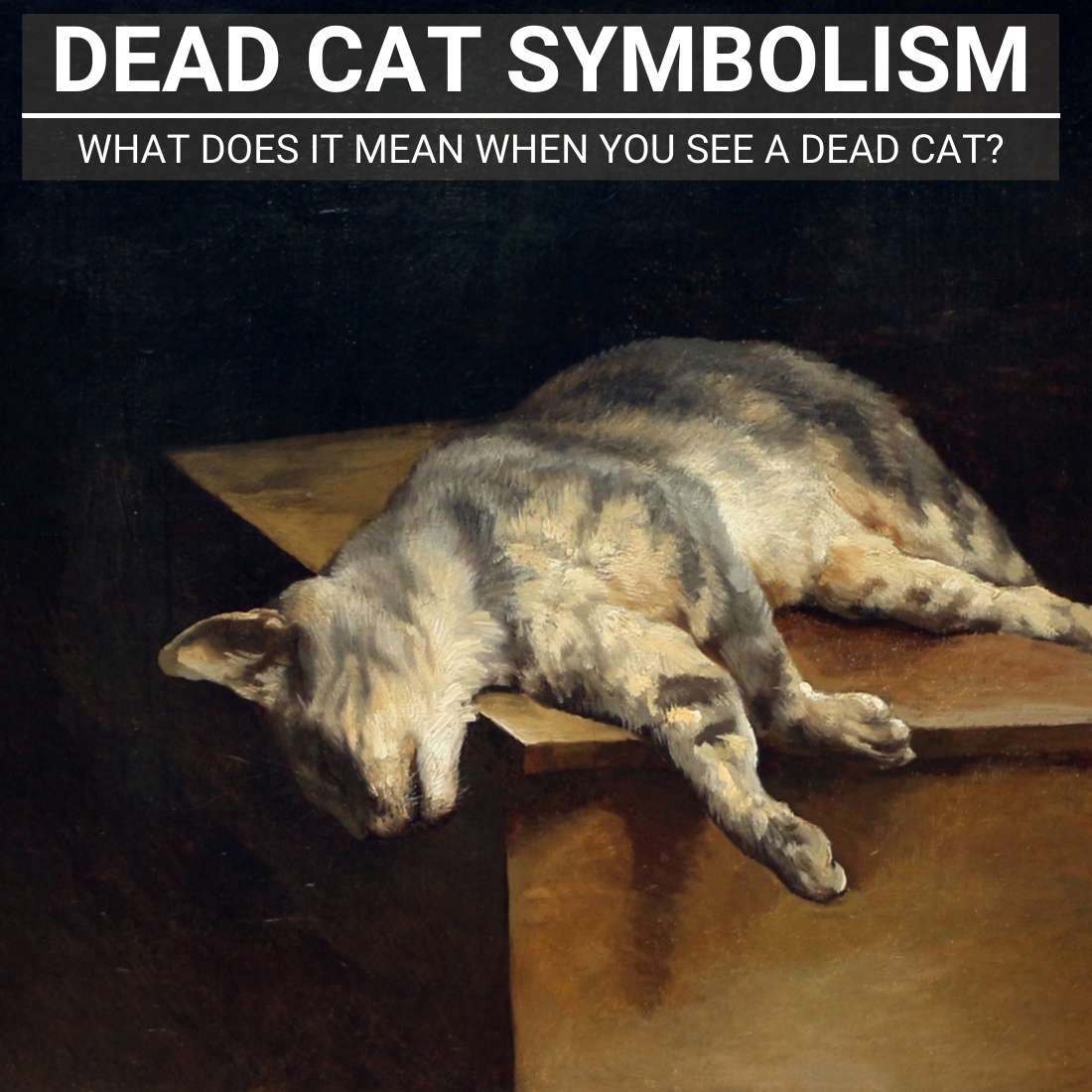
If you’ve already read somewhere that finding a dead cat means someone close to you is going to die, I’d ask you to set that aside for a minute. That reading comes from a narrow thread of European folk belief, and the longer record on this encounter is both more specific and considerably less catastrophic.
Key Takeaways
- Across most traditions I’ve been able to trace, a dead cat reads as a threshold signal, something completing, not something threatening.
- Where you found it matters. A dead cat on your doorstep carries different weight than one in your yard or inside your home.
- In Ancient Egyptian religious practice, cats were sacred threshold guardians; their deaths were treated as passages.
- If the cat was your pet, several folk traditions read the death as the end of a guardianship the animal chose to take on.
- The appropriate response in most traditions is acknowledgment. Something small, deliberate. Not fear.
What Does It Mean When You Find a Dead Cat?
Across the folk traditions I’ve been able to trace that actually name their sources, a dead cat reads as a threshold signal. Something is ending so something else can begin. That’s not a comfortable answer if you’re standing in your driveway at seven in the morning, but it’s a more accurate one than “bad omen”—though if you’re curious about cat sleeping above my head meaning spiritual, the symbolism often points to similar transitions in our inner lives.
Cats occupy a specific role in the symbolic record. Not birds, not dogs. The cat sits at the edge of the human world and the wild one, comes and goes through walls and fences, hunts at hours when people are asleep. That quality is what gives the dead cat its weight in folk interpretation. It’s a creature of the threshold, and finding its body at a threshold, your porch, your door, your property line, reads as a signal from the boundary itself.
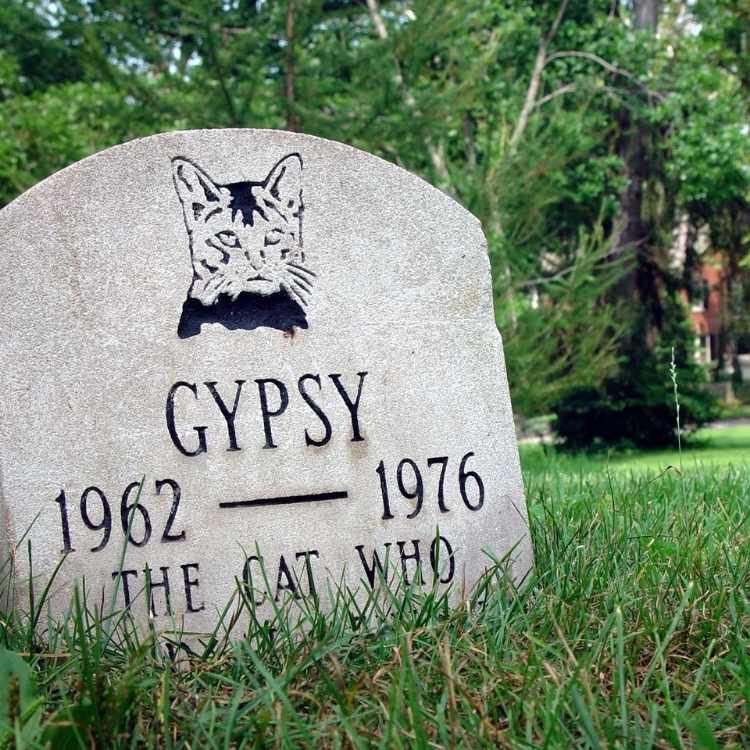
I write about these encounters because I’ve lived through enough of them to know that dismissing them feels false, and overclaiming them feels worse. The reading I trust is the one that stays close to what the traditions actually say: this is a moment to pay attention. Not to panic.
What Is the Spiritual Meaning of a Dead Cat?
The cat’s cross-cultural role as a psychopomp, a creature that moves between worlds, is what gives this encounter its particular texture. A psychopomp isn’t a bringer of death. It’s a guide at the boundary between life and whatever comes after. Finding one dead doesn’t mean something terrible is coming toward you. It may mean something has already passed through.
Folk traditions in the British Isles, documented by folklorist Katharine Briggs in her survey of British folk belief, consistently frame the cat as a liminal animal, associated with witches not because witches were evil but because both were understood to cross boundaries that ordinary people could not. A cat’s death at a threshold, in that tradition, marks the thinning of the membrane between the living and the dead. Not a curse. A notice.
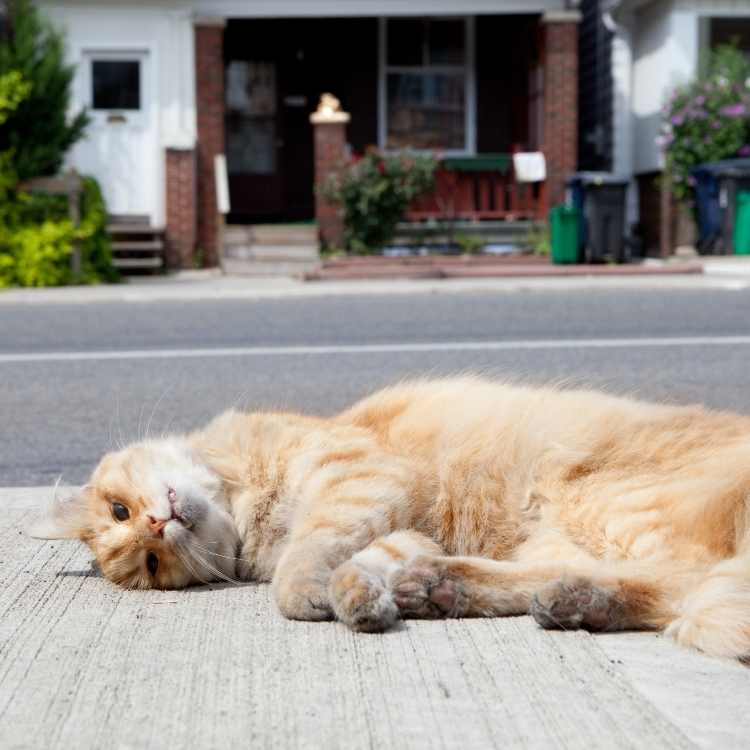
The broader reading is this: a dead cat near you signals a cycle completing. A relationship, a phase, a way of living that had been guarding you. The guardianship is done. You are not made vulnerable by it. You’re released into whatever comes next.
What Do Different Cultures Say About Dead Cats?
The most documented tradition is Ancient Egyptian. Cats were sacred to Bastet, goddess of the home, protection, and fertility, and the cat necropolises at Bubastis and Beni Hasan, excavated in the nineteenth century and studied by Egyptologist Jaromir Malek in The Cat in Ancient Egypt (1993), contained hundreds of thousands of mummified cats buried with deliberate ritual care. A cat’s death wasn’t mourned as a loss. It was treated as a passage. Herodotus recorded, in his Histories (circa 430 BCE), that Egyptian households shaved their eyebrows when a cat died. Equal to the death of a family member. The cat had completed its work in the living world and moved on.
Medieval European tradition looks less charitable on the surface. Cats, especially black ones, appear in church documents from the thirteenth century onward associated with witchcraft and night travel, particularly in papal inquisitorial records. But the folk layer beneath the church layer tells a different story. In German rural folk belief from the seventeenth and eighteenth centuries, documented in regional collections like Johann Wilhelm Wolf’s Beiträge zur deutschen Mythologie (1852), a cat found dead near the home was read as a sign that the house’s protective spirit had completed a task or was departing because a change was coming. Not punishment. Information.
My grandmother Theresa’s notebook, German cursive, Bavarian Forest, 1920s, falling apart at the spine, doesn’t mention cats specifically, but it does record the threshold animal as a category: the creature whose death at the doorway marks something crossing. Ravens, owls, occasionally foxes. The logic applies.
In Han Chinese folk practice, the cat appears in household protective traditions as a boundary animal, placed at doorways to ward off negative spirits. Michel Strickmann’s posthumous study Chinese Magical Medicine (2002) documents how liminal animals in Han Chinese folk religion carry dual power, they belong to both sides of the boundary they guard. A dead cat, in that frame, has finished its watch.
What Does Finding a Dead Cat Near Your Home Mean?
Location changes the reading. This is one place where the folk record is actually specific, and I think the specificity is worth following.
On the doorstep or porch: The threshold reading is strongest here. The cat died at the entry point of your home, the place where inside and outside meet. Most traditions read this as a completed act of protection. Something was being kept out; the work is done. The boundary held.
In the yard or garden: A wider protective perimeter. The cat was working the edges of your property. This reading is somewhat less charged, less about your personal threshold and more about the land itself cycling through something.
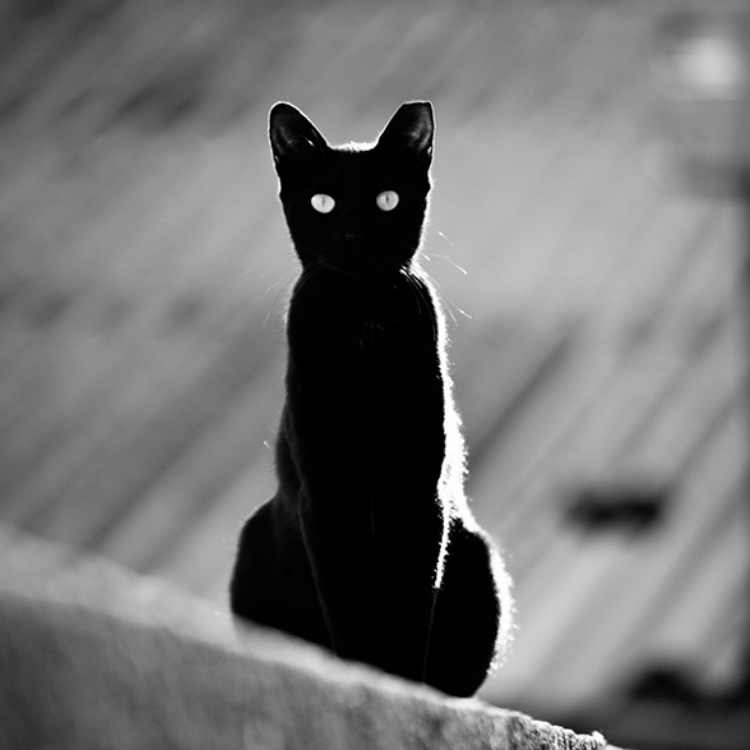
Inside the house: This one is harder to read, and I’ll be honest that the folk record is thinner here. The most consistent reading across European and some Appalachian folk traditions is that the animal chose the most protected place it knew. Not a bad sign. The animal trusted the space.
You are not making this up. The placement felt personal because the placement is personal, or at least, that’s how every tradition I’ve read treats it. Take that seriously without letting it frighten you.
What Does It Mean If the Dead Cat Was Your Own Pet?
This is the question that hurts most to ask.
Several folk traditions, and this is where I think they get something genuinely right, frame a pet’s death not as abandonment but as the completion of a contract. The cat chose your house. It guarded it for years. When it died, especially in the home or nearby, the tradition reads that as the animal finishing what it came to do. Not leaving. Finishing.
What Should You Do After Finding a Dead Cat?
- Acknowledge the animal. Say something out loud or in your head. Thank it for being where it was. This sounds small. It isn’t. It’s the difference between encountering something and walking past it.
- Handle the remains with care. If you can bury the animal, do so. In the Japanese folk tradition documented in Michael Dylan Foster’s Pandemonium and Parade (2009), even animals associated with dangerous power were treated with burial respect to close the interaction properly. The act of burial signals that you saw the animal as something, not nothing.
- Mark the threshold. If the cat was found at your door or porch, some Appalachian folk-magic traditions recommend sprinkling salt across the threshold afterward. Not as a cleansing from something bad, but as a quiet acknowledgment that the boundary has been noted. I know those traditions from living in Black Mountain, North Carolina, where they’re still practiced. I respect them. I don’t claim them as my own.
- Give it a day. The anxiety that follows this kind of encounter often softens within twenty-four hours. Not because the encounter wasn’t real, but because the mind settles. Let it settle before you decide what it meant.
Frequently Asked Questions
Is finding a dead cat bad luck?
Not in any tradition I’ve been able to trace that actually cites its sources. The bad-luck reading tends to come from a conflation of the dead cat with the black cat superstition, which is a separate folk tradition about living cats crossing paths. Dead cats, in Egyptian, European, and Appalachian folk belief, read as threshold signals or completed guardianships, not curses. The distinction between “a signal of change” and “bad luck” matters. One is information. The other is verdict. The folk record gives you information.
What does it mean if a dead cat is left on your doorstep by another animal?
Practically, this is often a coyote, fox, or larger predator. The placement by another animal does shift the reading for some traditions, the delivery carries that animal’s own symbolic weight. Honestly, I’m not sure how much that changes the core reading. The folk record on this specific variant is thin. What I’d say: the threshold reading still applies. Something arrived at your door. The source matters less than the fact that it arrived there, and that you noticed.
Does the color of the dead cat change the spiritual meaning?
Black cats carry the heaviest accumulated symbolic weight, largely because of European medieval associations with witchcraft and night. White cats, in several folk traditions including some documented in German-speaking Central European sources, read as more directly associated with spiritual protection. Tabby and mixed cats don’t have strong color-specific folk readings that I’ve found. My honest answer: color adds texture but doesn’t change the core reading. Dead cat, at a threshold, signals a passage or a completion.
What does a dead black cat symbolize specifically?
In medieval European tradition, the black cat was associated with liminal space, the boundary between the seen and unseen world, not because black was evil but because darkness itself was the realm of boundary-crossing. A dead black cat at your home, in that tradition, marks a particularly strong threshold signal. Something that was moving between worlds near you has completed that movement. The hysteria around black cats and bad luck is largely a Protestant-era distortion of an older reading that was more neutral and far more specific.
Is there a difference in meaning between a cat that died naturally versus one that was killed?
Most folk traditions I’ve read don’t distinguish sharply between the two, the reading focuses on where the body appeared, not how the death occurred. Where traditions do make a distinction, a violent death sometimes reads as a more urgent signal: the protection was forcibly ended rather than naturally completed. I wouldn’t call that a worse sign, but it can feel more charged. If the cat was clearly killed by another animal, the practical explanation is also real and worth knowing. Both can be true at once.
What does it mean if you keep seeing dead cats repeatedly?
A pattern is harder to dismiss than a single encounter, and it deserves honest attention rather than reassurance. Repeated dead cats in the same area can have a practical explanation: disease in the local feral cat population, a predator with territory near your home, a road hazard. Check those first. If no practical explanation accounts for it, the folk reading of repeated threshold signals is that something in your immediate environment is in a sustained period of change. The repetition is asking for sustained attention, not a one-time acknowledgment.
Should you bury a dead cat you find, or is there another appropriate way to handle remains?
Burial is the most consistent recommendation across traditions. Egyptian, European folk, and Appalachian all point toward placing the body in the earth as a way of properly closing the encounter. If burial isn’t possible, urban setting, frozen ground, the animal belongs to someone else, wrapping the body carefully and disposing of it with intention rather than as refuse accomplishes something similar. The intention is what matters: treating the remains as something that deserves a conclusion, treating it as an ending rather than mere removal. Say something when you do it. It doesn’t need to be formal.
What does finding a dead cat mean in Christianity or Biblical symbolism?
The cat doesn’t appear in the Hebrew Bible or the New Testament, which is itself worth noting given how present cats were in Egypt, where significant portions of the biblical narrative are set. Christian folk tradition absorbed some medieval European cat symbolism, but the official theological record is silent on the dead cat specifically. Some Catholic folk traditions in southern Europe and Latin America incorporated cats into household spiritual practice, but these are regional and syncretic rather than doctrinally grounded. Christianity doesn’t have a clear reading of this encounter.