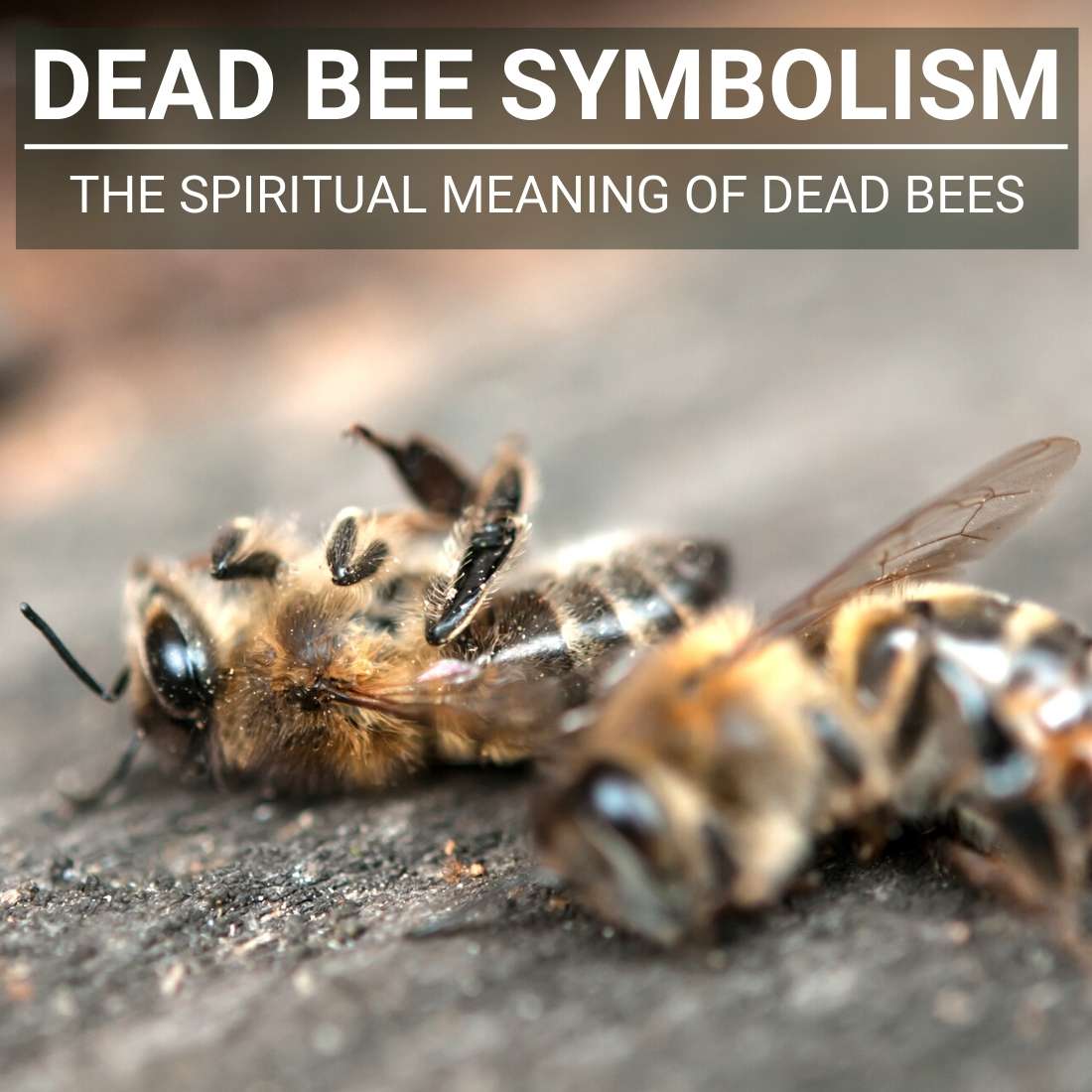
You found it on the kitchen counter, wings perfect, and felt that sick drop in your chest. In ancient Egyptian Pyramid Texts, bees were Ra’s tears made living, so a dead one meant divinity spent. But whether it died at your threshold or deep inside shifts what your finding asks of you.
Key Takeaways
- A dead bee signals the close of something. Not the end of everything. The close of a phase, a pattern, a way of working yourself that may have stopped serving you.
- Location changes the reading. Inside the house points toward domestic life; at the doorstep sits at a threshold; in the garden points outward.
- Egyptian, Celtic, and northern European folk traditions all linked bees to the soul and to household wellbeing. Their death was an occasion for attention, not panic.
- If you have been running on empty, the bee is a reasonable mirror for that.
- Remove it with care. Say something small. That is enough.
What Does It Mean When You Find a Dead Bee?
The short answer: a dead bee signals the close of something. Not the end of everything. The close of a phase, a pattern, a way of working yourself that may have stopped serving you. That is the reading that runs through the folk record from Egypt to Ireland, and I find it more honest than the bad-omen version, because as explored in various spiritual traditions, it asks something of you rather than just frightening you—much like the spiritual meaning of bees flying around you invites reflection rather than fear.
Take a breath. The fact that you noticed this bee, that it stopped you, that you are here, is part of the answer. Bees are not background animals. People have watched them, named them, and written about them for four thousand years, and the attention is not accidental.
According to the broader folk tradition of animal symbolism, insects that carry the weight of community labor are the ones whose deaths get read as mirrors of something larger. One bee, dead on your sill. It is a small thing. It is also not nothing.
What Is the Spiritual Meaning of a Dead Bee?
A dead bee, read spiritually, signals transition, the cost of overwork, and the need to acknowledge what has ended before starting what comes next.
In Hilda Ransome’s The Sacred Bee in Ancient Times and Folklore (1937), one of the few scholarly surveys that actually goes to primary sources rather than recycling itself, bees appear as soul-carriers in traditions from the Aegean to the British Isles. The bee’s death was not a verdict on you. It was a marker. An occasion to stop and register that something was changing.
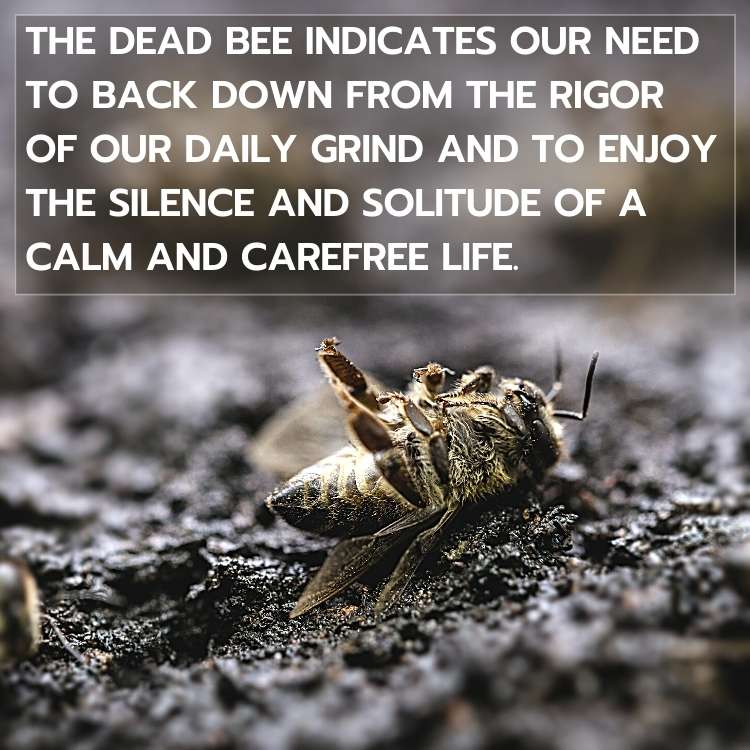
I read it that way, for what it’s worth. I am not a shaman or a psychic; my background is in raptor rehabilitation and a family tradition of watching animals closely. But I have read enough of the folk record to say with some confidence: the dead bee is not a sentence. It is a question the tradition is asking you to sit with.
What Does It Mean When You Find a Dead Bee in Your House?
A dead bee found inside, on a windowsill, on the kitchen floor, on the threshold between rooms, carries meaning around the home itself. Domestic harmony. The health of the relationships under that roof. Whether the busyness of the household has become its own kind of exhaustion.
Eva Crane’s The World History of Beekeeping and Honey Hunting (1999) documents the long European tradition of beekeepers treating their hives as members of the household, subject to the same griefs and changes as the family. A bee inside the house that dies is close kin to that tradition: the house and the hive were understood as mirrors of each other.
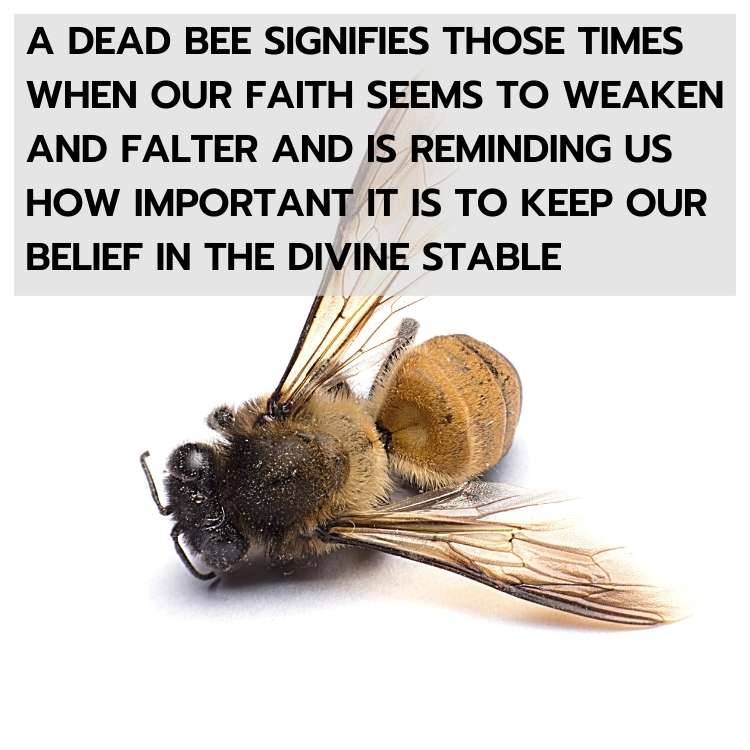
So if you found a dead bee in your kitchen this morning, the old reading would be: look at your home. Not in a frightened way. In an attentive way. Is something there that needs your care? A relationship running low, a domestic rhythm that has stopped working, something you have been too busy to address?
What Does Finding a Dead Bee Mean Across Different Cultures?
In the Pyramid Texts, bees were described as the tears of Ra that fell to earth and became living creatures. That is not metaphor dressed up as fact; that is the actual cosmological claim. Which means a dead bee, in that tradition, was a spent piece of the divine. Worth noticing. Worth handling with care.
In Celtic folk belief, as documented by scholars of British and Irish folklore, bees were understood to carry souls between worlds. Finding a dead bee was understood as a moment when that passage had completed, not a warning of death, but an acknowledgment that something had moved on.
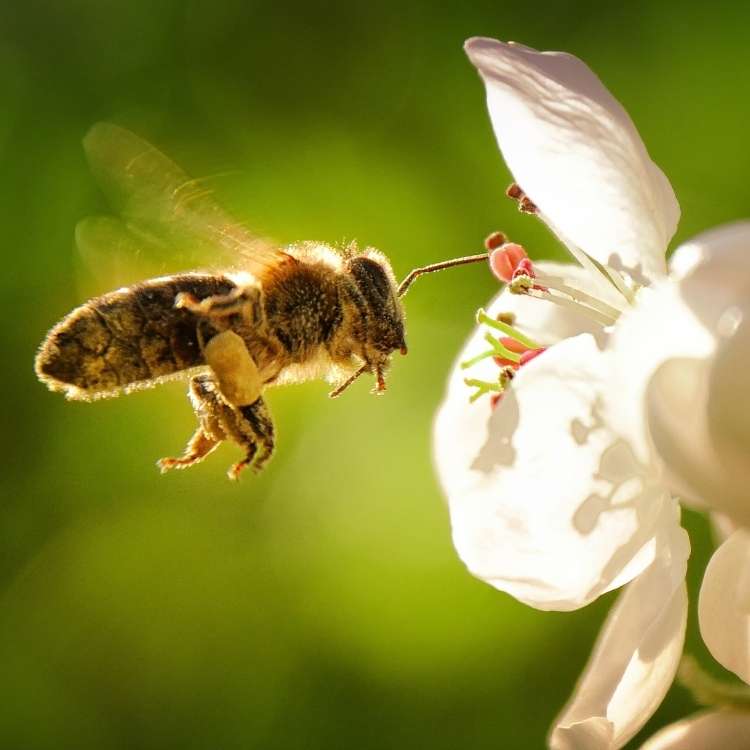
The European custom called “telling the bees”, in which beekeepers formally announced deaths, marriages, and births to their hives, was practiced across England, France, Germany, and parts of New England well into the nineteenth century. John Greenleaf Whittier wrote about it in his 1858 poem “Telling the Bees,” which is a poem about grief and about the strange formality of making sure the hive knew what the house knew. According to Ransome’s 1937 survey, beekeepers who failed to tell their bees of a death in the family believed the hive would die or leave.
My grandmother Theresa’s leather notebook from the Bavarian Forest has an entry, I cannot date it precisely but the German cursive suggests her grandmother’s hand, which would put it around the 1890s, that reads roughly: wenn die Biene stirbt, stirbt auch etwas in uns. When the bee dies, something in us dies too. Not a threat. An observation.
What Did Ancient Civilizations Believe About Dead Bees as Omens?
In ancient Greece, bees were understood as psychopomps in the Eleusinian tradition, animals that moved between the living world and whatever lay beyond it. The priestesses of Demeter at Eleusis were called Melissai, “the bees.” A dead bee near the sanctuary was a formal omen requiring ritual response, not because it meant something catastrophic, but because bees were too close to the sacred to die without comment.
In Mesopotamian omen literature, the Summa alu tablets catalogued household omens and bee death near a dwelling was among the signs that required a ritual specialist to assess. The assessment was not usually dire. It was procedural. The tradition took the bee seriously enough to have a procedure for its death. That is its own kind of respect.
Ancient Egypt again: the Pyramid Texts are among the oldest religious writings we have, and the bee appears in them not as a minor symbol but as a creature carrying real weight. According to the Encyclopedia of Religion and Nature (Bron Taylor, ed., 2005), bee imagery in ancient Egypt linked directly to the pharaoh’s dual role over Upper and Lower Egypt. The bee was royal, sacred, alive with meaning. Its death was a thing you registered.
What Does a Dead Bee Mean for Your Personal Energy or Life Path?
Here is the reading I find most honest. The bee is the animal we associate with relentless, purposeful work. A honeybee colony, about 60,000 bees in a healthy summer hive, functions because every member is working without pause. A single worker bee covers roughly 500 miles of flying across her entire life. Her wings literally wear out.
So a dead bee asks: have you been running your wings to nothing?
I am not the person to tell you the answer. But the folk tradition consistently points in this direction: the dead bee is less a warning about what is coming than a mirror of what you have already been doing. Or rather, a mirror of what may need to stop. The end of a cycle is not the end of everything. It is just the end of this particular way of moving through the world.
You are not making this up. Most people step over a dead bee without a second thought. You didn’t. That attention is worth something.
What Should You Do After Finding a Dead Bee?
Remove it with care. That is the simplest version. Don’t flick it into the trash without looking at it. Hold it for a moment, or just acknowledge it.
The tradition of “telling the bees” was built on the idea that bees deserved to be spoken to, kept in the loop of the household’s life. You can do a small version of that. Take it outside. Set it down somewhere in the garden, near a flower it might have visited. Say something aloud, even something small. “Thank you for the work you did.” That is enough.
The folk traditions that took bees most seriously were also the most practical people in the world. They were beekeepers. They had actual hives to tend. The gestures were small and the attention was real.
If the encounter has been unsettling you, write about it. Not to interpret it away, but to sit with what it opened. Is there something in your own life that feels like it has run its course? A commitment, a relationship, a way of spending your energy? The bee is a good prompt for that kind of looking.
For related encounters, the spiritual meaning of bees flying around you covers what a living bee in your space signals, which is a notably different reading.
What Does It Mean to Dream of a Dead Bee?
A dead bee in a dream points most directly toward fears about productivity, the feeling that you are not doing enough, or that the work you have been doing has stopped mattering. Or it points to a relationship where the collaboration has gone quiet.
I don’t have a confident answer about dream symbolism generally, because the folk record on dreams is thinner than the folk record on waking encounters, and the academic record is thinner still. The consistent thread in Jungian psychology reads the bee as an archetype of the collective, of community functioning, of productive purpose. A dead bee in a dream suggests some part of that energy in your life has gone dormant. Not died permanently. Dormant.
The emotional quality of the dream matters. Did you feel grief at the bee’s death, or relief, or nothing? Jung would say each of those is a different reading. Grief suggests you valued what the bee represented. Relief suggests you were already exhausted by it. Nothing suggests the thing it represented was already further gone than you realized.
Frequently Asked Questions
Is finding a dead bee bad luck?
Not in the tradition I trust most. In the European folk record documented by Hilda Ransome in The Sacred Bee in Ancient Times and Folklore (1937), a dead bee was an occasion for attention, not a curse. The worst-case reading in most traditions is that something in your home or your own energy needs tending. That is not bad luck; that is information. The bee died. You noticed. Now you have something to think about.
What does it mean when multiple dead bees appear in the same place?
A cluster is a different situation from a single one, and I want to be honest: it may also be a practical situation. Pesticide exposure, a diseased colony nearby, or a cold snap can kill bees in numbers. Check whether there is a hive or colony in the area before reading it as an omen. If you have already ruled that out, the folk reading tends to treat patterns as amplifications: whatever the single bee was signaling, multiple bees in the same location suggest the signal is louder and the situation more pressing.
Does the location of the dead bee change the meaning?
Yes, significantly. Inside the house points toward domestic life and household relationships. On the doorstep sits at a threshold, something about what you are bringing in or keeping out. In the garden points outward, toward your external work and community. On a windowsill, which is technically both inside and outside, carries the ambiguity of something that hasn’t fully crossed over yet. The traditions that took bee omens most seriously were observant about location because location was information, not because they were superstitious.
Is a dead bee a sign from a deceased loved one?
I don’t believe in messages from the dead, and I won’t tell you otherwise. What I will say is this: bees have carried the association with souls and the passage between worlds in enough distinct traditions, Greek, Celtic, Egyptian, that if you are grieving someone and a bee appears and dies near you, the tradition gives you full permission to sit with that. Not as proof. As permission to feel what you feel.
What does a dead bee mean for relationships or love?
The bee’s role as a community animal makes this reading fairly consistent: a dead bee found during a period of relationship strain reads as a signal that something in the partnership’s shared effort has run down. Not ended, necessarily. Run down. The “telling the bees” custom in 18th- and 19th-century England was practiced at weddings as much as deaths. Beekeepers told their hives about marriages too. The hive was kin to the household. What affected one, you registered in the other.
Is there a difference between a dead bumblebee and a dead honeybee?
Honestly, the folk record does not draw a sharp line here, and I would not trust anyone who claims it does with great specificity. Most of the tradition developed around honeybees, which were kept and tended and integral to the household economy in a way bumblebees were not. A dead bumblebee carries some of the same associations. But the honeybee is the one with four thousand years of documented symbolic weight behind it. If you found a bumblebee, I’d read it the same general direction, transition, the end of a cycle, but I hold that reading more loosely.
What does it mean if a bee dies in your hand or directly on you?
That is the most personal form of the encounter, and the tradition treats it accordingly. In the folk belief systems that took bee death seriously, a bee dying in contact with your body was understood as direct communication, not a curse, but a choosing. Something was being handed to you, actively placed in your environment rather than passively left there. What you do with it is yours. Sit with it. Either the bee chose contact with you, or the world arranged it that way, depending on what you believe. Either way, it lands differently than a bee on a windowsill.